Mughal-e-Azam is one of the grandest and most loved films in Indian cinema. Directed by K Asif and released on 5 August 1960, it tells the legendary love story of Prince Salim and the court dancer Anarkali.
The story
The film is set in the court of the Mughal emperor Akbar. Prince Salim falls in love with Anarkali, a dancer. Akbar opposes the relationship, leading to a conflict between father and son and between duty and love. The story is based on popular legend rather than recorded history.
The cast
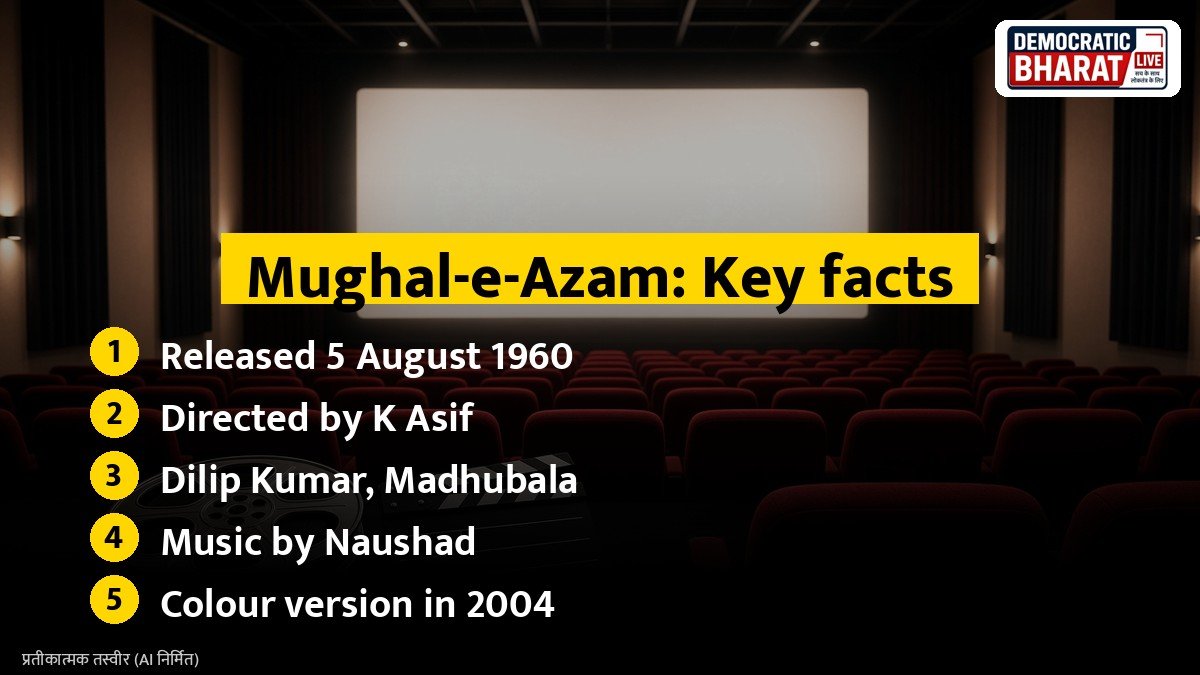
- **Prithviraj Kapoor** as Emperor Akbar
- **Dilip Kumar** as Prince Salim
- **Madhubala** as Anarkali
- **Durga Khote** as Queen Jodhabai
- **Ajit** as Durjan Singh
Madhubala’s performance as Anarkali is often counted among the finest by an Indian actress.
A long making
K Asif began work on the project in the 1940s, but the film faced many delays, including changes in cast and financing. It took more than a decade to complete. The film was known for its huge sets, costumes made by skilled artisans, and real jewellery and armour.
Also Read: Doordarshan History: From a 1959 Experiment in Delhi to Ramayan, Colour TV and DD Free Dish | Alam Ara: The Story of India’s First Talkie Film and How It Changed Indian Cinema
The music
The music was composed by Naushad, with lyrics by Shakeel Badayuni. Songs like Pyar Kiya To Darna Kya, Mohe Panghat Pe and Teri Mehfil Mein Kismat Aazmakar remain popular. Pyar Kiya To Darna Kya was picturised in the Sheesh Mahal, a hall of mirrors set, and parts of it were shot in colour. Lata Mangeshkar sang several of the songs, and the classical vocalist Bade Ghulam Ali Khan sang in the film.
Release and success
The film opened at Maratha Mandir in Bombay to huge crowds and became one of the biggest hits of its time. It won the National Film Award for Best Feature Film in Hindi and the Filmfare Award for Best Film.
The colour version
Most of the original film was in black and white. In 2004, a digitally coloured version was released in theatres, a first for a full length Hindi classic, and it was well received by both old and new audiences.
Legacy
Mughal-e-Azam continues to be shown on TV and at festivals. A stage musical based on the film has been performed in India and abroad. Its dialogues, songs and scenes are part of popular culture.
Bottom line
Mughal-e-Azam is a landmark of Hindi cinema, remembered for its scale, performances and music, and for K Asif’s determination to make it perfect.
Source / स्रोत: National Film Archive of India, Press Information Bureau