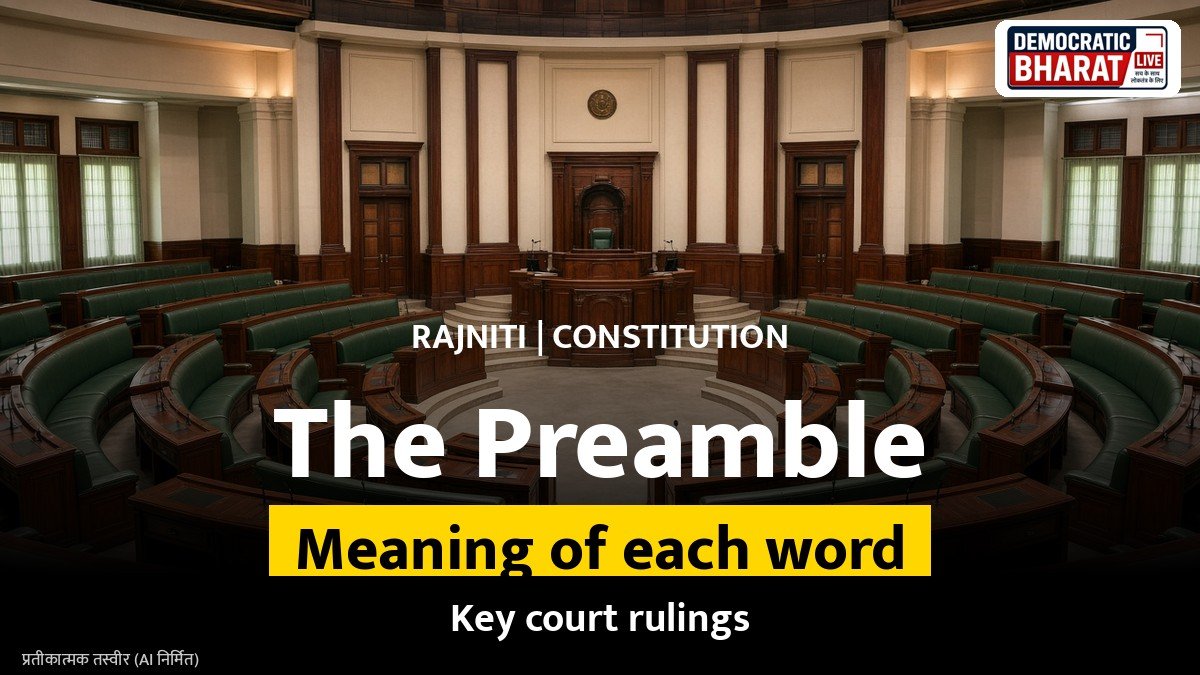
The Preamble is the introduction to the Constitution of India. It sets out the ideals and goals of the Constitution in a few lines. Here is what it says and what it means.
The text
The Preamble declares that the people of India have resolved to constitute India into a Sovereign Socialist Secular Democratic Republic and to secure to all its citizens Justice, social, economic and political; Liberty of thought, expression, belief, faith and worship; Equality of status and of opportunity; and to promote among them all Fraternity assuring the dignity of the individual and the unity and integrity of the Nation.
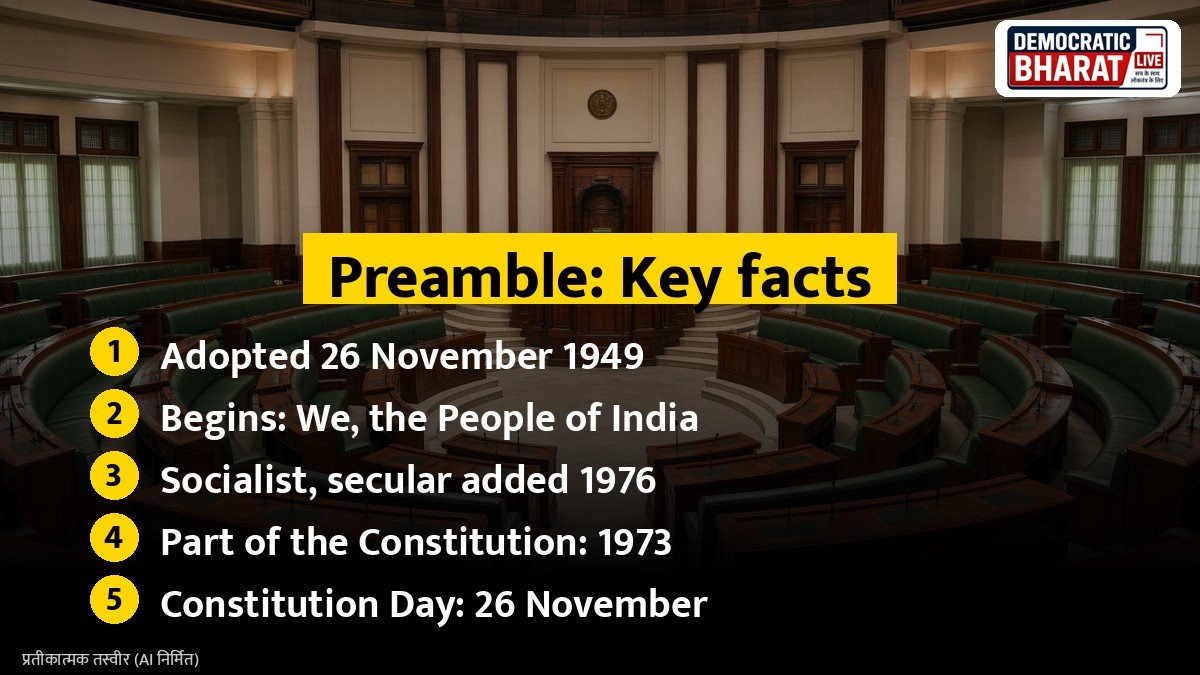
It ends with: In our Constituent Assembly this twenty sixth day of November, 1949, do hereby adopt, enact and give to ourselves this Constitution.
Meaning of key words
- **We, the People of India:** the Constitution draws its authority from the people.
- **Sovereign:** India is free to make its own decisions, internal and external.
- **Socialist:** the state aims to reduce inequality and ensure social and economic justice.
- **Secular:** the state has no official religion and treats all religions equally.
- **Democratic:** the government is elected by the people.
- **Republic:** the head of state, the President, is elected, not hereditary.
- **Justice, Liberty, Equality, Fraternity:** the core values the Constitution aims to secure.
The 1976 amendment
The 42nd Constitutional Amendment Act, 1976 added the words Socialist and Secular, and changed unity of the Nation to unity and integrity of the Nation. In November 2024, the Supreme Court dismissed petitions challenging the addition of these words.
Also Read: Role of the Governor in India: Appointment, Powers Over Bills and the Supreme Court’s Rulings | Collegium System Explained: How Supreme Court and High Court Judges Are Appointed in India
Is the Preamble part of the Constitution
- In the Berubari case of 1960, the Supreme Court said the Preamble was not part of the Constitution.
- In the Kesavananda Bharati case of 1973, the court held that the Preamble is part of the Constitution and can be used to interpret it. Its ideals are linked to the basic structure.
- In the LIC of India case of 1995, the court again said the Preamble is an integral part of the Constitution.
The Preamble is not enforceable in court by itself, but it guides how courts read the rest of the Constitution.
Where the ideas came from
The Preamble is based on the Objectives Resolution moved by Jawaharlal Nehru in the Constituent Assembly in December 1946 and adopted in January 1947.
Constitution Day
India celebrates Constitution Day, or Samvidhan Divas, on 26 November, the day the Constituent Assembly adopted the Constitution. The Constitution came into force on 26 January 1950, celebrated as Republic Day. Reading the Preamble aloud is a common part of Constitution Day events.
Bottom line
The Preamble sums up the spirit of the Constitution: a sovereign, socialist, secular, democratic republic built on justice, liberty, equality and fraternity.
Source / स्रोत: Constitution of India, Legislative Department, Supreme Court of India