
The International Solar Alliance (ISA) is an international organisation that promotes solar energy around the world. It is notable for being the first treaty based international organisation headquartered in India. Here is how it works.
History
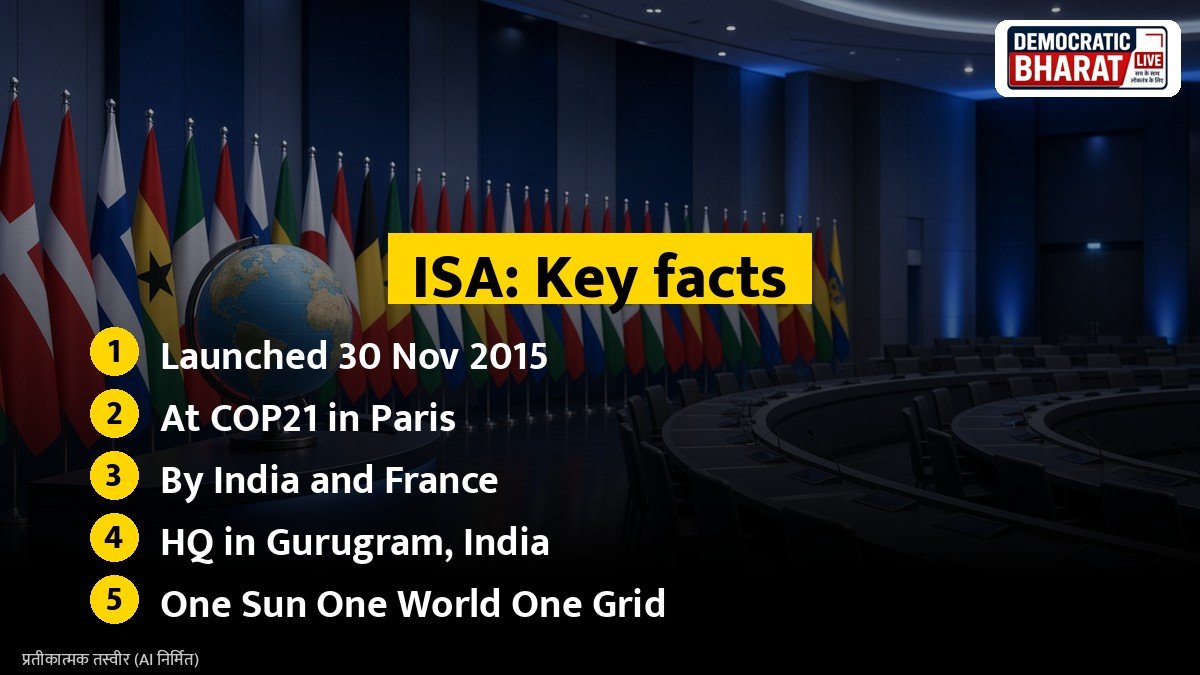
The ISA was launched on 30 November 2015 by Prime Minister Narendra Modi and then French President Francois Hollande at the UN climate conference, COP21, in Paris. Its Framework Agreement came into force in December 2017, making it a treaty based body.
Its headquarters is in Gurugram, Haryana, on the campus of the National Institute of Solar Energy.
Members
Initially, ISA was open to countries lying fully or partly between the Tropics of Cancer and Capricorn, which receive a lot of sunshine. In 2020, membership was opened to all UN member states. More than 100 countries have signed the Framework Agreement.
Goals
- Promote the use of solar energy to meet energy needs
- Reduce the cost of solar technology and finance
- Mobilise investment in solar energy, with a stated aim of USD 1 trillion by 2030
- Support energy access in developing countries, especially in Africa, small island states and least developed countries
Also Read: What Is the IMF? How the International Monetary Fund Works, Quotas, Loans and India’s 1991 Crisis | What Is the WTO? How the World Trade Organization Works and the Issues India Raises
How it works
- **Assembly:** the main decision making body, with all member countries
- **Secretariat:** led by a Director General in Gurugram
- **President and Co President:** India holds the presidency and France the co presidency in recent terms, as decided by the Assembly
ISA runs programmes on solar for agriculture, solar mini grids, rooftop solar, solar parks, e mobility and storage. It also helps members with training and project preparation.
One Sun One World One Grid
India proposed One Sun One World One Grid (OSOWOG), an idea to connect solar power grids across countries so that solar energy can be shared across time zones. The Green Grids Initiative, launched with the UK at COP26 in Glasgow in 2021, works with ISA on this.
Why it matters for India
ISA supports India’s role as a leader in renewable energy and its own target of 500 GW of non fossil fuel capacity by 2030. It also strengthens India’s ties with developing countries through solar projects and training.
Bottom line
The International Solar Alliance brings countries together to expand solar power. Headquartered in Gurugram, it reflects India’s leadership in global climate action.
Source / स्रोत: International Solar Alliance, Ministry of New and Renewable Energy