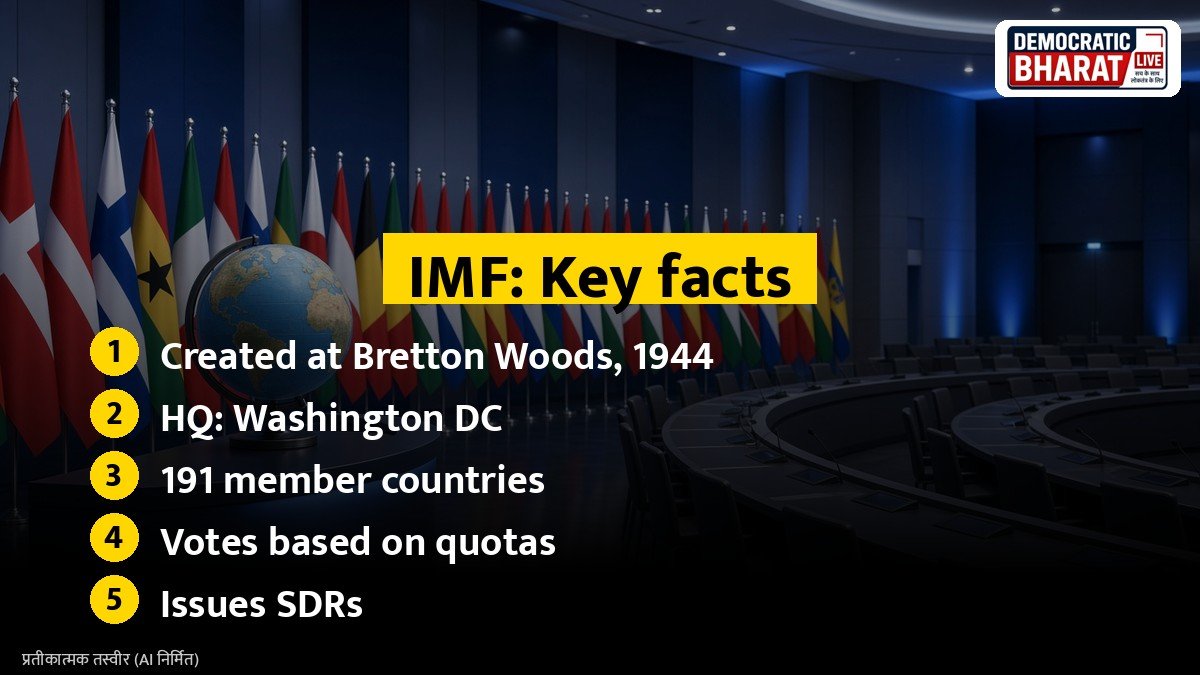
The International Monetary Fund (IMF) was created at the Bretton Woods conference in 1944 along with the World Bank. It began work in 1945 and is headquartered in Washington DC. It has 191 member countries.
What the IMF does
- Surveillance: monitors the global economy and members’ policies, through regular reviews called Article IV consultations.
- Lending: gives loans to countries facing balance of payments problems, usually with policy conditions.
- Capacity development: provides technical help and training.
Quotas and voting
Each member has a quota, based broadly on its size in the world economy. The quota decides how much a country contributes, how much it can borrow and its voting power. The United States has the largest share and an effective veto over major decisions that need an 85 percent majority. India and other emerging economies have pushed for quota reform to reflect their larger role.
Special Drawing Rights
The IMF issues Special Drawing Rights (SDRs), an international reserve asset based on a basket of five currencies: the US dollar, euro, Chinese renminbi, Japanese yen and British pound.
Also Read: What Is the WTO? How the World Trade Organization Works and the Issues India Raises | What Is ASEAN? Members, How It Works and Why It Matters for India’s Act East Policy
India and the IMF
In 1991, India faced a severe balance of payments crisis, with foreign exchange reserves enough for only a few weeks of imports. India took IMF support and launched major economic reforms of liberalisation. India repaid its IMF loans and has not needed a programme since. Today India has large forex reserves and is a contributor to IMF resources.
Criticism
Critics say IMF conditions can be harsh, forcing spending cuts during crises. Supporters say the IMF acts as a lender of last resort that prevents worse collapses.
Bottom line
The IMF lends to countries in crisis and monitors the global economy. India’s 1991 experience shows both the pressure and the reform push that can come with IMF support.
Source / स्रोत: International Monetary Fund, Reserve Bank of India, Ministry of Finance