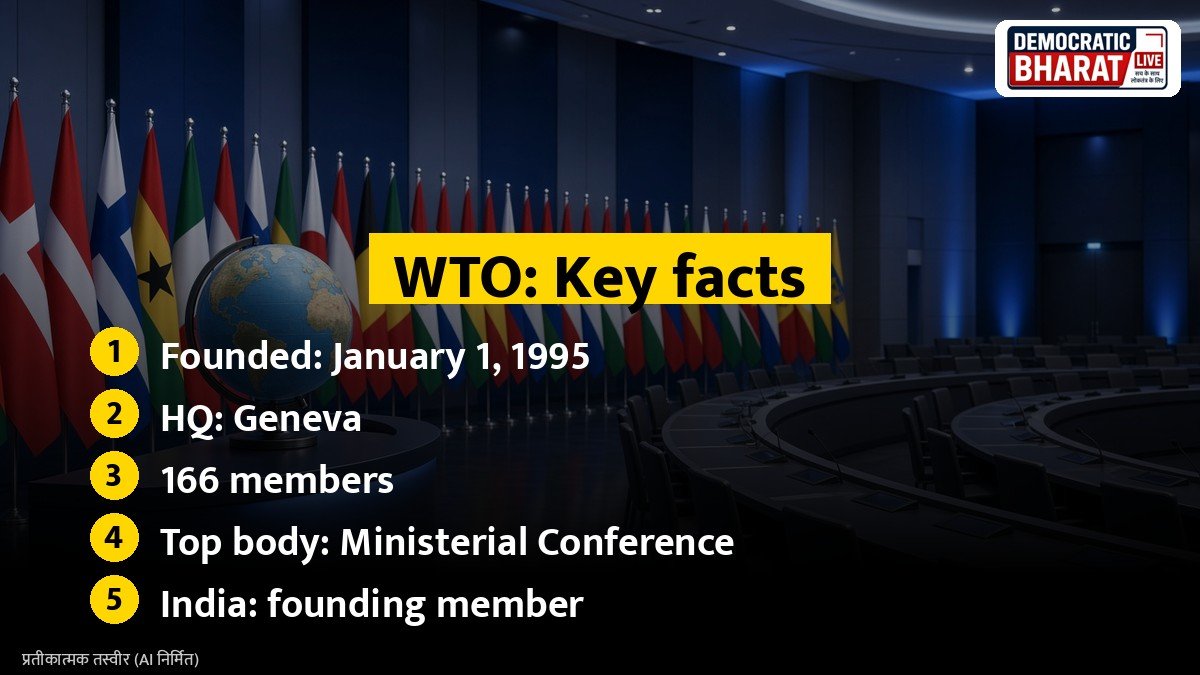
The World Trade Organization (WTO) is the only global body that deals with the rules of trade between nations. It came into being on January 1, 1995, replacing the General Agreement on Tariffs and Trade (GATT) of 1947. Its headquarters are in Geneva, Switzerland. India is a founding member.
Members
The WTO has 166 members, which together account for the vast majority of world trade. Members negotiate trade agreements, settle disputes and review each other’s trade policies.
How decisions are made
The WTO is member driven, and most decisions are taken by consensus. The highest body is the Ministerial Conference, which usually meets every two years. Between conferences, the General Council handles daily work. The WTO is headed by a Director General; Ngozi Okonjo-Iweala of Nigeria has held the post since 2021 and was reappointed for a second term starting in 2025.
Key agreements
- GATT, for trade in goods
- GATS, for trade in services
- TRIPS, for intellectual property
- Agreement on Agriculture
- Trade Facilitation Agreement
Also Read: What Is the G20? Members, How the Presidency Rotates and What India Achieved in 2023 | COP Climate Summit Explained: What Happens at a COP, the Paris Agreement and What India Seeks
Dispute settlement
Members can bring disputes to the WTO. Panels hear cases first, and appeals go to the Appellate Body. However, the Appellate Body has not functioned since December 2019 because the United States has blocked appointments of new members. Some members have set up an interim appeal arrangement, but India is not part of it.
Issues India raises
- Food security: India wants a permanent solution on public stockholding, so that buying food grains at MSP for public distribution is not challenged under subsidy rules. A “peace clause” agreed in Bali in 2013 offers temporary protection.
- Fisheries subsidies: India supports curbs on harmful subsidies by big fishing nations, but wants protection for small and traditional fishers.
- Special and differential treatment: India argues developing countries need flexibility.
- E commerce customs duties: India has questioned the long running moratorium on duties on electronic transmissions.
- Reform: India supports restoring the Appellate Body and keeping the consensus based system.
Why it matters
WTO rules affect tariffs on Indian exports, farm support at home, medicines under patent rules and much more. A rules based system gives smaller economies protection against unilateral trade measures.
Bottom line
The WTO is the referee of world trade. For India, its priorities are food security, fair treatment for developing countries and a working dispute settlement system.
Source / स्रोत: World Trade Organization, Department of Commerce