The Public Provident Fund (PPF) is a long term savings scheme backed by the Government of India. It is popular because it is safe, offers tax free returns and has a reasonable interest rate. Here are the key PPF account rules.
Who can open
Any resident Indian can open one PPF account in their own name. A parent or guardian can open an account for a minor. Non resident Indians cannot open a new account, but can continue an existing one till maturity under the rules. Joint accounts are not allowed.
Where to open
You can open a PPF account at a post office or at authorised banks, including major public sector banks and some private banks. Many banks allow you to open it online through net banking.
Deposit rules
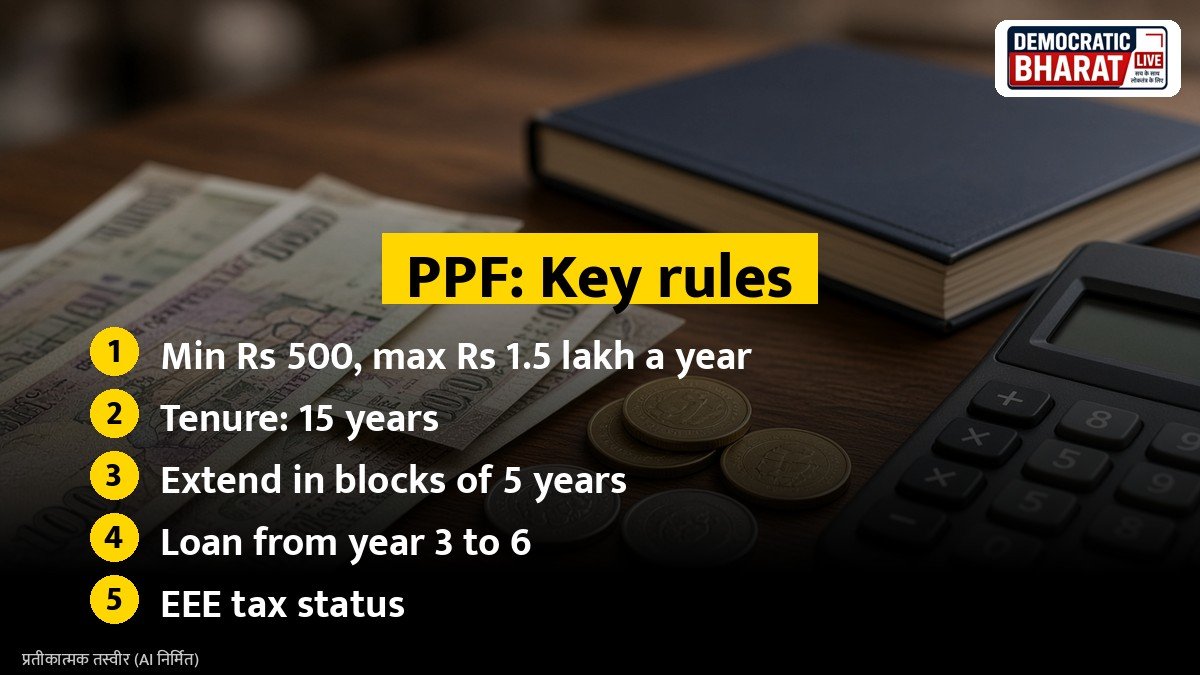
- Minimum deposit: Rs 500 in a financial year.
- Maximum deposit: Rs 1.5 lakh in a financial year, combined for your own account and any minor’s account you hold.
- You can deposit in a lump sum or in instalments.
- If you miss the minimum, the account becomes discontinued and can be revived with a penalty of Rs 50 per year of default plus the minimum deposit.
Also Read: Sukanya Samriddhi Account: Rules, Deposit Limits, Tax Benefits and When the Money Can Be Withdrawn | How to Check Your Credit Score Free in India and 7 Ways to Improve It Before Taking a Loan
Interest rate
The interest rate is announced by the government every quarter. Interest is calculated on the lowest balance between the fifth and the last day of each month, so deposit before the 5th to earn interest for that month. It is credited at the end of the financial year. Check the current rate on the National Savings Institute or India Post website.
Tenure and maturity
The account matures after 15 full financial years, not counting the year of opening. On maturity you can:
- close the account and withdraw the full amount,
- extend it in blocks of five years with fresh deposits, or
- extend it in blocks of five years without deposits.
Loan against PPF
You can take a loan from the third financial year to the sixth financial year, up to 25 percent of the balance at the end of the second year before the year of loan. The interest on the loan is lower than most personal loans.
Partial withdrawal
From the seventh financial year onwards, one partial withdrawal a year is allowed, subject to limits set in the rules.
Premature closure
Premature closure is allowed after five years for specific reasons, such as serious illness or higher education of the account holder or children, with a small reduction in interest.
Tax benefits
PPF enjoys EEE status. Deposits qualify for Section 80C deduction under the old tax regime, and interest and maturity are tax free.
Bottom line
A PPF account suits those who want safe, tax free growth over the long term. Deposit early in the month and every year to make the most of it.
Source / स्रोत: National Savings Institute, India Post: Savings schemes, Department of Economic Affairs