The Governor is the constitutional head of a state, just as the President is for the Union. Articles 153 to 167 of the Constitution deal with the office.
Appointment and term
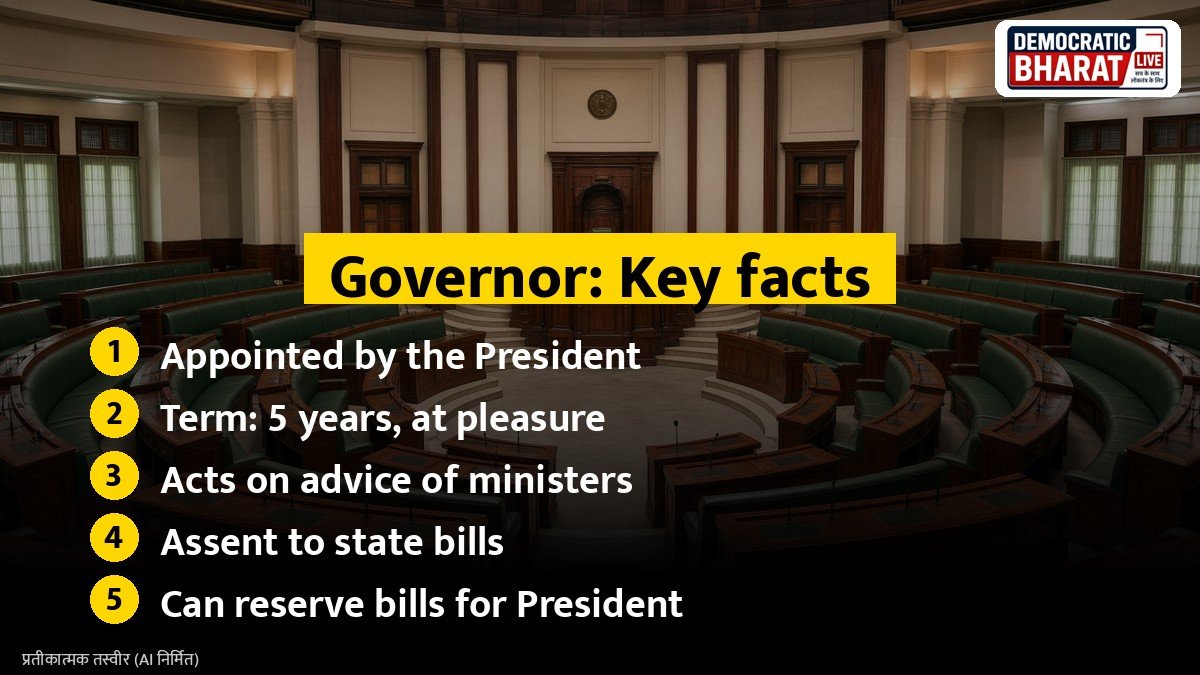
The Governor is appointed by the President under Article 155 and holds office during the pleasure of the President, usually for five years. A person must be an Indian citizen and at least 35 years old. One person can be Governor of two or more states.
Acting on advice
Under Article 163, the Governor acts on the aid and advice of the Council of Ministers headed by the Chief Minister, except where the Constitution allows discretion. The Supreme Court has repeatedly held that the Governor is a constitutional head and must generally follow ministerial advice.
Executive powers
- Appoints the Chief Minister and, on the CM’s advice, other ministers.
- Appoints the Advocate General and the State Election Commissioner.
- Can grant pardons for offences under state laws under Article 161.
Also Read: Election Commission of India Explained: Powers, How the CEC Is Appointed and the 2023 Law | No-Confidence Motion Explained: How It Works in the Lok Sabha and What Happens if a Government Loses
Legislative powers
- Summons and prorogues the Assembly, and can dissolve it on the CM’s advice.
- Addresses the Assembly at the start of the first session each year.
- Can issue ordinances when the Assembly is not in session, under Article 213.
Assent to bills
Under Article 200, when a bill passed by the Assembly is sent to the Governor, the Governor can give assent, withhold assent, return it for reconsideration (if not a money bill), or reserve it for the President. If the Assembly passes it again, the Governor cannot withhold assent, though may still reserve it in some cases.
In April 2025, in the Tamil Nadu Governor case, the Supreme Court held that Governors cannot sit on bills indefinitely and set timelines. Later in 2025, on a Presidential reference, a Constitution Bench gave its opinion on these questions. The debate over Governors’ timelines continues, so follow official judgments for the current position.
Emergency role
Under Article 356, the Governor can report to the President that the state government cannot be carried on as per the Constitution, which may lead to President’s Rule.
Bottom line
The Governor is a constitutional head who mostly acts on the advice of the elected government, with limited discretion, a balance the courts continue to define.
Source / स्रोत: Constitution of India, Supreme Court of India