In a parliamentary democracy, a government stays in office only as long as it enjoys the confidence of the elected house. In India, the Council of Ministers is collectively responsible to the Lok Sabha under Article 75(3) of the Constitution. The no-confidence motion is the main tool used to test this.
Where the rule comes from
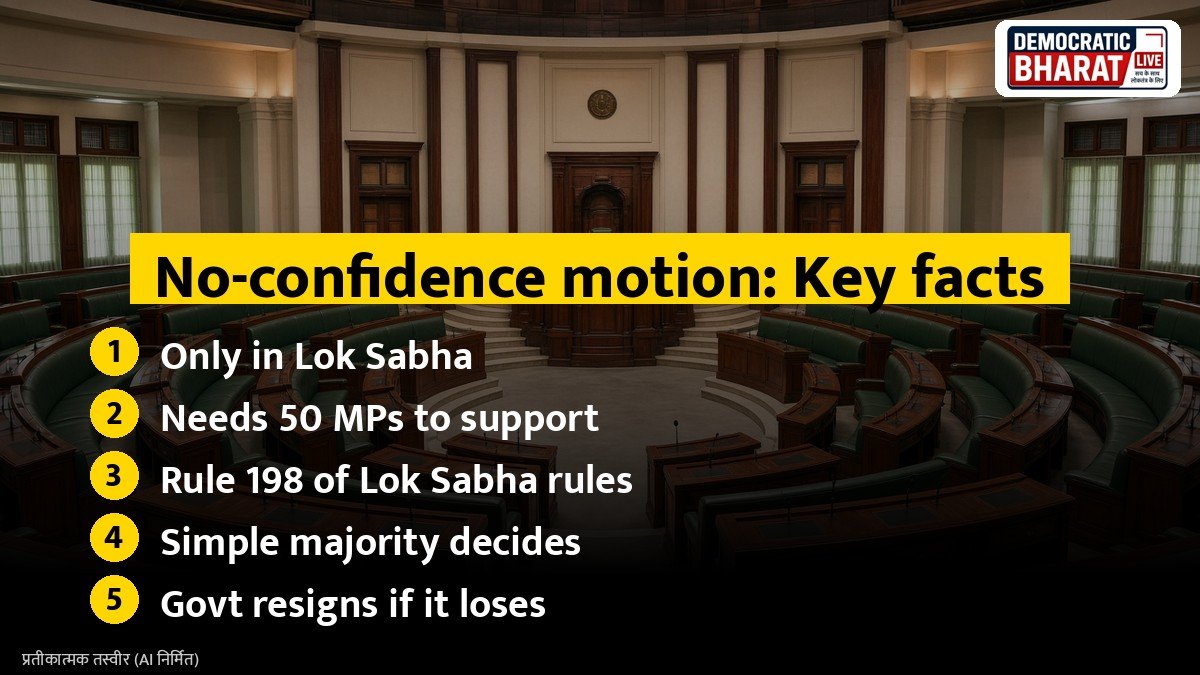
The Constitution does not use the words “no-confidence motion”. The procedure is laid down in Rule 198 of the Rules of Procedure and Conduct of Business in the Lok Sabha. Similar rules exist in state Assemblies for state governments.
How it is moved
- Any member can give notice of the motion to the Speaker.
- The motion does not need to state reasons.
- When the Speaker reads it out, at least 50 members must stand up in support for it to be admitted.
- If admitted, the Speaker fixes a date for discussion, which must be within 10 days.
Debate and vote
During the debate, opposition members explain why they have lost confidence in the government, and the Prime Minister and ministers reply. The motion is then put to vote. It needs a simple majority of members present and voting. If it passes, the government must resign.
Only the Lok Sabha can pass a no-confidence motion. The Rajya Sabha has no such power because the Council of Ministers is not responsible to it.
Also Read: How Rajya Sabha Election Works: Who Votes, Seats per State and the Single Transferable Vote | Anti-Defection Law Explained: What the Tenth Schedule Says and When an MLA or MP Is Disqualified
Confidence motion
A confidence motion is the opposite. It is moved by the government itself to prove its majority, often after a coalition partner withdraws support. In 1999, the Atal Bihari Vajpayee government lost a confidence vote by one vote.
History in India
The first no-confidence motion was moved in 1963 against the Jawaharlal Nehru government by Acharya Kripalani. It was defeated. Many motions have been moved since then. In 1979, the Morarji Desai government resigned before a no-confidence vote could be completed. In recent years, motions were moved in 2018 and 2023 and both were defeated.
Why opposition parties use it
Even when the numbers are against them, opposition parties sometimes move a no-confidence motion to force a long debate on issues and to make the Prime Minister reply in the House.
Bottom line
A no-confidence motion is the strongest check the Lok Sabha has over the government. It needs 50 MPs to start, and a simple majority to bring a government down.
Source / स्रोत: Lok Sabha Rules of Procedure, Constitution of India