Laws made by Parliament start as bills. A bill is a draft proposal that becomes an Act only after both Houses pass it and the President gives assent. Here is how a bill becomes law in India.
Types of bills
- Ordinary bills: deal with any matter other than money bills and constitutional amendments.
- Money bills: deal only with taxes, borrowing and spending from the Consolidated Fund, as defined in Article 110.
- Financial bills: have some money bill features along with other matters.
- Constitution amendment bills: need a special majority under Article 368.
A bill moved by a minister is a government bill. One moved by any other member is a private member’s bill.
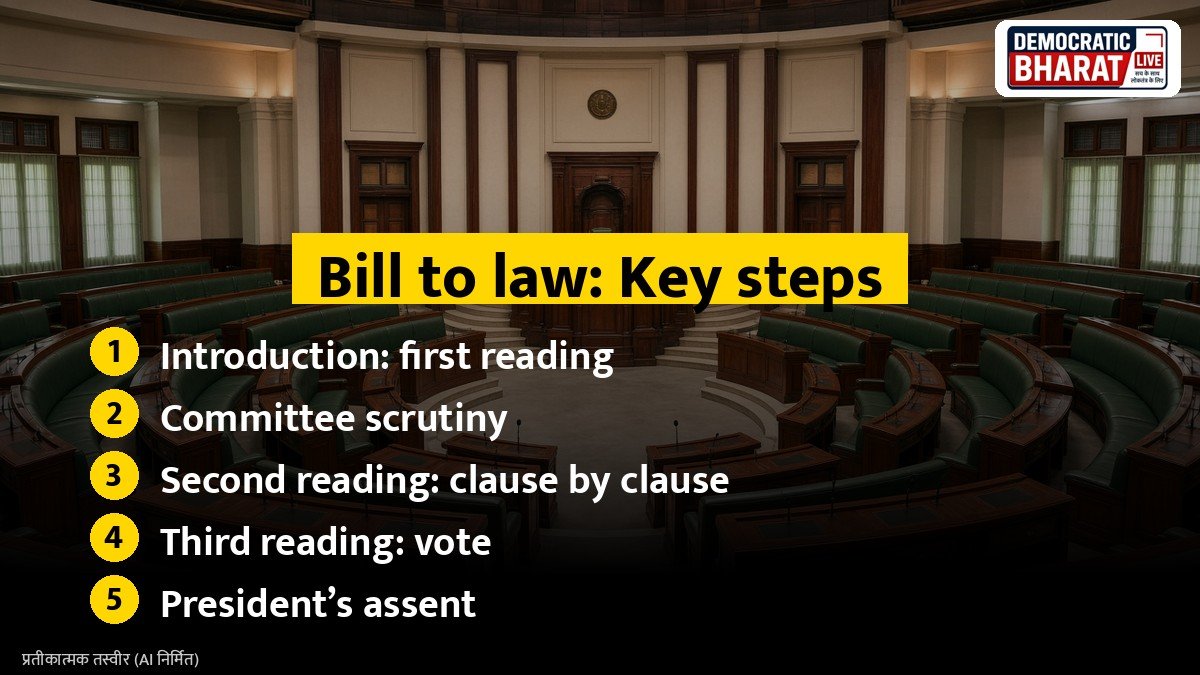
Step 1: First reading
The bill is introduced in either House, except money bills, which can only be introduced in the Lok Sabha on the President’s recommendation. The minister seeks leave to introduce it, and it is then published in the Gazette.
Step 2: Committee scrutiny
The bill may be referred to a Department Related Standing Committee, a Select Committee of one House or a Joint Parliamentary Committee (JPC). Committees hear experts and stakeholders and submit a report. Referral is not compulsory.
Also Read: How the President of India Is Elected: Electoral College, Vote Value and the Single Transferable Vote | No-Confidence Motion Explained: How It Works in the Lok Sabha and What Happens if a Government Loses
Step 3: Second reading
The House discusses the general principles of the bill, and then considers it clause by clause. Members can move amendments, which are voted on.
Step 4: Third reading
The House votes on the bill as a whole. Ordinary bills need a simple majority of members present and voting.
Step 5: The other House
The bill goes to the other House and follows a similar process. The second House can pass it, amend it or reject it.
Deadlock and joint sitting
If the Houses disagree on an ordinary bill, or the second House does not act for six months, the President can call a joint sitting under Article 108. The Speaker of the Lok Sabha presides, and a majority of members present and voting decides. Joint sittings have been held only a few times since 1950. There is no joint sitting for money bills or constitutional amendments.
Money bill rule
The Rajya Sabha must return a money bill within 14 days. It can only make recommendations, which the Lok Sabha may accept or reject.
Step 6: President’s assent
Under Article 111, the President can give assent, withhold assent, or return a non money bill for reconsideration. If both Houses pass it again, the President must give assent. Once assent is given, the bill becomes an Act and comes into force on the date notified.
Bottom line
A bill becomes law in India after passing both Houses, often after committee review, and receiving the President’s assent.
Source / स्रोत: Lok Sabha, Rajya Sabha, Constitution of India