


The President of India is the head of the state and the supreme commander of the armed forces. Unlike in some countries, the President is not elected directly by the people. The Constitution sets out an indirect process in Articles 54 and 55.
The electoral college
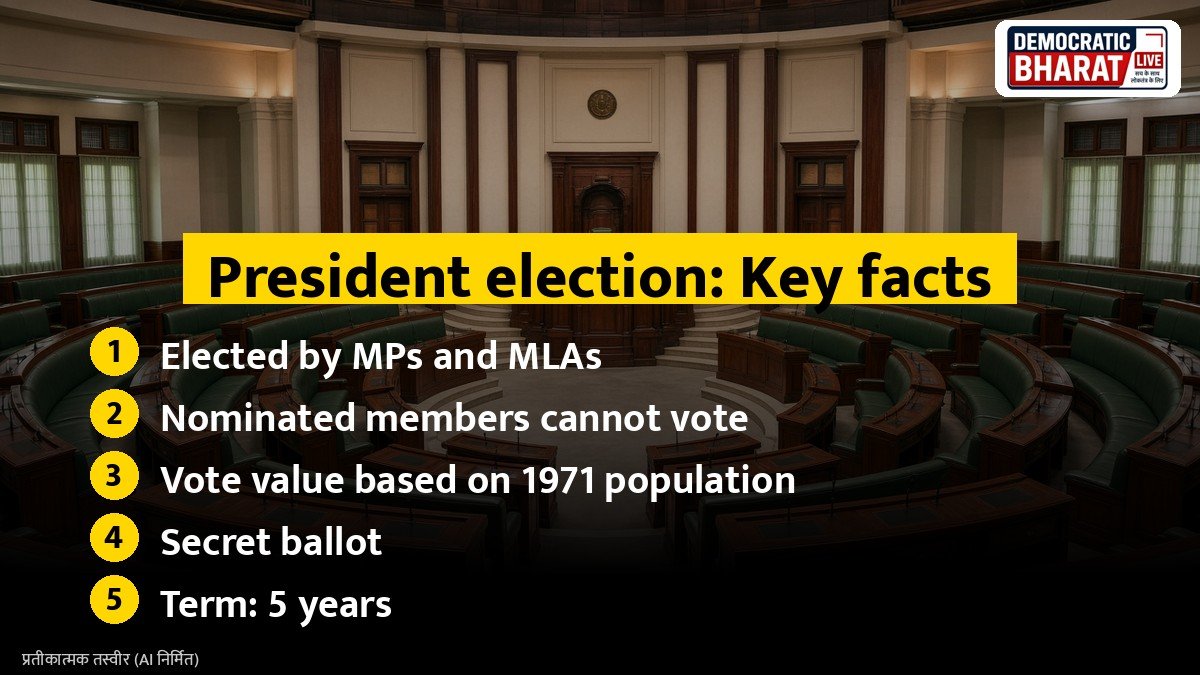
Under Article 54, the President is elected by an electoral college made up of:
- the elected members of both Houses of Parliament, and
- the elected members of the Legislative Assemblies of all states, including the National Capital Territory of Delhi and the Union Territory of Puducherry.
Nominated members of Parliament and the Assemblies, and members of Legislative Councils, do not vote.
Value of votes
Article 55 aims for uniformity among states and parity between the states and the Union. The value of an MLA’s vote depends on the population of the state, as per the 1971 Census, divided by the number of elected MLAs, and then divided by 1,000. So an MLA from a populous state carries a higher vote value than one from a small state.
The total value of all MLA votes is then divided by the number of elected MPs to find the value of each MP’s vote. This is why the votes of MPs and MLAs together carry roughly equal weight.
How voting happens
Voting is by secret ballot under proportional representation by means of the single transferable vote. Each elector marks preferences for candidates. Party whips do not apply, and the anti defection law does not cover this election. MPs usually vote in Parliament House, and MLAs vote in their state Assembly buildings.
Also Read: How Rajya Sabha Election Works: Who Votes, Seats per State and the Single Transferable Vote | Anti-Defection Law Explained: What the Tenth Schedule Says and When an MLA or MP Is Disqualified
Counting
To win, a candidate must reach a quota, which is more than half of the total value of valid votes. If no one crosses the quota on first preferences, the candidate with the least votes is eliminated and their votes are transferred according to the next preferences. This continues until someone reaches the quota.
Who can contest
A candidate must be a citizen of India, at least 35 years old, qualified to be a member of the Lok Sabha, and must not hold an office of profit. The nomination must be proposed by at least 50 electors and seconded by at least 50 electors, along with a security deposit as fixed in the law.
Term and oath
The President holds office for five years and can be re elected. The oath is administered by the Chief Justice of India. The Election Commission of India conducts the election, and disputes are decided by the Supreme Court.
Bottom line
The President of India is chosen by the elected representatives of the people, using a vote value formula that balances large and small states.
Source / स्रोत: Election Commission of India, President of India, Constitution of India


टिप्पणियां (1)