

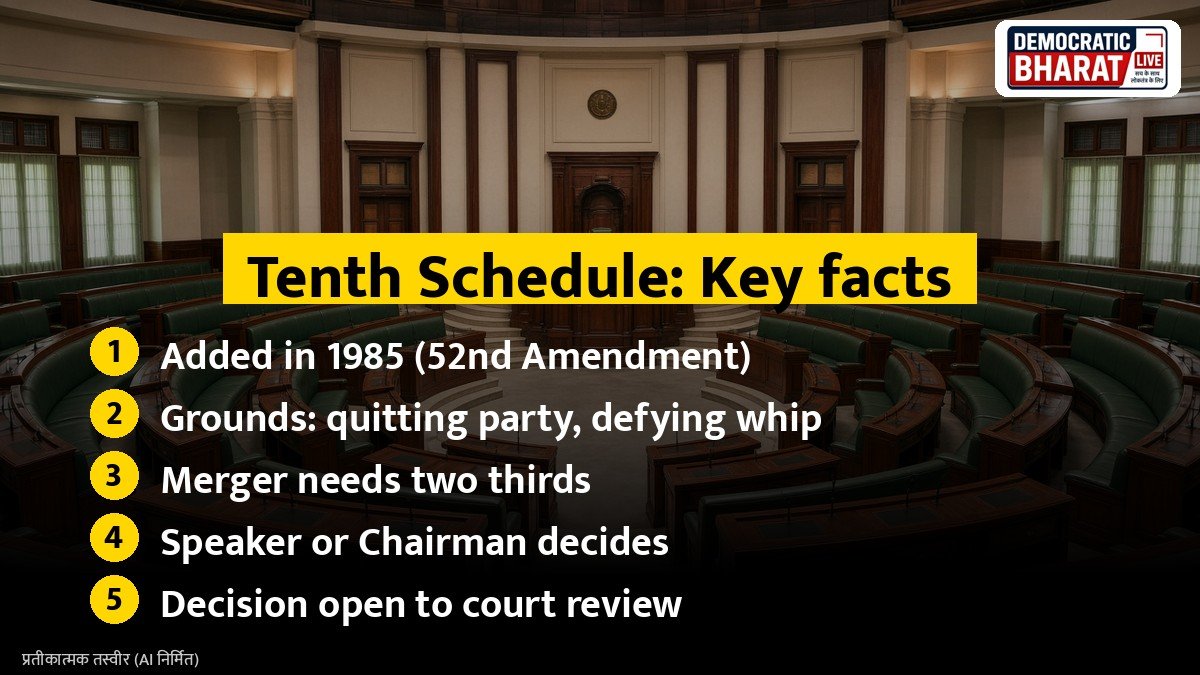
India’s anti-defection law is contained in the Tenth Schedule of the Constitution. It was added by the 52nd Amendment in 1985 to stop elected representatives from switching parties for personal gain, a practice that had brought down many governments in the 1960s and 1970s.
Grounds for disqualification
Under the Tenth Schedule, a member of Parliament or a state legislature can be disqualified if:
- they voluntarily give up membership of the party on whose ticket they were elected;
- they vote, or abstain from voting, in the House against the direction (whip) of their party without prior permission, and the party does not condone it within 15 days;
- an independent member joins a political party after the election;
- a nominated member joins a party more than six months after taking their seat.
The Supreme Court has held that “voluntarily giving up membership” can be inferred from conduct. A formal resignation from the party is not required.
The merger exception
Paragraph 4 protects a legislator if their original party merges with another party, and at least two thirds of the members of the legislature party agree to the merger. The earlier provision that allowed a split by one third of members was removed by the 91st Amendment in 2003.
Who decides
Petitions for disqualification are decided by the Speaker of the Lok Sabha or the Assembly, or the Chairman of the Rajya Sabha or the Council. In the Kihoto Hollohan case of 1992, the Supreme Court upheld the law but ruled that the presiding officer’s decision is subject to judicial review. In later judgments, the court has said that such petitions should be decided within a reasonable time, and has suggested a period of about three months.
Also Read: How Rajya Sabha Election Works: Who Votes, Seats per State and the Single Transferable Vote
What the law does not cover
The Tenth Schedule does not apply to votes cast in Rajya Sabha elections, as clarified by the courts. It also does not stop a legislator from resigning the seat altogether and contesting again, which has become a common route in recent years.
Why it matters
The law aims to protect the mandate given by voters to a party. Critics say it also reduces the freedom of individual legislators to vote on conscience, since every vote on a whip becomes a party vote. Various commissions have suggested that the power to decide disqualification should move to an independent body such as the Election Commission, but no such change has been made so far.
Bottom line
The anti-defection law makes changing sides costly for MPs and MLAs, but the merger route and resignations mean that political realignments still happen. The role of the Speaker remains the most debated part of the law.
Source / स्रोत: Constitution of India, Legislative Department, Supreme Court of India


टिप्पणियां (2)