Judges of the Supreme Court and High Courts in India are appointed through a system called the collegium. It is not mentioned in the Constitution, but developed through Supreme Court judgments. Here is how it works.
What the Constitution says
Article 124 says the President appoints Supreme Court judges after consulting judges of the Supreme Court and High Courts as needed, and the Chief Justice of India must always be consulted for judges other than the Chief Justice. Article 217 covers the appointment of High Court judges.
How the collegium came about
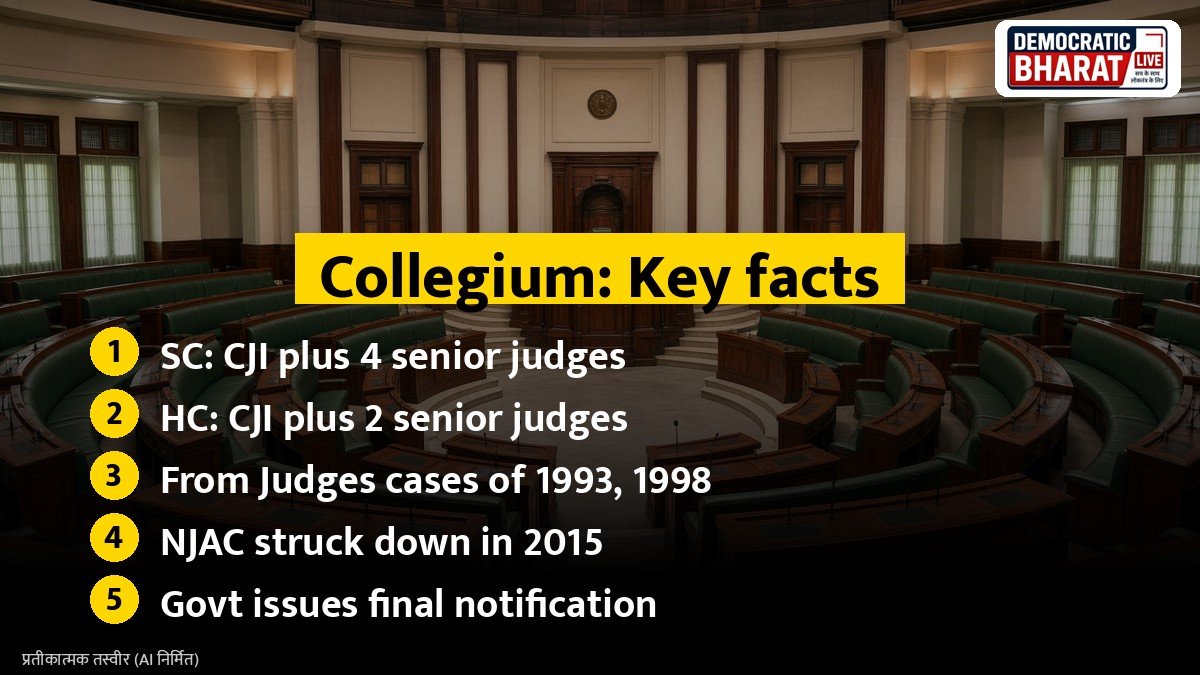
The collegium system grew from three cases, called the Judges Cases:
- **First Judges Case (1981):** the court held that consultation with the Chief Justice did not mean concurrence, giving the executive the upper hand.
- **Second Judges Case (1993):** the court reversed this and held that the Chief Justice’s opinion, formed with senior judges, would have primacy.
- **Third Judges Case (1998):** on a Presidential reference, the court said the Chief Justice must consult a collegium of four senior most judges.
Who is in the collegium
- **For the Supreme Court:** the Chief Justice of India and the four senior most judges of the Supreme Court.
- **For High Courts:** the Chief Justice of India and the two senior most Supreme Court judges, based on proposals that start from the High Court collegium of the Chief Justice and two senior judges of that court.
Also Read: Role of the Governor in India: Appointment, Powers Over Bills and the Supreme Court’s Rulings | Election Commission of India Explained: Powers, How the CEC Is Appointed and the 2023 Law
The process
- The collegium recommends names.
- The Union Law Ministry processes the file, including Intelligence Bureau inputs.
- The government can return a name once for reconsideration.
- If the collegium reiterates the name, it is generally treated as binding.
- The President issues the appointment by notification.
Transfers of High Court judges and Chief Justices also go through the collegium. The process is guided by a Memorandum of Procedure.
The NJAC case
In 2014, Parliament passed the 99th Constitutional Amendment and the National Judicial Appointments Commission Act, to replace the collegium with a commission including the Law Minister and eminent persons. In October 2015, a Constitution Bench of the Supreme Court struck down both, saying they affected judicial independence, and the collegium system was restored.
Debate
Supporters say the collegium protects the independence of the judiciary. Critics say it lacks transparency. Since 2017, the Supreme Court has published collegium resolutions on its website.
Bottom line
The collegium system gives senior judges the main role in choosing judges, with the government processing and notifying appointments.
Source / स्रोत: Supreme Court of India, Department of Justice