The Chief Minister is the head of the government in a state, just as the Prime Minister is at the Centre. The Constitution sets out how a Chief Minister is appointed and how the state government works. Here is a simple guide.
Appointment
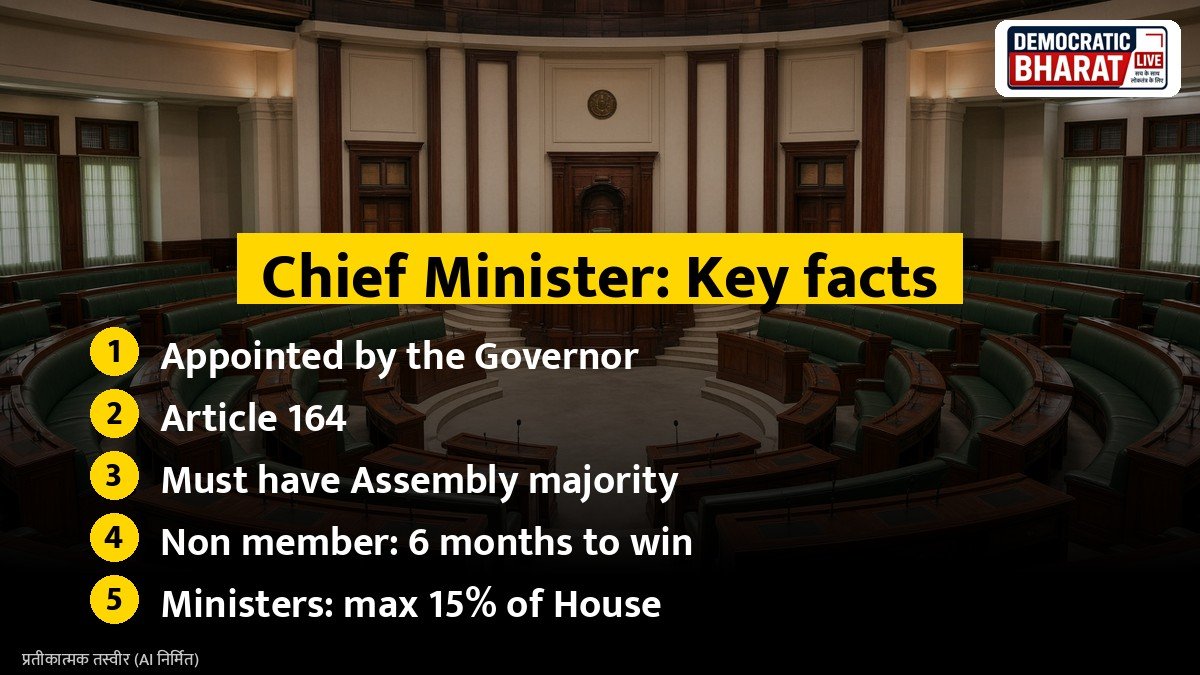
Under Article 164 of the Constitution, the Chief Minister is appointed by the Governor of the state. The other ministers are appointed by the Governor on the advice of the Chief Minister.
The Constitution does not spell out who must be appointed, but by convention the Governor invites the leader of the party or coalition that has a majority in the Legislative Assembly. If no party has a clear majority, the Governor uses discretion to invite the leader most likely to prove majority support, and may ask them to prove it within a set time.
Who can become Chief Minister
The Chief Minister must be a member of the state legislature, either the Assembly or, where it exists, the Legislative Council. A person who is not a member can be appointed but must become one within six months, as per Article 164(4). Otherwise, they must step down.
Floor test
The Council of Ministers is collectively responsible to the Legislative Assembly. The Chief Minister must keep the confidence of the House. In the SR Bommai case of 1994, the Supreme Court held that the question of majority must be tested on the floor of the House, not in the Governor’s residence. Courts have since ordered floor tests in several disputes.
Also Read: Election Commission of India Explained: Powers, How the CEC Is Appointed and the 2023 Law | Role of the Governor in India: Appointment, Powers Over Bills and the Supreme Court’s Rulings
Size of the Council of Ministers
The 91st Amendment of 2003 limits the total number of ministers, including the Chief Minister, to 15 percent of the total strength of the Assembly. The minimum is 12. Members disqualified under the anti defection law cannot be made ministers until they are re elected.
Powers and functions
- Advises the Governor on appointing ministers and allocating portfolios
- Leads the Council of Ministers and chairs cabinet meetings
- Advises the Governor on summoning and proroguing the Assembly and on dissolving it
- Advises on appointments such as the Advocate General and State Public Service Commission members
- Leads the state’s development and policy agenda
- Represents the state in bodies like the NITI Aayog Governing Council and Zonal Councils
Term
The Chief Minister holds office during the pleasure of the Governor, but in practice stays in office as long as they have majority support in the Assembly. There is no fixed limit on terms.
Union Territories
Union Territories with legislatures, such as Delhi and Puducherry, also have Chief Ministers, under separate constitutional provisions and laws.
Bottom line
The Governor appoints the Chief Minister, but real power depends on keeping a majority in the Assembly, which can be tested through a floor test.
Source / स्रोत: Constitution of India, Legislative Department, Ministry of Home Affairs