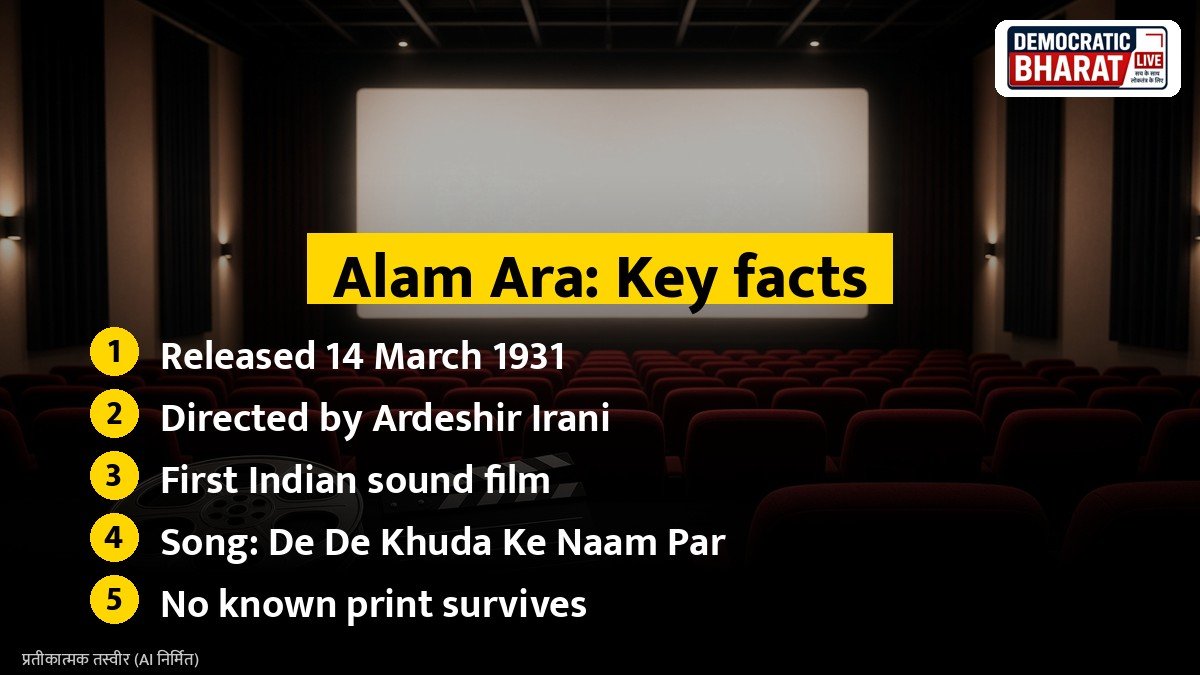
Alam Ara is remembered as India’s first talkie, the first Indian feature film with synchronised sound. It was released on 14 March 1931 at the Majestic Cinema in Bombay and changed the direction of Indian cinema.
Background
Indian cinema began with silent films. Dadasaheb Phalke’s Raja Harishchandra in 1913 is considered the first full length Indian feature film. By the late 1920s, sound films had become popular in Hollywood, and Indian producers wanted to bring sound to local audiences.
The making of Alam Ara
The film was produced and directed by Ardeshir Irani under his Imperial Film Company. It was based on a Parsi stage play and told a story of royal intrigue, love and a lost princess.
The cast included:
- Master Vithal as the prince
- Zubeida as the heroine
- Prithviraj Kapoor in a supporting role
- Wazir Mohammed Khan, who sang the first song
Since sound studios were new, much of the shooting was done at night to avoid outside noise, and the sound was recorded directly on film using imported equipment.
The first film song
Alam Ara had several songs. De De Khuda Ke Naam Par, sung by Wazir Mohammed Khan, is widely remembered as the first song of Indian cinema. Songs soon became a central part of Indian films, a tradition that continues today.
Also Read: IFFI Goa Guide: What Is the International Film Festival of India, Indian Panorama and How to Register | How India Picks Its Oscar Entry: Film Federation of India, Best International Feature and Past Nominees
Response and impact
The film was a huge success, and crowds gathered at the theatre for weeks. After Alam Ara, studios quickly moved to sound, and talkies were soon made in many Indian languages. Kalidas, released in 1931, was among the early talkies in Tamil and Telugu.
Sound also changed who became a star. Actors now needed good voices and diction, and singing actors became popular. Music directors and lyricists became key members of film teams.
A lost film
Sadly, no complete print of Alam Ara is known to survive. The National Film Archive of India has listed it among important lost films, and only photographs and posters remain.
Legacy
Alam Ara remains a landmark that film students and historians still study.
Bottom line
Alam Ara gave Indian cinema its voice and its songs. Even though the film itself is lost, its impact is heard in every Indian movie today.
Source / स्रोत: National Film Archive of India, Press Information Bureau