Parliament has several tools to make the government answerable. Two of the best known are Question Hour and Zero Hour.
Question Hour
The first hour of a sitting in the Lok Sabha is usually Question Hour, as per the Rules of Procedure. The Rajya Sabha has also fixed a time for Question Hour in its schedule. During this hour, MPs ask ministers questions about their ministries.
Types of questions
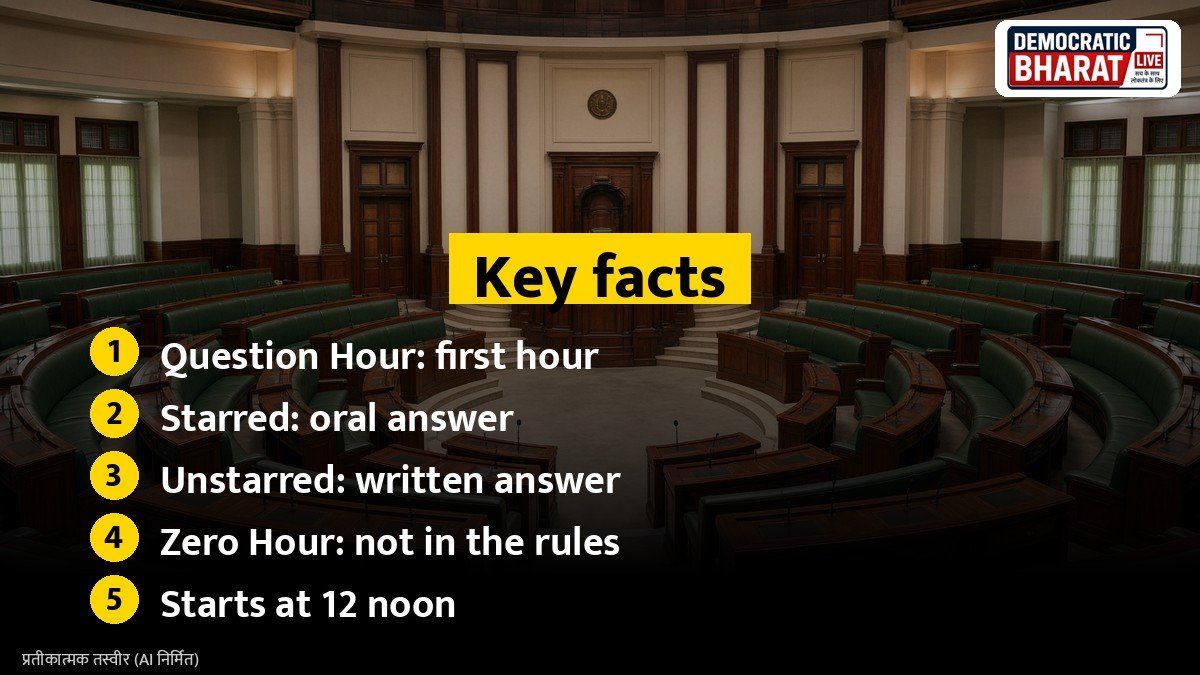
- Starred questions: need an oral answer in the House. After the answer, MPs can ask supplementary questions. They are marked with an asterisk.
- Unstarred questions: receive a written answer, placed on the table of the House. No supplementary questions are allowed.
- Short notice questions: on matters of urgent public importance, asked with less than the usual notice, and answered orally if the minister agrees.
- Questions to private members: rarely, questions can be asked to a member who is in charge of a bill or resolution.
MPs must give notice of questions in advance, usually 15 days. Ministries prepare answers, and the Speaker or Chairman decides which questions are admitted.
Why it matters
Question Hour brings out data and facts that the government may not otherwise share. Many reports in the media are based on written answers given in Parliament. Questions and answers are published on the websites of both Houses.
Also Read: No-Confidence Motion Explained: How It Works in the Lok Sabha and What Happens if a Government Loses | How a Bill Becomes Law in India: Readings, Committees, Joint Sitting and the President’s Assent
Zero Hour
Zero Hour is an Indian parliamentary innovation. It is not mentioned in the rules. It usually begins at 12 noon after Question Hour, which is why it is called Zero Hour. MPs raise matters of urgent public importance with the permission of the presiding officer, often with short notice. There is no fixed procedure for ministers to reply.
Other accountability tools
- Calling attention motions, to draw a minister’s attention to an urgent matter.
- Adjournment motions, to discuss a definite matter of urgent public importance.
- Half an hour discussions on answers to questions.
- Debates on bills and the budget.
- Parliamentary committees, which examine ministries in detail.
Disruptions
Question Hour is often lost due to disruptions. During the 2020 monsoon session, Question Hour was suspended due to COVID-19 and only written questions were taken, which was debated widely.
Bottom line
Question Hour lets MPs question ministers directly, while Zero Hour lets them raise urgent issues. Both are key to holding the government to account.
Source / स्रोत: Lok Sabha, Rajya Sabha, Digital Sansad