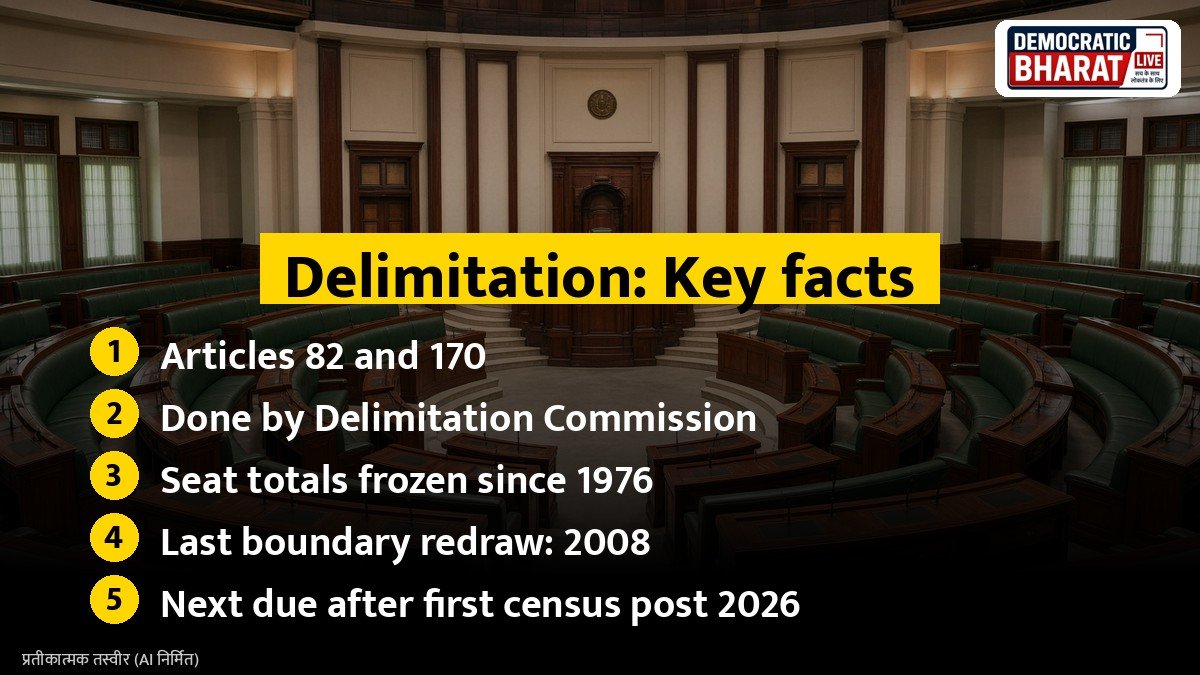
Delimitation means fixing the number of seats and drawing the boundaries of Lok Sabha and Assembly constituencies, based on population. Under Articles 82 and 170 of the Constitution, seats are to be readjusted after every census.
Who does it
Delimitation is done by a Delimitation Commission set up by Parliament through a law. The commission is usually headed by a retired Supreme Court judge, with the Chief Election Commissioner or an Election Commissioner and state election commissioners as members. Its orders have the force of law and cannot be challenged in court, as per the Delimitation Act.
History
Delimitation commissions have been set up four times, in 1952, 1963, 1973 and 2002.
The freeze
The 42nd Amendment in 1976 froze the total number of Lok Sabha and Assembly seats per state, based on the 1971 census, until after the 2001 census. The reason was to avoid penalising states that controlled population growth. The 84th Amendment in 2001 extended the freeze until the first census taken after 2026.
The Delimitation Commission of 2002 redrew constituency boundaries within states using the 2001 census, without changing the number of seats per state. The new boundaries were used from 2008.
Also Read: How Rajya Sabha Election Works: Who Votes, Seats per State and the Single Transferable Vote | No-Confidence Motion Explained: How It Works in the Lok Sabha and What Happens if a Government Loses
Reserved seats
Delimitation also decides which seats are reserved for Scheduled Castes and Scheduled Tribes, based on their share of population. The Women’s Reservation Act of 2023 (Nari Shakti Vandan Adhiniyam), which reserves one third of seats in the Lok Sabha and Assemblies for women, will come into effect after the next delimitation, which follows the next census.
Why the next round matters
The next census is being conducted, and delimitation is due after the first census after 2026. Because population has grown faster in some states, mainly in the north, than in others, mainly in the south, a seat allocation purely by population could shift the balance of seats between regions. Some southern states have raised concerns that they could lose relative representation. Options under discussion include increasing the total number of seats. The new Parliament building has room for more members. Any decision will need constitutional and legal changes.
Jammu and Kashmir and Assam
A separate delimitation for Jammu and Kashmir was completed in 2022, and for Assam in 2023, under specific provisions.
Bottom line
Delimitation redraws India’s political map. The next exercise, after the coming census, will decide seat shares, reserved seats and the start of women’s reservation.
Source / स्रोत: Election Commission of India, Constitution of India