Doordarshan is India’s public service broadcaster. For decades it was the only television channel most Indians watched, and many of its shows remain part of the country’s shared memory.
The beginning
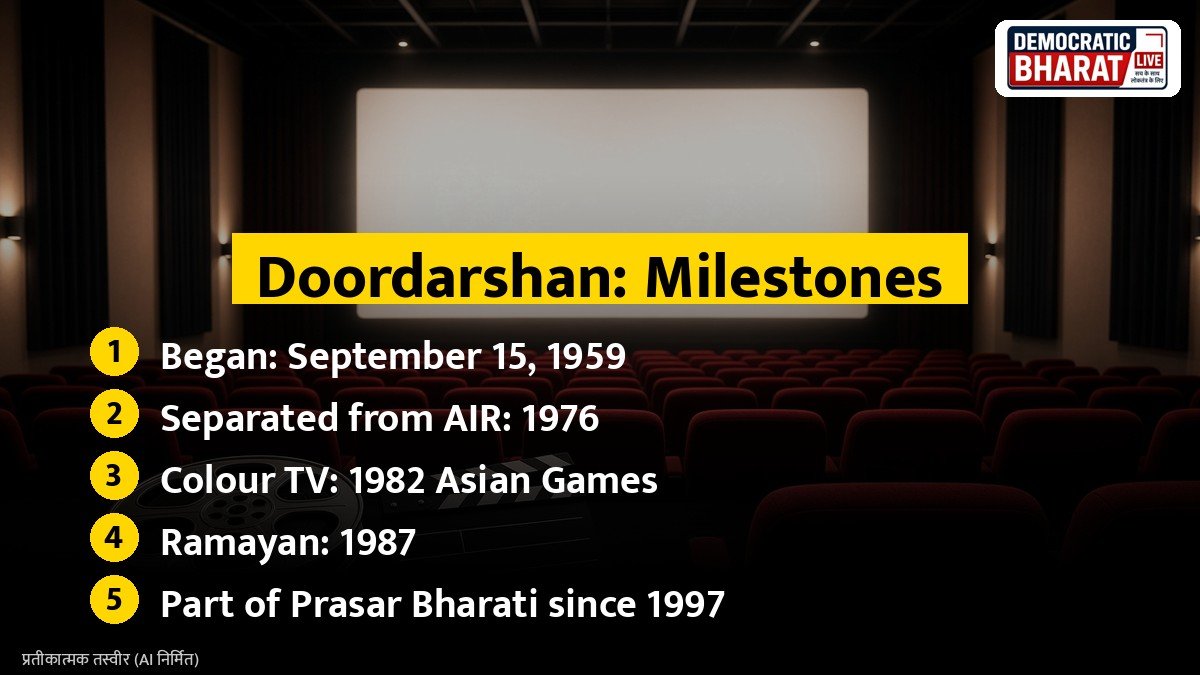
Doordarshan began on September 15, 1959 as an experimental service from Delhi, part of All India Radio. It started with short broadcasts a few days a week, mainly on education and community development. Regular daily service began in 1965.
Growth in the 1970s
Television reached Mumbai in 1972 and other cities in the following years. In 1975-76, the Satellite Instructional Television Experiment (SITE), done with ISRO, took educational programmes to villages. In 1976, Doordarshan was separated from All India Radio as a separate department.
Colour TV and national broadcast
The 1982 Asian Games in Delhi were a turning point. Doordarshan began colour broadcasts and launched a national programme. The number of transmitters grew rapidly in the 1980s, bringing TV to small towns.
Also Read: OTT Rules in India: How Streaming Content Is Classified and How Viewers Can File a Complaint | IFFI Goa Guide: What Is the International Film Festival of India, Indian Panorama and How to Register
The golden era of shows
- Hum Log (1984), India’s first soap opera.
- Buniyaad, Nukkad and Malgudi Days.
- Ramayan (1987) by Ramanand Sagar and Mahabharat (1988) by B R Chopra, which drew huge audiences on Sunday mornings.
- Chitrahaar and Rangoli for film songs.
- Krishi Darshan for farmers, one of its longest running shows.
During the 2020 lockdown, reruns of Ramayan and Mahabharat again drew very large audiences.
Prasar Bharati
The Prasar Bharati Act came into force in 1997, making Doordarshan and All India Radio part of Prasar Bharati, an autonomous public broadcaster.
Channels today
Doordarshan runs national channels such as DD National, DD News, DD Sports, DD India, DD Kisan, DD Bharati and many regional language channels. Lok Sabha and Rajya Sabha proceedings are shown on Sansad TV, which is separate.
DD Free Dish
DD Free Dish is a free to air direct to home service of Prasar Bharati. Viewers buy a set top box and dish once and watch many channels without a monthly fee. It is popular in rural areas.
Regional reach
Doordarshan’s regional Kendras produce news and programmes in many Indian languages, which keeps local culture, folk music and regional news on national airwaves. For many rural viewers, DD remains a trusted source of weather, farming and government information.
Waves OTT
In 2024, Prasar Bharati launched an OTT platform called Waves, offering live channels and on demand content.
Bottom line
From a small experiment in 1959 to a network of channels and a free DTH service, Doordarshan’s journey mirrors the story of Indian television itself.
Source / स्रोत: Prasar Bharati, Doordarshan, Ministry of Information and Broadcasting