Most bills in India must be passed by both Houses of Parliament. When the Lok Sabha and Rajya Sabha disagree on an ordinary bill, the Constitution provides a way out called a joint sitting. Here is how it works.
When can a joint sitting be called
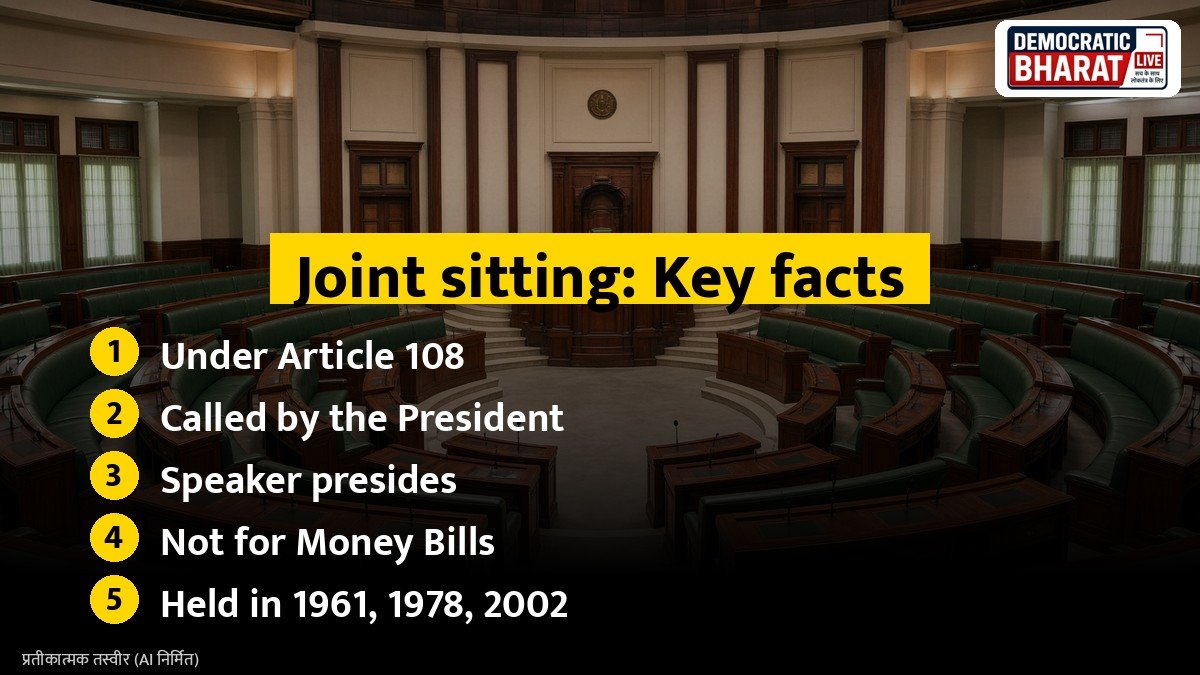
Under Article 108, the President may call a joint sitting of both Houses if, after a bill is passed by one House and sent to the other:
- The other House rejects the bill, or
- The Houses finally disagree on amendments to the bill, or
- More than six months pass without the other House passing the bill
The six month period does not count days when the House is adjourned or prorogued for more than four days in a row.
Bills that cannot go to a joint sitting
- **Money Bills:** the Lok Sabha has the final say on them, so there is no deadlock to resolve.
- **Constitution Amendment Bills:** under Article 368, each House must pass these separately by a special majority.
If the Lok Sabha is dissolved after the President has notified a joint sitting, the sitting can still be held.
How it is conducted
The joint sitting is presided over by the Speaker of the Lok Sabha. If the Speaker is absent, the Deputy Speaker presides, and if both are absent, the Deputy Chairman of the Rajya Sabha. The Chairman of the Rajya Sabha, who is the Vice President, does not preside.
The bill is passed if a majority of the total members present and voting in both Houses together vote for it. Since the Lok Sabha has many more members than the Rajya Sabha, its view usually prevails. Only limited new amendments are allowed at a joint sitting.
Also Read: How a Bill Becomes Law in India: Readings, Committees, Joint Sitting and the President’s Assent | President’s Rule Explained: When Article 356 Is Used, How Long It Lasts and the S R Bommai Judgment
The three joint sittings so far
- **1961:** the Dowry Prohibition Bill, 1959
- **1978:** the Banking Service Commission (Repeal) Bill, 1977
- **2002:** the Prevention of Terrorism Bill, 2002 (POTA)
In all three cases, the bill was passed at the joint sitting.
Why it is rare
Governments usually try to build agreement in both Houses through committees, talks and changes to the bill. A joint sitting is treated as a last resort.
Bottom line
Article 108 gives Parliament a tie breaker for ordinary bills, but it has been used only three times since independence.
Source / स्रोत: Constitution of India, Legislative Department, Lok Sabha