President’s Rule, also called State Emergency, is imposed under Article 356 of the Constitution. It allows the Union government to take over the administration of a state when the constitutional machinery in that state fails.
When it can be imposed
The President can impose it if satisfied, on a report from the Governor or otherwise, that the government of the state cannot be carried on in accordance with the Constitution. Common situations include no party being able to form a government, the fall of a government with no alternative, or a serious breakdown of order.
What happens
- The state Council of Ministers is dismissed.
- The Governor runs the state on behalf of the President, assisted by advisers.
- The Assembly is either suspended (kept in animation) or dissolved.
- Parliament makes laws for the state, or delegates this power.
Parliament’s approval and time limits
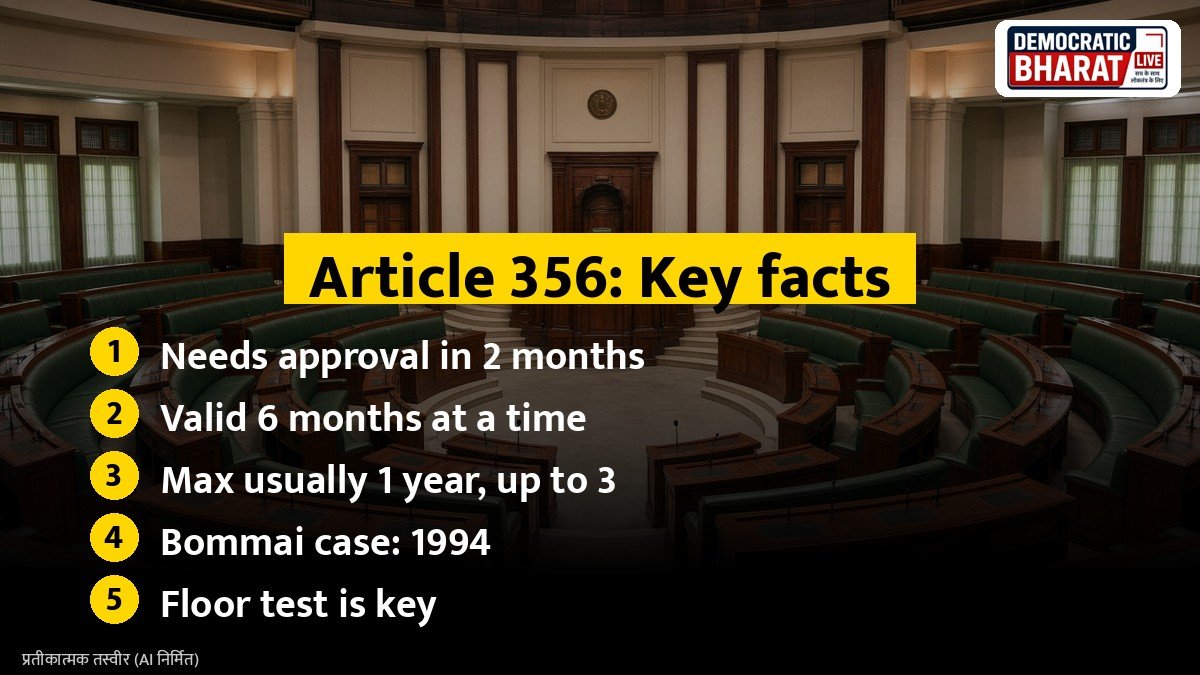
- The proclamation must be approved by both Houses of Parliament within two months.
- Once approved, it lasts six months and can be extended by six months at a time.
- Beyond one year, extension is allowed only if a National Emergency is in force and the Election Commission certifies that elections cannot be held, with a maximum of three years.
Also Read: Anti-Defection Law Explained: What the Tenth Schedule Says and When an MLA or MP Is Disqualified | How the President of India Is Elected: Electoral College, Vote Value and the Single Transferable Vote
The S R Bommai judgment
In S R Bommai v Union of India (1994), a nine judge bench of the Supreme Court set key limits:
- The proclamation is open to judicial review.
- The majority of a government must be tested on the floor of the Assembly, not in the Governor’s office.
- The Assembly should not be dissolved until Parliament approves the proclamation.
- Courts can restore a dismissed government if the proclamation is found invalid.
After Bommai, the use of Article 356 has fallen sharply.
History
Article 356 has been used more than 100 times since 1950. Dr B R Ambedkar had hoped it would remain a dead letter, used only as a last resort. The Sarkaria and Punchhi Commissions also recommended sparing use.
Bottom line
President’s Rule is meant as a last resort when a state’s constitutional machinery fails. The Bommai judgment ensures it can be challenged in court and that majorities are tested on the floor.
Source / स्रोत: Constitution of India, Supreme Court of India