A Money Bill is a special kind of bill in Parliament that deals only with financial matters. The Constitution gives it a separate process, in which the Lok Sabha has the final say. Here is how it works.
What is a Money Bill
Article 110 of the Constitution says a bill is a Money Bill if it contains only provisions dealing with matters such as:
- Imposing, abolishing, changing or regulating any tax
- Borrowing of money or giving guarantees by the Government of India
- Custody of the Consolidated Fund or Contingency Fund of India, and payment into or withdrawal from them
- Appropriation of money out of the Consolidated Fund
- Declaring any expenditure to be charged on the Consolidated Fund
- Receipt of money on account of the Consolidated Fund or public account of India
- Any matter incidental to these
A bill is not a Money Bill just because it provides for fines, fees for licences or services, or taxes by local bodies.
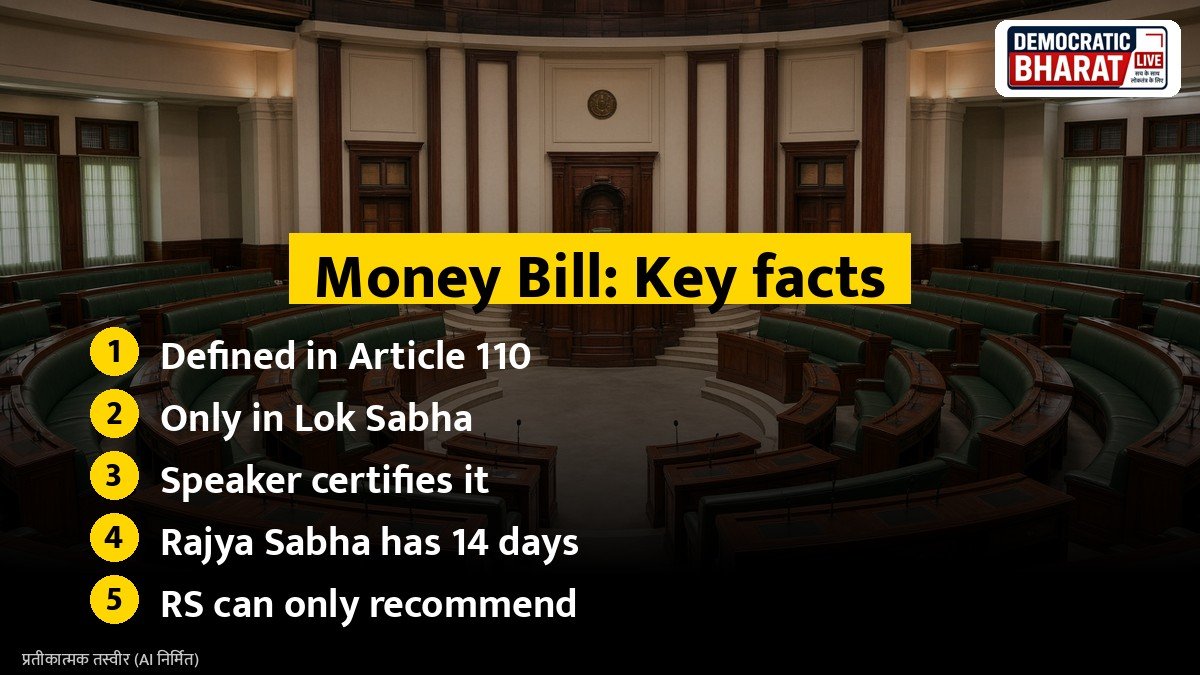
The Speaker decides
If a question arises whether a bill is a Money Bill, the decision of the Lok Sabha Speaker is final. The Speaker’s certificate is attached to the bill when it goes to the Rajya Sabha and to the President.
How it is passed
Under Article 109:
- A Money Bill can be introduced only in the Lok Sabha, and only with the recommendation of the President.
- After the Lok Sabha passes it, the bill goes to the Rajya Sabha.
- The Rajya Sabha must return it within 14 days, with or without recommendations.
- The Lok Sabha can accept or reject the recommendations.
- If the Rajya Sabha does not return it in 14 days, the bill is deemed passed by both Houses.
The President can give or withhold assent, but cannot return a Money Bill for reconsideration. There is no joint sitting for a Money Bill.
Also Read: President’s Rule Explained: When Article 356 Is Used, How Long It Lasts and the S R Bommai Judgment | Anti-Defection Law Explained: What the Tenth Schedule Says and When an MLA or MP Is Disqualified
Money Bill and Finance Bill
Every Money Bill is a Finance Bill, but not every Finance Bill is a Money Bill. Under Article 117, a Financial Bill that contains Money Bill matters along with other provisions follows the normal process in both Houses, though it also needs the President’s recommendation and can be introduced only in the Lok Sabha. The annual Finance Bill presented with the Budget is usually certified as a Money Bill.
Why it is debated
The use of the Money Bill route for laws that are not purely financial has been challenged in courts, as it limits the Rajya Sabha’s role. The Supreme Court has examined this issue in cases such as the Aadhaar case in 2018, and larger benches have been asked to look at it further.
Bottom line
A Money Bill gives the directly elected Lok Sabha control over taxes and spending, with the Speaker deciding what counts as one.
Source / स्रोत: Constitution of India, Legislative Department, Lok Sabha