
Filing your income tax return in the wrong form can make it defective and lead to a notice. The Income Tax Department notifies ITR forms every year, and the right one depends on your type of income. Here is a simple guide.
ITR-1 (Sahaj)
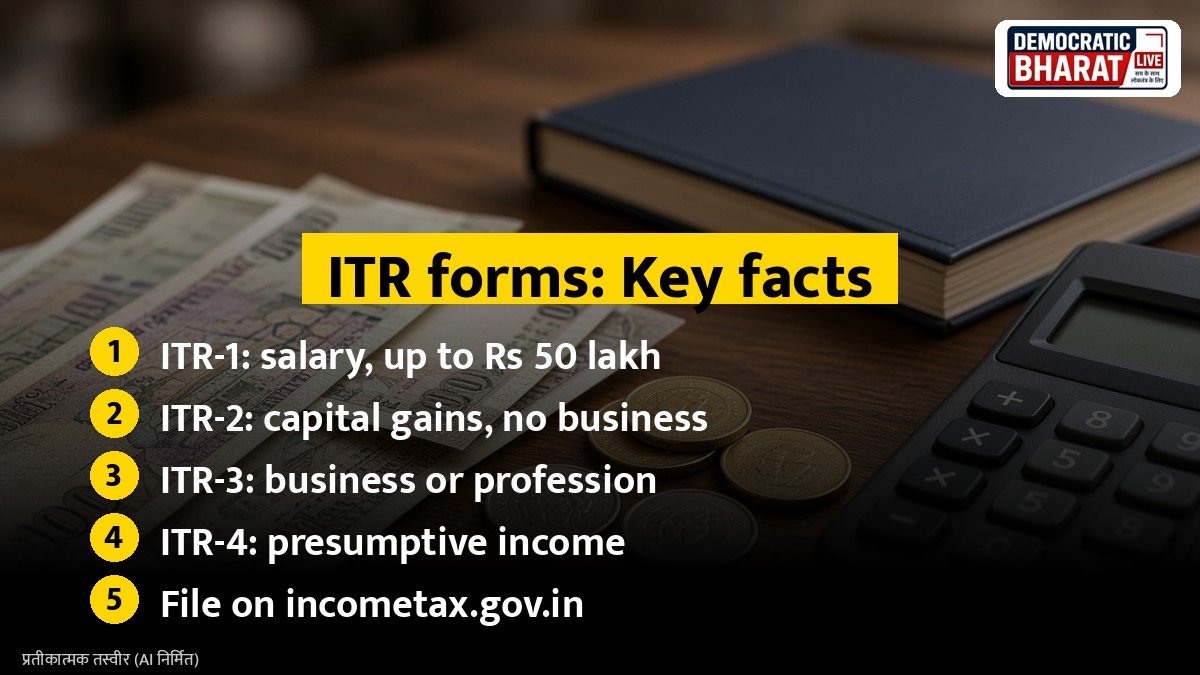
For resident individuals with total income up to Rs 50 lakh from:
- Salary or pension
- One house property
- Other sources such as interest
- Agricultural income up to Rs 5,000
From assessment year 2025-26, ITR-1 also allows long term capital gains under section 112A of up to Rs 1.25 lakh, such as from listed shares or equity funds. It cannot be used by company directors, those with unlisted shares, or those with foreign assets or income.
ITR-2
For individuals and Hindu Undivided Families (HUFs) who do not have business or professional income, but who have:
- Income above Rs 50 lakh
- Capital gains beyond the ITR-1 limit
- More than one house property
- Foreign income or assets
- Directorship or unlisted shares
ITR-3
For individuals and HUFs who have income from business or profession, such as traders, doctors or consultants who keep regular accounts, along with other income.
Also Read: National Pension System Explained: Tier 1 vs Tier 2, Tax Benefits and Withdrawal Rules | Sukanya Samriddhi Account: Rules, Deposit Limits, Tax Benefits and When the Money Can Be Withdrawn
ITR-4 (Sugam)
For resident individuals, HUFs and firms (other than LLPs) with total income up to Rs 50 lakh, who opt for presumptive taxation of business or professional income under sections 44AD, 44ADA or 44AE.
ITR-5, ITR-6 and ITR-7
- **ITR-5:** firms, LLPs, associations of persons and bodies of individuals
- **ITR-6:** companies, other than those claiming exemption as charities
- **ITR-7:** trusts, political parties and institutions filing under certain exemption sections
How to file
- Log in to the e-filing portal at incometax.gov.in with your PAN.
- Download and check Form 26AS and the Annual Information Statement (AIS).
- Choose the assessment year and the correct ITR form, or let the portal guide you.
- Fill in details, pay any tax due, and submit.
- E-verify the return within the time allowed, using Aadhaar OTP or net banking.
The usual due date for individuals not needing audit is 31 July, unless extended by the department.
Common mistakes
- Using ITR-1 when you have capital gains above the limit
- Not reporting interest income
- Forgetting to e-verify
Bottom line
Match your income type to the right ITR form. When in doubt, check the instructions on the e-filing portal or consult a tax professional.
Source / स्रोत: Income Tax Department e-filing portal, Central Board of Direct Taxes