The Nuclear Suppliers Group (NSG) is a group of countries that supply nuclear materials and technology. It aims to prevent the spread of nuclear weapons by controlling exports of nuclear and related items. Here is how it works and how it relates to India.
History
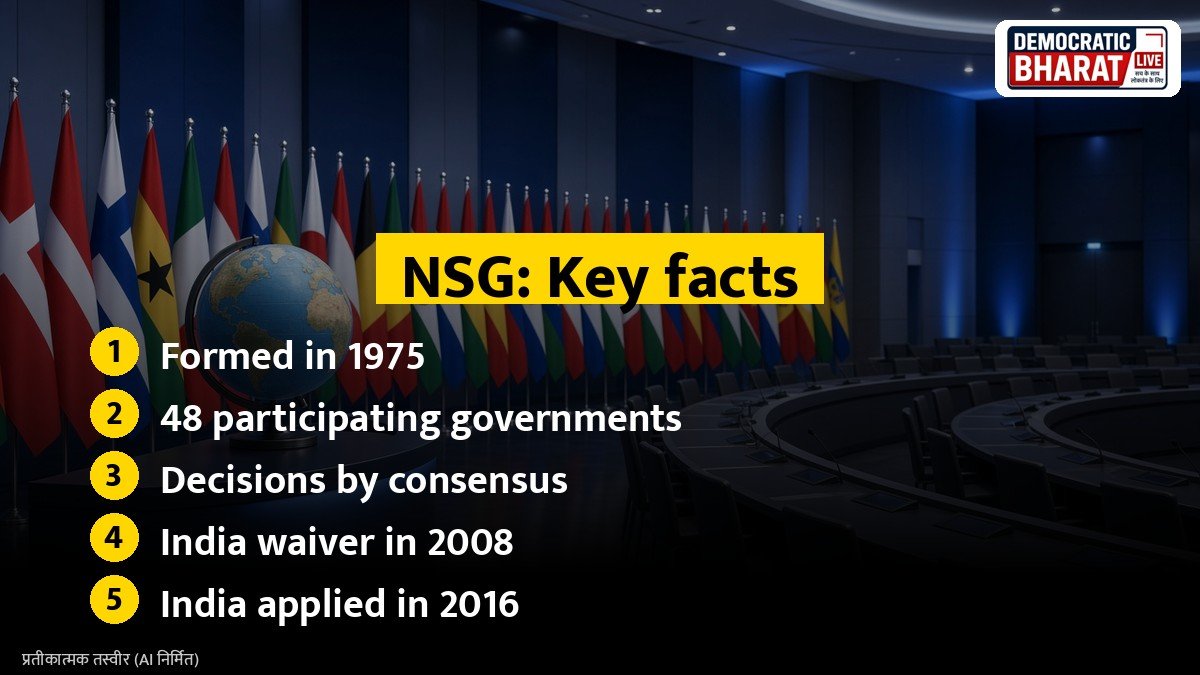
The NSG was formed in 1975, after India’s first nuclear test at Pokhran in May 1974. Supplier countries were concerned that nuclear technology meant for peaceful uses could be used to make weapons, and they agreed on common rules for nuclear exports.
Members
The NSG has 48 participating governments, including the United States, Russia, China, France, the United Kingdom, Japan, Germany and others. The European Commission and the chair of the Zangger Committee take part as observers.
How it works
- The NSG has two sets of guidelines: one for nuclear materials and equipment, and one for dual use items that have both nuclear and non nuclear uses.
- Members agree to export such items only to countries that accept International Atomic Energy Agency (IAEA) safeguards.
- Decisions are taken by consensus, which means any single member can block a decision.
- The NSG is not a treaty body. Its guidelines are put into practice through members’ national export laws.
Also Read: What Is the International Solar Alliance? India Led Group, Its Goals and How It Works | What Is the WTO? How the World Trade Organization Works and the Issues India Raises
The 2008 waiver for India
India has not signed the Treaty on the Non Proliferation of Nuclear Weapons (NPT), which normally blocks nuclear trade under NSG rules. In September 2008, after the India United States civil nuclear agreement, the NSG granted India a special waiver. This allowed members to trade in civil nuclear technology and fuel with India.
As part of the process, India separated its civil and military nuclear facilities, placed civil facilities under IAEA safeguards, and announced a voluntary moratorium on nuclear testing.
After the waiver, India signed civil nuclear cooperation agreements with several countries, including the United States, France, Russia, Canada, Australia and Japan.
India’s membership bid
India formally applied for NSG membership in 2016. Many members, including the United States, France, the United Kingdom and Russia, have expressed support. However, China has opposed India’s entry, arguing that non NPT countries should not be admitted without a common approach. Since decisions need consensus, India’s application remains pending.
Why membership matters
Full membership would give India a say in writing the rules of nuclear trade, strengthen its position as a responsible nuclear power and support its plans to expand nuclear power and export nuclear technology.
Bottom line
The NSG controls global nuclear trade. India got a special waiver in 2008 but is still seeking full membership, which needs the consent of all members.
Source / स्रोत: Nuclear Suppliers Group, Ministry of External Affairs