Every few months, news headlines say the Reserve Bank of India (RBI) has cut, raised or kept the repo rate unchanged. This one number affects home loans, car loans and fixed deposits across the country. Here is a simple explanation.
What is the repo rate
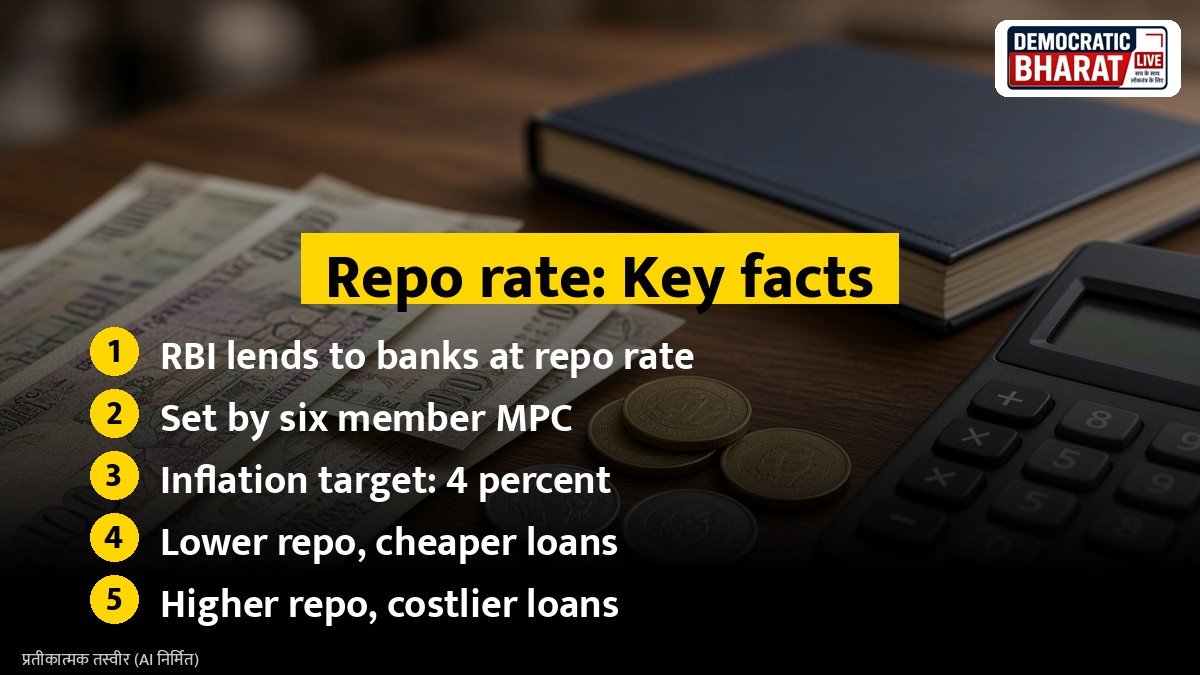
The repo rate is the interest rate at which the RBI lends money to commercial banks for a short period, against government securities. Repo stands for repurchase agreement: banks sell securities to the RBI and agree to buy them back later at a fixed price.
Who decides it
The repo rate is set by the Monetary Policy Committee (MPC), created under amendments to the RBI Act in 2016.
- The MPC has six members: three from the RBI, including the Governor who chairs it, and three external members appointed by the government.
- Decisions are taken by majority vote. The Governor has a casting vote if there is a tie.
- The MPC usually meets six times a year.
Inflation target
The government has set an inflation target of 4 percent for consumer price inflation, with a tolerance band of 2 percentage points on either side. The MPC uses the repo rate mainly to keep inflation within this range, while also keeping growth in mind.
Also Read: Home Loan EMI Explained: How It Is Calculated, Floating vs Fixed Rate and Ways to Save Interest | How to Check Your Credit Score Free in India and 7 Ways to Improve It Before Taking a Loan
How it reaches you
- When the repo rate falls, banks can borrow more cheaply. Over time, they lower lending rates, and loan EMIs can come down.
- When the repo rate rises, borrowing becomes costlier, and EMIs tend to go up.
- Many floating rate home loans are now linked to an external benchmark such as the repo rate, so changes pass through faster.
- FD rates usually move in the same direction as the repo rate, though with a lag.
Other policy tools
- Standing Deposit Facility (SDF): the rate at which banks park surplus money with the RBI.
- Marginal Standing Facility (MSF): an emergency window for banks to borrow overnight at a higher rate.
- Cash Reserve Ratio (CRR): the share of deposits banks must keep with the RBI.
- Statutory Liquidity Ratio (SLR): the share of deposits banks must keep in safe assets like government securities.
Policy stance
Along with the rate, the MPC announces its stance, such as neutral or accommodative. This signals whether future moves are more likely to be cuts or hikes.
How to check the current rate
The current repo rate and the latest policy statement are published on the RBI website after every MPC meeting. Check there before making a loan or deposit decision.
Bottom line
The repo rate is the RBI’s main lever to control inflation. A change in this rate slowly flows through banks to your EMIs and deposit returns.
Source / स्रोत: Reserve Bank of India, RBI Monetary Policy, Ministry of Finance