When someone believes an election to the Lok Sabha or a state assembly was won unfairly, the only legal way to challenge the result is an election petition. Here is how the process works under Indian law.
The law
Article 329(b) of the Constitution says no election to Parliament or a state legislature can be questioned except by an election petition presented to an authority set by law. The Representation of the People Act, 1951 (RP Act) gives the details.
Where it is filed
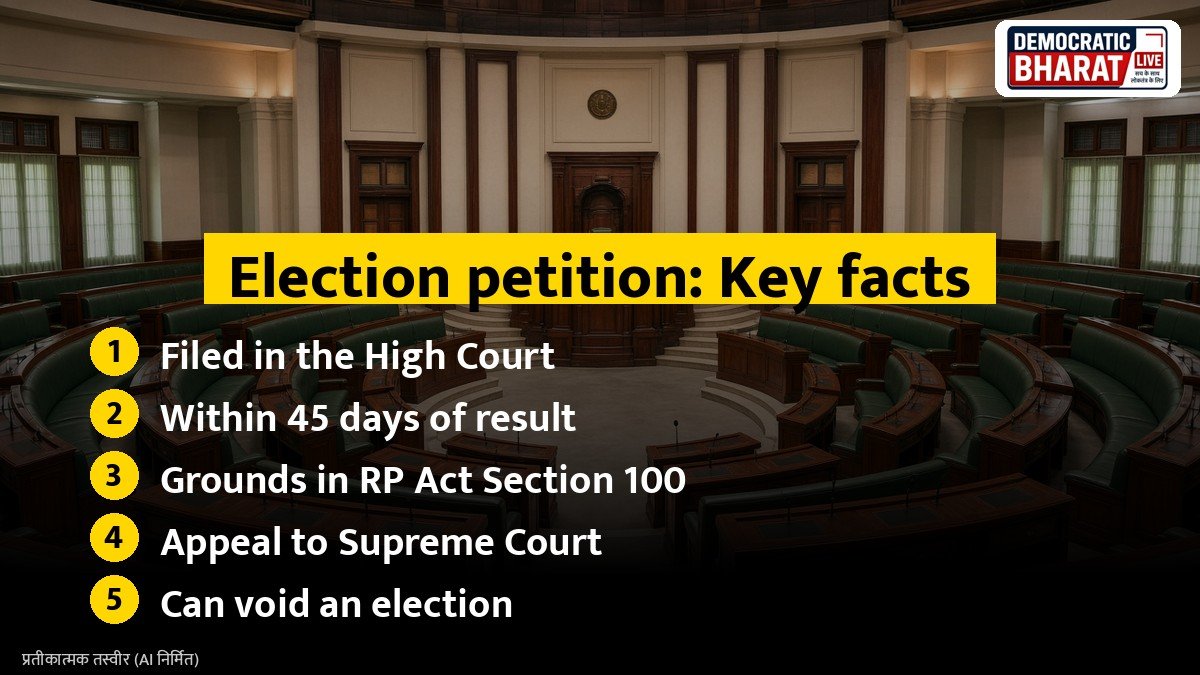
Election petitions for Lok Sabha and assembly seats are filed in the High Court of the state concerned. Disputes about the election of the President and Vice President are decided by the Supreme Court under Article 71.
Who can file
- Any candidate in that election.
- Any elector, meaning a voter, of that constituency.
Also Read: Model Code of Conduct Explained: What Governments and Parties Cannot Do Once Elections Are Announced | Collegium System Explained: How Supreme Court and High Court Judges Are Appointed in India
Time limit
The petition must be filed within 45 days from the date of election of the returned candidate, which is usually the date of declaration of the result. A petition filed late is dismissed.
Grounds
Section 100 of the RP Act lists the grounds on which an election can be declared void, including:
- The winning candidate was not qualified or was disqualified on the date of election.
- Corrupt practices by the candidate or their agent, such as bribery, undue influence, appeals on the basis of religion or caste, or spending above the limit.
- Improper acceptance or rejection of a nomination.
- Improper counting of votes or reception of void votes that affected the result.
- Non compliance with the Constitution or election laws that materially affected the result.
What the court can do
- Dismiss the petition.
- Declare the election of the returned candidate void.
- In some cases, declare the petitioner or another candidate duly elected.
- A person found guilty of corrupt practice can also be disqualified for a period.
The RP Act says the High Court should try to finish the trial within six months, though many cases take longer.
Appeal
An appeal against the High Court’s order lies to the Supreme Court within 30 days.
A landmark case
In 1975, the Allahabad High Court set aside Indira Gandhi’s election from Rae Bareli on a petition filed by Raj Narain, finding her guilty of electoral malpractice. The ruling was followed by the declaration of the Emergency, and the case remains one of the most important in Indian political history.
Bottom line
An election petition is the legal route to challenge a poll result. It must be filed in the High Court within 45 days and must prove specific grounds set out in the RP Act.
Source / स्रोत: Election Commission of India, Representation of the People Act, 1951, India Code, Supreme Court of India