Laws in India are normally made by Parliament. But when Parliament is not in session and urgent action is needed, the government can bring an ordinance. Ordinances are often in the news, so here is a simple explainer.
What is an ordinance
An ordinance is a temporary law issued by the President on the advice of the Union Cabinet. It has the same force as an Act of Parliament while it lasts.
Article 123
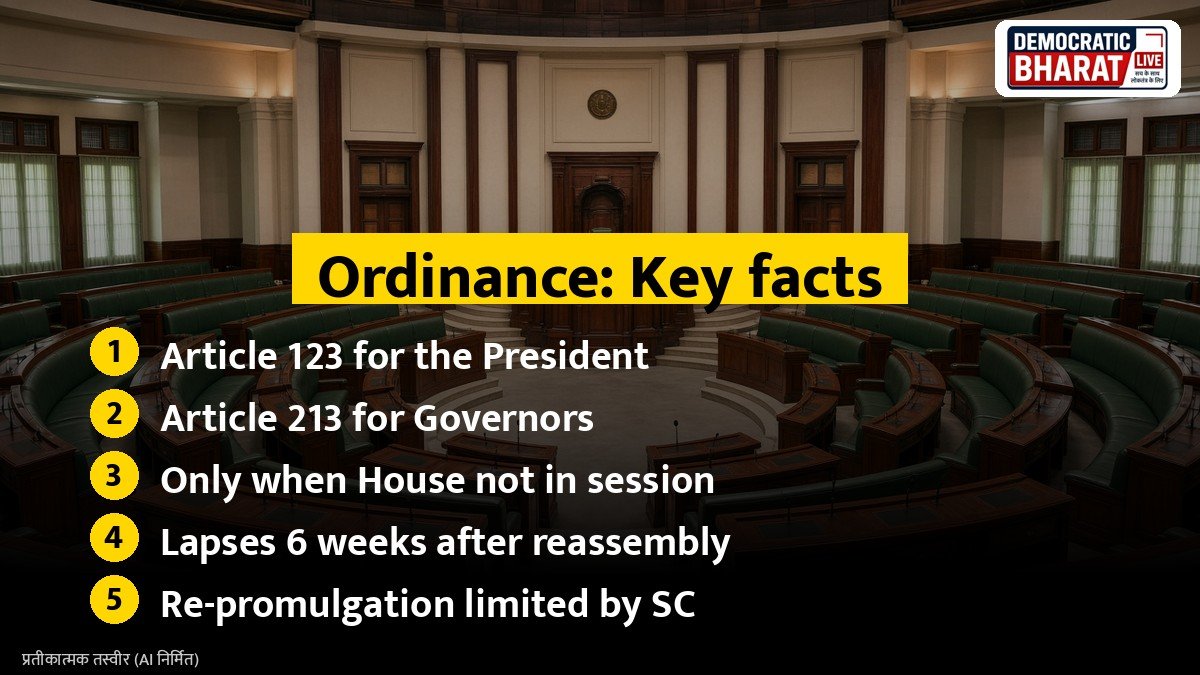
Article 123 of the Constitution allows the President to promulgate an ordinance when:
- Both Houses of Parliament are not in session, or one House is not in session.
- The President is satisfied that circumstances exist that make immediate action necessary.
The President acts on the advice of the Council of Ministers.
Ordinances in states
Article 213 gives a similar power to Governors when the state legislature is not in session.
Also Read: Role of the Governor in India: Appointment, Powers Over Bills and the Supreme Court’s Rulings | Collegium System Explained: How Supreme Court and High Court Judges Are Appointed in India
The six week rule
- An ordinance must be laid before both Houses when Parliament reassembles.
- It ceases to operate six weeks after Parliament reassembles, unless Parliament passes a bill to replace it before that.
- Parliament can also pass resolutions disapproving it, which ends it earlier.
- The President can withdraw an ordinance at any time.
Since the gap between two sessions cannot exceed six months, an ordinance can last for at most around six months and six weeks without Parliament’s approval.
Limits on the power
- An ordinance can only cover subjects on which Parliament can make laws.
- It cannot take away fundamental rights, just like a regular law.
- It cannot amend the Constitution.
What the courts have said
- In R C Cooper v Union of India (1970), the Supreme Court said the President’s satisfaction could be examined in court.
- The 38th Amendment of 1975 tried to make this satisfaction final, but the 44th Amendment of 1978 removed that clause.
- In D C Wadhwa v State of Bihar (1987), the court said repeated re-promulgation of ordinances without placing them before the legislature was a fraud on the Constitution.
- In Krishna Kumar Singh v State of Bihar (2017), a seven judge bench held that re-promulgation is subject to judicial review and that failing to place an ordinance before the legislature is a serious constitutional breach.
Why ordinances are debated
Supporters say ordinances help deal with emergencies. Critics say frequent use bypasses debate in Parliament. Constitutional experts often call for ordinances to be used only in real urgency.
Bottom line
An ordinance is a stopgap law for urgent situations when Parliament is not sitting. It must be approved by Parliament within six weeks of its return, or it lapses.
Source / स्रोत: Constitution of India, Legislative Department, Ministry of Law and Justice, Supreme Court of India