The Constitution of India can be changed to meet new needs, but the process is designed to be careful. Article 368 sets out how Parliament can amend the Constitution. Here is how it works.
Three ways to amend
1. Simple majority
Some provisions can be changed by a simple majority of members present and voting in Parliament, like an ordinary law. These are not treated as amendments under Article 368. Examples include forming new states or changing state boundaries under Articles 2 and 3, and rules on citizenship.
2. Special majority
Most parts of the Constitution, including Fundamental Rights and Directive Principles, can be amended by a special majority under Article 368. This means:
- A majority of the total membership of each House, and
- At least two thirds of the members present and voting in each House
3. Special majority plus state ratification
Some provisions that affect the federal structure need, in addition to a special majority, ratification by the legislatures of at least half of the states. These include:
- Election of the President
- Extent of executive power of the Union and states
- The Supreme Court and High Courts
- Distribution of legislative powers between the Union and states
- Representation of states in Parliament
- Article 368 itself
The GST amendment of 2016, the 101st Amendment, needed state ratification.
The procedure
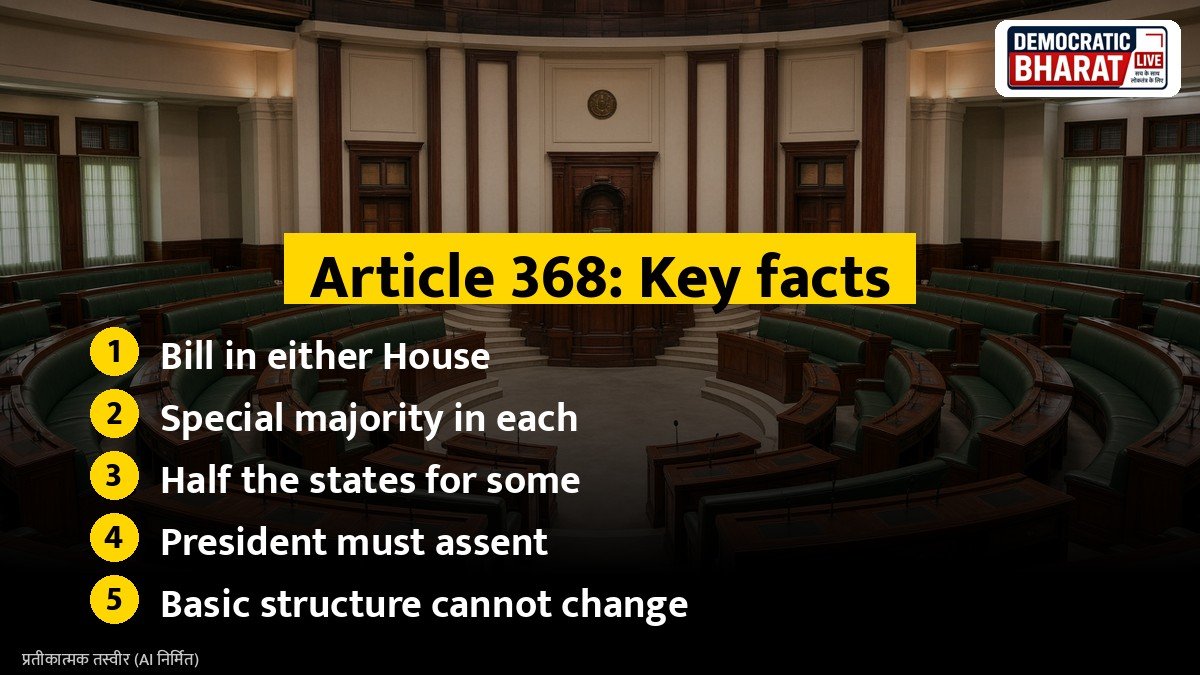
- An amendment bill can be introduced in either House of Parliament, by a minister or a private member.
- It does not need the President’s prior permission.
- Each House must pass it separately with the required majority. There is no joint sitting for amendment bills.
- If needed, it goes to the states for ratification.
- The President must give assent. Since the 24th Amendment in 1971, the President cannot withhold assent to a constitutional amendment bill.
Limits: the basic structure
In the Kesavananda Bharati case in 1973, a 13 judge bench of the Supreme Court held that Parliament can amend any part of the Constitution, but cannot change its basic structure. Courts have identified features such as the supremacy of the Constitution, democracy, secularism, federalism, separation of powers, judicial review and free and fair elections as part of the basic structure.
In the Minerva Mills case of 1980, the court struck down parts of the 42nd Amendment that tried to remove limits on Parliament’s amending power.
Also Read: How Rajya Sabha Election Works: Who Votes, Seats per State and the Single Transferable Vote | Election Commission of India Explained: Powers, How the CEC Is Appointed and the 2023 Law
Amendments so far
The Constitution has been amended more than 100 times since 1950.
Bottom line
Article 368 makes the Constitution flexible but not easy to change, and the basic structure doctrine protects its core.
Source / स्रोत: Constitution of India, Legislative Department, Supreme Court of India