The International Court of Justice (ICJ), often called the World Court, is the main judicial body of the United Nations. It settles legal disputes between countries and gives opinions on questions of international law. Here is a simple guide.
How it began
The ICJ was set up in 1945 under the UN Charter and began work in 1946. It replaced the Permanent Court of International Justice of the League of Nations. It sits at the Peace Palace in The Hague, Netherlands.
The judges
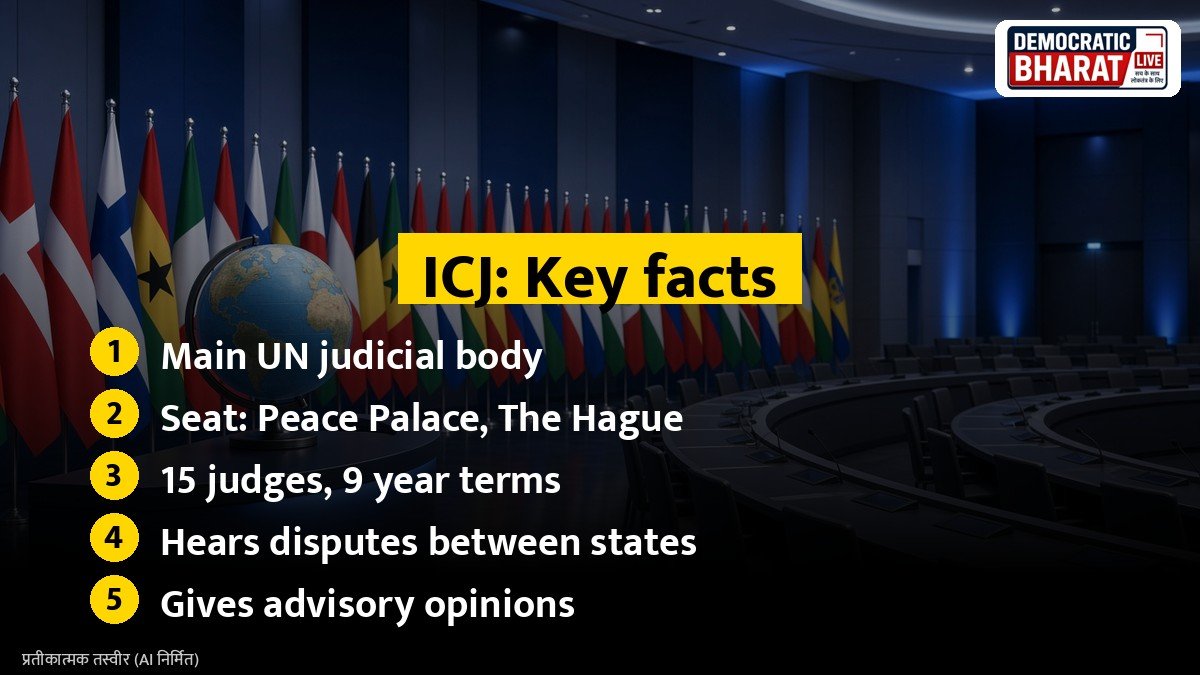
- The court has 15 judges, each elected for a term of nine years.
- Judges are elected by both the UN General Assembly and the Security Council, voting separately. A candidate needs an absolute majority in both.
- One third of the court is elected every three years.
- No two judges can be from the same country.
- Judges act independently and do not represent their governments.
What cases it hears
Contentious cases
These are disputes between states only. Individuals, companies and groups cannot bring cases. A state can be taken to court only if it has accepted the court’s jurisdiction, through a special agreement, a treaty clause or a general declaration.
Advisory opinions
UN bodies and agencies can ask the court for advisory opinions on legal questions. These are not binding but carry great legal weight. For example, the court gave an advisory opinion in 2025 on states’ obligations regarding climate change.
Also Read: What Is the WTO? How the World Trade Organization Works and the Issues India Raises | What Is the IMF? How the International Monetary Fund Works, Quotas, Loans and India’s 1991 Crisis
Are judgments binding
Judgments in contentious cases are final and binding on the parties, with no appeal. If a state does not comply, the other party can go to the Security Council, though enforcement depends on politics there.
ICJ and ICC
The ICJ is different from the International Criminal Court (ICC). The ICJ settles disputes between states, while the ICC tries individuals for crimes like genocide and war crimes.
Indian judges
Several Indians have served on the ICJ, including Sir Benegal Narsing Rau, Nagendra Singh, who was President of the court from 1985 to 1988, R S Pathak and Dalveer Bhandari, who was re-elected in 2017.
India’s cases
In the Kulbhushan Jadhav case, India approached the ICJ against Pakistan. In 2019, the court ruled that Pakistan had violated the Vienna Convention on Consular Relations by denying India consular access and directed an effective review of his conviction and sentence.
Bottom line
The ICJ is the world’s main court for disputes between countries. Its rulings help build international law, and India has both used the court and contributed judges to it.
Source / स्रोत: International Court of Justice, United Nations, Ministry of External Affairs