
Sri Harmandir Sahib, popularly called the Golden Temple, in Amritsar is the holiest gurdwara of Sikhism. Lakhs of people of all faiths visit it every year. Here is a look at its history and a guide for visitors.
History
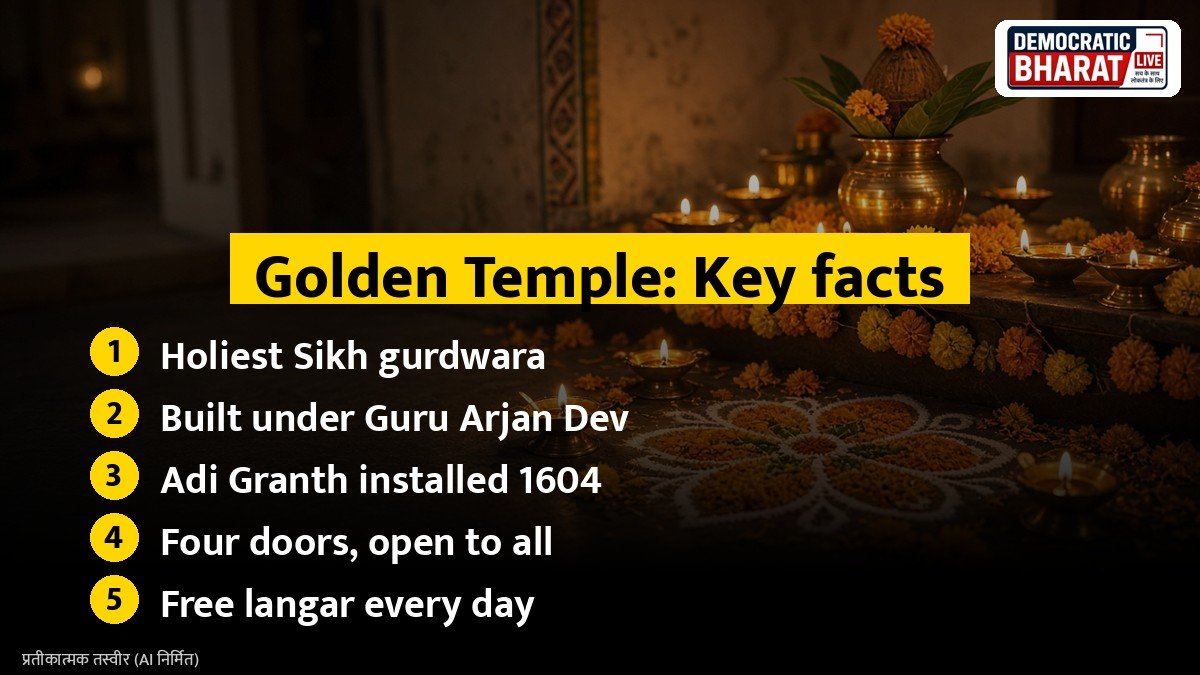
- The fourth Sikh Guru, Guru Ram Das, developed the town around a sacred pool, which came to be called Amritsar, meaning pool of nectar.
- The fifth Guru, Guru Arjan Dev, built the Harmandir Sahib in the middle of the pool in the late 16th century. By tradition, the foundation stone was laid by the Sufi saint Mian Mir.
- In 1604, Guru Arjan Dev installed the Adi Granth, the holy scripture of the Sikhs, in the temple.
- The temple was damaged several times in the 18th century and rebuilt.
- In the early 19th century, Maharaja Ranjit Singh covered the upper floors with gold leaf, which gave it the name Golden Temple.
Meaning of its design
- The temple has four entrances, one on each side, symbolising that it is open to people of every faith, caste and background.
- It is built at a lower level than the surrounding land, symbolising humility.
- The sacred pool around it is called the Amrit Sarovar.
Akal Takht
Facing the Harmandir Sahib is the Akal Takht, the highest temporal seat of Sikh authority, established by the sixth Guru, Guru Hargobind.
Also Read: Kamakhya Temple Guwahati: History, Ambubachi Mela, Darshan and Visitor Guide | Siddhivinayak Temple Mumbai: History, Darshan Timings, Tuesday Crowd and Visitor Tips
The langar
The Guru Ka Langar at the Golden Temple is one of the largest free community kitchens in the world. Volunteers cook and serve simple vegetarian meals to everyone, who sit together on the floor. On festivals, the number of visitors fed is far higher than on regular days. Visitors are welcome to volunteer in the kitchen.
Management
The temple is managed by the Shiromani Gurdwara Parbandhak Committee (SGPC).
Visitor guide
- Cover your head with a scarf or cloth. Scarves are available at the entrance.
- Remove shoes and wash your feet before entering.
- Do not smoke or carry tobacco or alcohol.
- Dress modestly.
- Free accommodation is available in sarais near the temple, subject to availability.
Best time to visit
The temple is open round the clock. Early morning and late evening, during the Palki Sahib ceremony when the Guru Granth Sahib is carried in and out of the sanctum, are especially moving. Gurpurabs and Diwali, celebrated as Bandi Chhor Divas, draw huge crowds.
Nearby places
- Jallianwala Bagh, the site of the 1919 massacre.
- The Partition Museum.
- The Attari Wagah border ceremony, about 30 km away.
Bottom line
The Golden Temple is a place of deep faith and a living example of equality and service. Its open doors and free langar welcome everyone.
Source / स्रोत: Shiromani Gurdwara Parbandhak Committee, Punjab Tourism, Incredible India, Ministry of Tourism