
Parliament has limited time to debate every bill and budget in detail. So much of its careful work happens in committees, small groups of MPs who study issues, question officials and make recommendations. Here is a guide.
Why committees matter
- They allow detailed study of bills, budgets and policies.
- They work away from the noise of the House, which encourages cross party agreement.
- They can call officials and experts to give evidence.
- Their reports help Parliament make better decisions.
Financial committees
Public Accounts Committee (PAC)
- Examines the government’s accounts and the reports of the Comptroller and Auditor General.
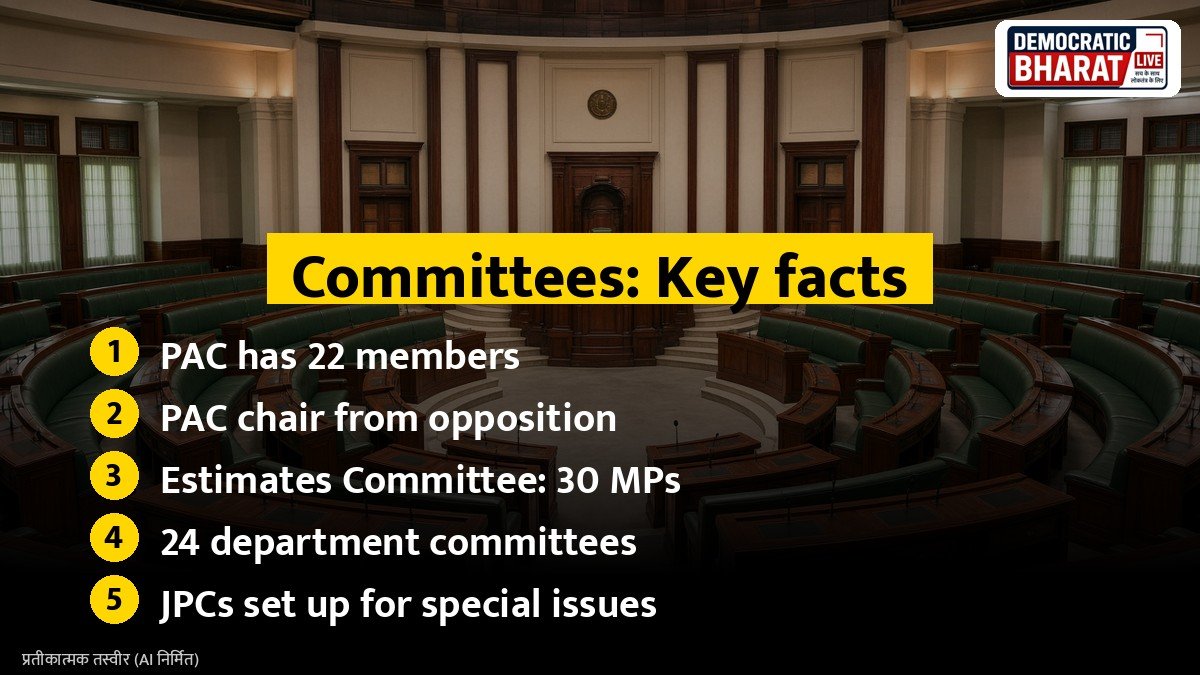
- Has 22 members: 15 from the Lok Sabha and 7 from the Rajya Sabha.
- By convention since 1967, its chairperson is from the opposition.
- Ministers cannot be members.
Estimates Committee
- Examines budget estimates and suggests economies and efficiency.
- Has 30 members, all from the Lok Sabha.
Committee on Public Undertakings
- Examines the working of public sector undertakings.
- Has 22 members from both Houses.
Departmentally Related Standing Committees
Since 1993, Parliament has had standing committees attached to ministries. There are 24 such committees, each with members from both Houses. They examine:
- Demands for grants of ministries.
- Bills referred to them.
- Annual reports and long term policies.
Also Read: How a Bill Becomes Law in India: Readings, Committees, Joint Sitting and the President’s Assent | Question Hour and Zero Hour in Parliament: How MPs Hold the Government to Account
Ad hoc committees
- Select committees: formed by one House to study a specific bill.
- Joint Parliamentary Committees (JPCs): formed with members of both Houses for a specific bill or issue, such as investigations into scams or major bills like the One Nation One Election bill.
Other committees
- Business Advisory Committee: sets the timetable of the House.
- Committee of Privileges: examines breaches of privilege.
- Ethics Committee: looks into the conduct of members.
- Committee on Subordinate Legislation: checks rules made by the government under laws.
Concerns
Experts and groups like PRS Legislative Research have noted that the share of bills referred to committees has fallen in recent years. Many say more bills should go to committees for scrutiny.
Are reports binding
Committee recommendations are not binding on the government, but the government reports back on actions taken. These reports carry weight and often lead to changes.
How to read committee reports
Committee reports are published on the Lok Sabha and Rajya Sabha websites. Anyone can read them for free. They often contain detailed data from ministries that is not easily available elsewhere, which makes them useful for students, journalists and researchers.
Bottom line
Parliamentary committees are where detailed lawmaking and scrutiny happen. The PAC, led by an opposition MP, is one of the most powerful tools to hold the government accountable.
Source / स्रोत: Lok Sabha Secretariat, Rajya Sabha Secretariat, PRS Legislative Research