Indian classical music has two major traditions: Hindustani music, mainly in north India, and Carnatic music, mainly in south India. They share deep roots but have grown in different ways. Here is a simple guide.
Common roots
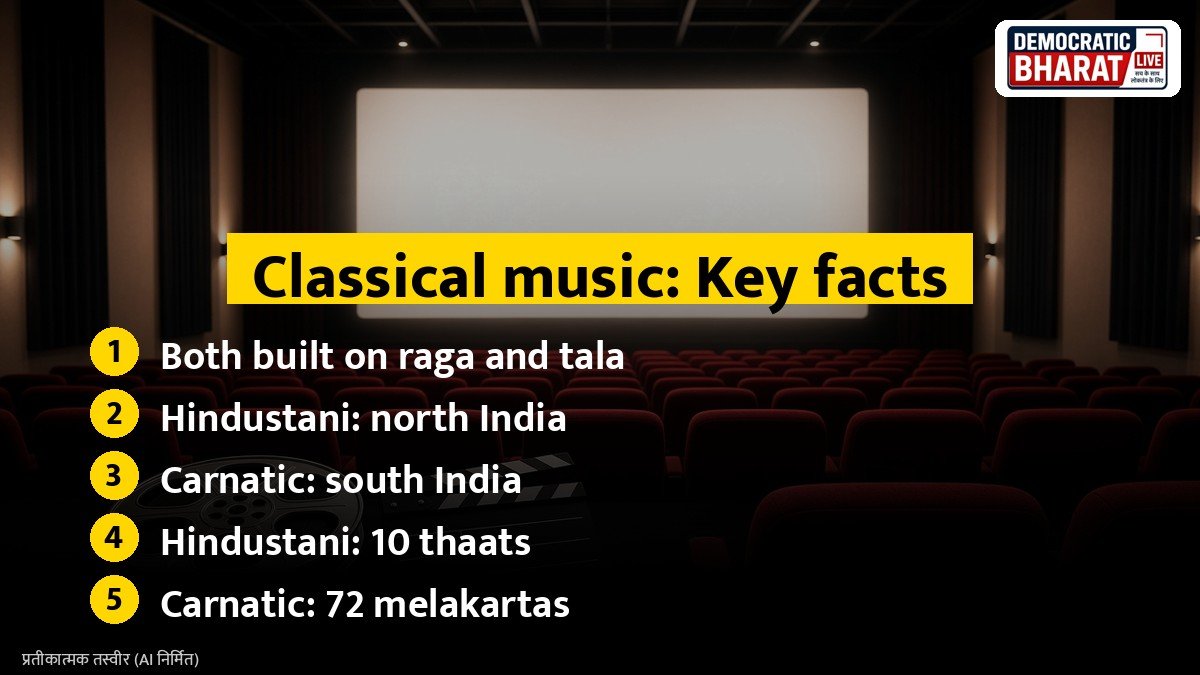
Both traditions trace their origins to ancient texts like the Samaveda and the Natya Shastra. Both are built on two core ideas:
- Raga: a melodic framework with a set of notes and rules for how to move between them, meant to create a mood.
- Tala: a rhythmic cycle of beats.
Both also place great value on improvisation within these frameworks.
How they grew apart
From around the 13th century, music in north India absorbed influences from Persian and Central Asian traditions at royal courts. Music in the south developed more within temple and devotional settings. Over time, the two styles became distinct.
Hindustani music
- Organised into 10 parent scales called thaats, a system popularised by musicologist Vishnu Narayan Bhatkhande.
- Main vocal forms include dhrupad, khayal, thumri, tappa and tarana.
- Performers belong to gharanas, or schools of style, like Gwalior, Kirana, Agra, Jaipur Atrauli and Patiala.
- Main instruments: sitar, sarod, santoor, bansuri, shehnai, sarangi and tabla.
- A common tala is teentaal, a cycle of 16 beats.
- Ragas are often linked to times of day and seasons.
Also Read: Indian Classical Dance Forms: The Eight Styles Recognised by Sangeet Natak Akademi and Where They Come From | Natyashastra Explained: Bharata Muni’s Ancient Text on Drama, Dance, Music and Rasa
Carnatic music
- Organised into 72 parent scales called melakartas, a system linked to the 17th century scholar Venkatamakhin.
- Concerts are built around compositions called kritis, sung with improvisation in sections such as alapana, niraval and kalpanaswaram.
- Main instruments: veena, violin, mridangam, ghatam, flute and nadaswaram.
- A common tala is Adi tala, a cycle of eight beats.
- Composition is especially central, and lyrics are often devotional.
Great composers and artists
- Purandara Dasa is called the father of Carnatic music for creating a system of teaching.
- The Carnatic trinity: Tyagaraja, Muthuswami Dikshitar and Syama Sastri.
- In Hindustani music, Tansen of Akbar’s court is a legendary figure.
- Modern greats include M S Subbulakshmi, the first musician to receive the Bharat Ratna, Pandit Bhimsen Joshi and many others.
Festivals
The Tyagaraja Aradhana at Thiruvaiyaru and the December music season in Chennai are major Carnatic events. The Sawai Gandharva Bhimsen Mahotsav in Pune is a landmark Hindustani festival.
Bottom line
Hindustani and Carnatic music share the raga and tala but differ in scales, forms, instruments and style. Together, they form one of the world’s great musical heritages.
Source / स्रोत: Sangeet Natak Akademi, Ministry of Culture, Prasar Bharati Archives