The Organization of the Petroleum Exporting Countries, or OPEC, is a group of major oil producing nations that coordinate their oil policies. Its decisions on how much oil to pump can move global crude prices, which in turn affect fuel costs in India. Here is a simple guide.
How OPEC began
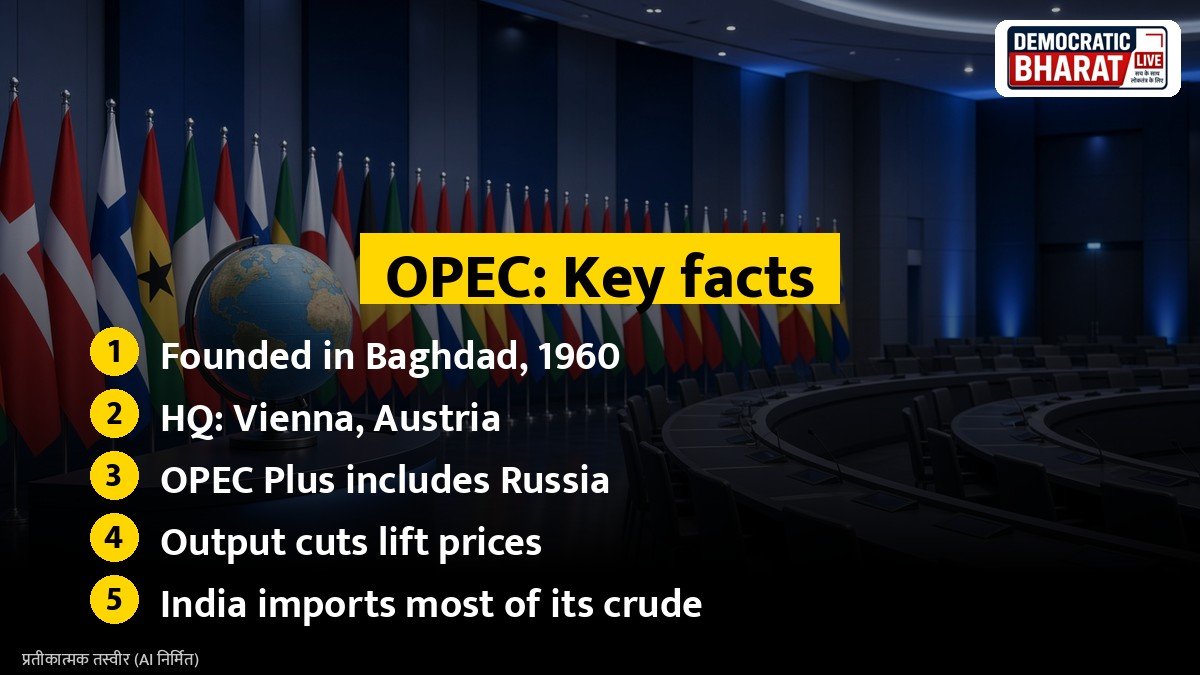
OPEC was founded in September 1960 at a conference in Baghdad by five countries: Iran, Iraq, Kuwait, Saudi Arabia and Venezuela. Its headquarters is in Vienna, Austria.
Members
OPEC currently has 12 members: Algeria, Congo, Equatorial Guinea, Gabon, Iran, Iraq, Kuwait, Libya, Nigeria, Saudi Arabia, the United Arab Emirates and Venezuela. Membership has changed over time. Qatar left in 2019, Ecuador in 2020 and Angola in 2024.
What OPEC does
- Coordinates oil production policies among members.
- Aims for stable prices that are fair to producers and consumers.
- Publishes monthly reports on the oil market.
Saudi Arabia is the largest producer in the group and plays a leading role.
Also Read: What Is ASEAN? Members, How It Works and Why It Matters for India’s Act East Policy | What Is the G20? Members, How the Presidency Rotates and What India Achieved in 2023
OPEC Plus
In 2016, OPEC began working with other big producers, led by Russia, in an arrangement called OPEC Plus. Other non OPEC members include Kazakhstan, Oman, Azerbaijan and Mexico. Together, OPEC Plus accounts for a large share of world oil output, so its decisions carry much more weight than OPEC alone.
How decisions affect prices
- When OPEC Plus cuts production, supply falls and crude prices tend to rise.
- When it raises output, prices tend to soften.
- Prices also depend on demand, the global economy, wars and supply from countries like the United States.
The benchmark Brent crude price is watched closely after every OPEC Plus meeting.
Why it matters for India
India is the world’s third largest consumer of crude oil and imports most of what it uses. According to the Petroleum Planning and Analysis Cell, imports meet well over 80 percent of India’s crude oil needs. Higher crude prices raise the import bill, put pressure on the rupee and can push up inflation. India has diversified its imports across many countries and has built strategic petroleum reserves to cope with supply shocks.
India’s view
India has often urged producers to keep prices reasonable, arguing that very high prices hurt growth in developing countries.
Bottom line
OPEC and its wider OPEC Plus group shape global oil supply. For an import dependent country like India, their decisions matter for fuel prices, inflation and the economy.
Source / स्रोत: Organization of the Petroleum Exporting Countries, Ministry of Petroleum and Natural Gas, Petroleum Planning and Analysis Cell