
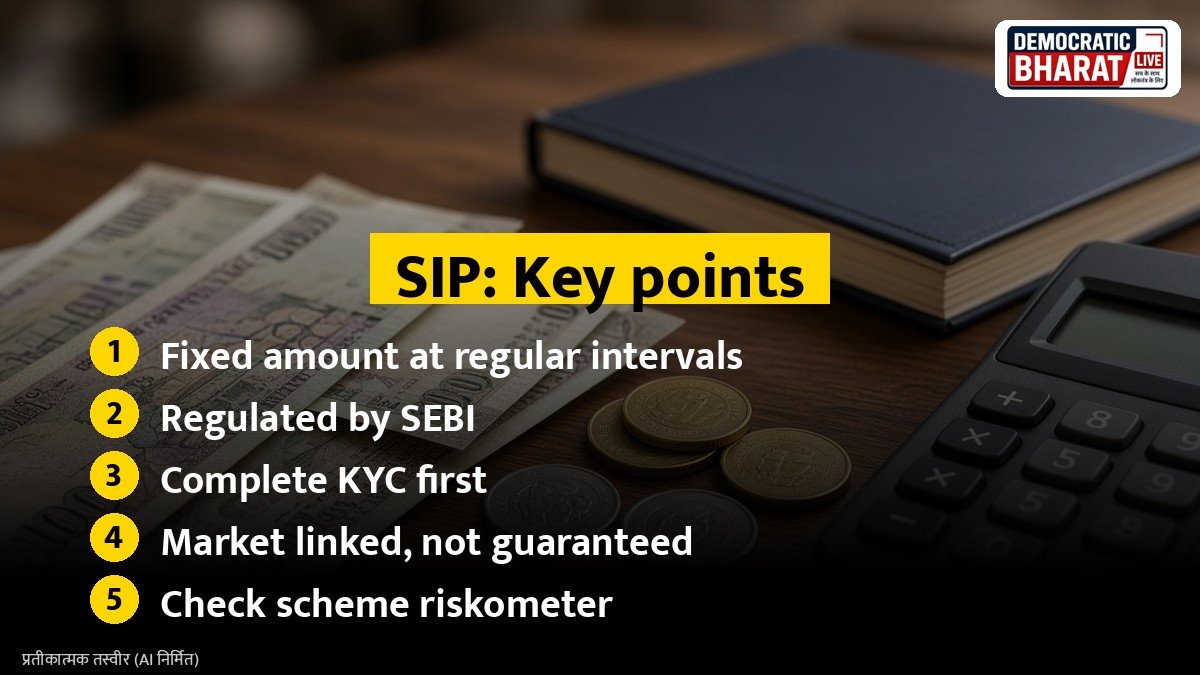
A Systematic Investment Plan (SIP) is a way of investing a fixed amount in a mutual fund at regular intervals, usually every month. Mutual funds in India are regulated by the Securities and Exchange Board of India (SEBI), and the Association of Mutual Funds in India (AMFI) is the industry body.
How SIP works
You choose a mutual fund scheme and an amount, say Rs 1,000 a month. On a fixed date, the amount is debited from your bank account and invested in the fund. You get units based on that day’s Net Asset Value (NAV).
Rupee cost averaging
When markets fall, the same amount buys more units. When markets rise, it buys fewer units. Over time, this can average out the cost of buying. It does not guarantee profits, but it reduces the risk of investing a large amount at a bad time.
Types of funds
- Equity funds: invest mainly in shares. Higher risk and potential for higher long term returns.
- Debt funds: invest in bonds and money market instruments. Lower risk than equity, but not risk free.
- Hybrid funds: mix of equity and debt.
- Index funds: track a market index at low cost.
Every scheme has a riskometer, mandated by SEBI, that shows its risk level from low to very high.
Also Read: PPF Account Rules: Deposit Limit, 15 Year Lock In, Loan, Partial Withdrawal and Extension Explained | Deposit Insurance Explained: How DICGC Covers Your Bank Savings and FDs up to Rs 5 Lakh
Risks
Mutual fund returns are market linked and not guaranteed. Past returns do not guarantee future performance. Equity funds can fall sharply in the short term. Choose funds based on your goal, time horizon and risk appetite.
How to start a SIP
- Complete KYC with your PAN, Aadhaar and bank details, through a registered intermediary or the fund house.
- Choose a scheme. Compare its objective, riskometer, expense ratio and long term performance.
- Decide between a direct plan, bought directly from the fund house with lower costs, or a regular plan through a distributor.
- Register a bank mandate for auto debit.
- Track your investments through the consolidated account statement (CAS).
Tax
Gains from mutual funds are taxed as capital gains, with different rules for equity and debt funds and for short and long term holding. Check the current rules or consult a tax adviser.
Safety tips
- Invest only through SEBI registered entities.
- Be wary of anyone promising guaranteed returns.
- Do not share OTPs or login details.
Bottom line
A SIP builds discipline and spreads your investment over time. Start with a clear goal, choose funds that match your risk level and stay invested for the long term.
Source / स्रोत: SEBI investor website, AMFI, SEBI