All India Radio (AIR), also known as Akashvani, is India’s national public radio broadcaster. For generations, it brought news, music, sports commentary and education to homes across the country. Here is its story.
Early days
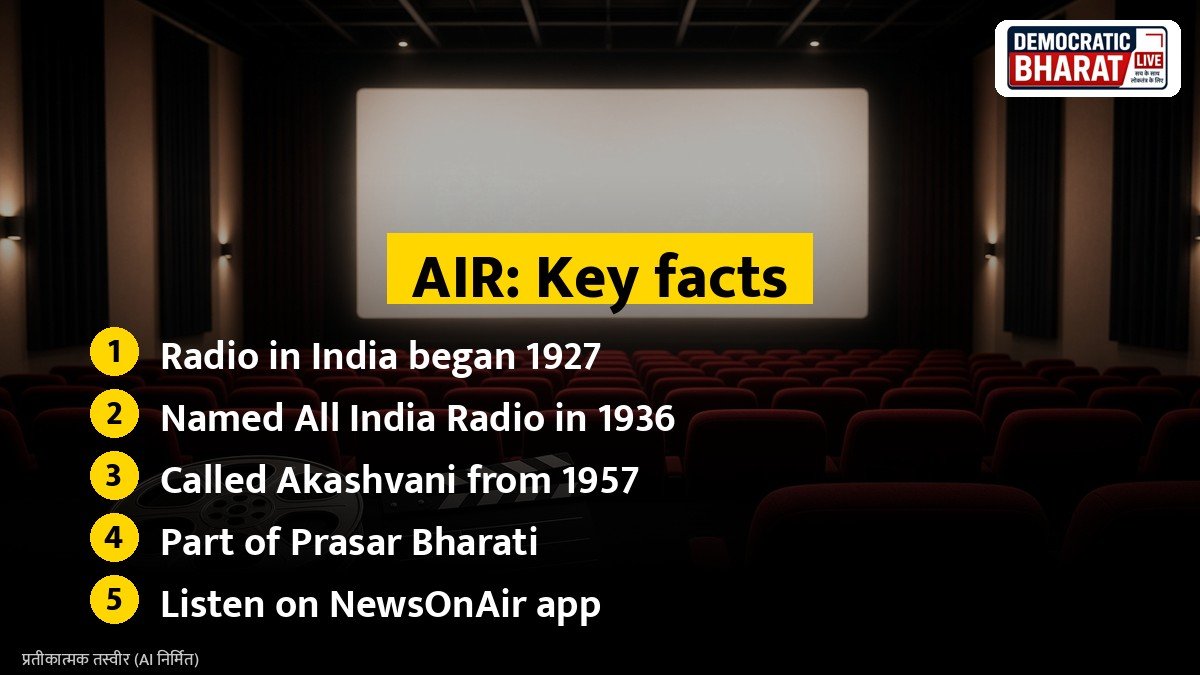
Organised radio broadcasting in India began on 23 July 1927, when the Indian Broadcasting Company started its Bombay station. This date is now marked as National Broadcasting Day. The company ran into losses, and in 1930 the government took over broadcasting as the Indian State Broadcasting Service.
Becoming All India Radio
In June 1936, the service was renamed All India Radio. At Independence in 1947, it had only a handful of stations. Over the following decades, AIR expanded to reach almost the entire population.
The name Akashvani
From 1957, All India Radio has also been known as Akashvani, meaning a voice from the sky. The name was first used for a station in Mysore in the 1930s.
Also Read: Doordarshan History: From a 1959 Experiment in Delhi to Ramayan, Colour TV and DD Free Dish | Filmfare Awards History: From 1954 to Today, the Black Lady Trophy and How Winners Are Chosen
Key milestones
- 1957: Vividh Bharati, a popular entertainment service of film music and programmes, was launched.
- 1977: FM broadcasting began in Madras.
- 1997: AIR and Doordarshan were placed under Prasar Bharati, an autonomous public broadcaster created by law.
- 2014: The Prime Minister’s monthly radio programme Mann Ki Baat began on AIR in October.
What AIR offers
- News bulletins in many Indian and foreign languages.
- Classical, folk and film music.
- Farm and home programmes for rural listeners.
- Educational and health awareness programmes.
- Live sports commentary.
- External services broadcasting to listeners abroad.
Reach
AIR runs a large network of stations across India and covers the vast majority of the country’s area and population, according to Prasar Bharati. In remote and border areas, it is often the main source of information.
Listening today
- On radio sets, on medium wave, short wave and FM.
- On the NewsOnAir mobile app, which streams many AIR stations live.
- On DTH services and online.
Cultural role
AIR has archived recordings of great musicians, leaders and writers. The weekly Sangeet Sammelan and the National Programme of Music helped bring classical music to millions.
AIR in emergencies
During floods, cyclones and other disasters, AIR stations carry official warnings and relief information, often when power and mobile networks fail. Battery powered radio sets remain a dependable source in such times.
Bottom line
From a single station in 1927 to a nationwide network today, All India Radio has shaped how India hears news and music. It remains a key public broadcaster in the digital age.
Source / स्रोत: Prasar Bharati, All India Radio, NewsOnAir, Ministry of Information and Broadcasting