

One Nation One Election (ONOE) is the proposal to hold elections to the Lok Sabha and all state assemblies at the same time, followed by local body polls within a short period. It is one of the biggest electoral reforms being debated in India. Here is a simple explainer.
History
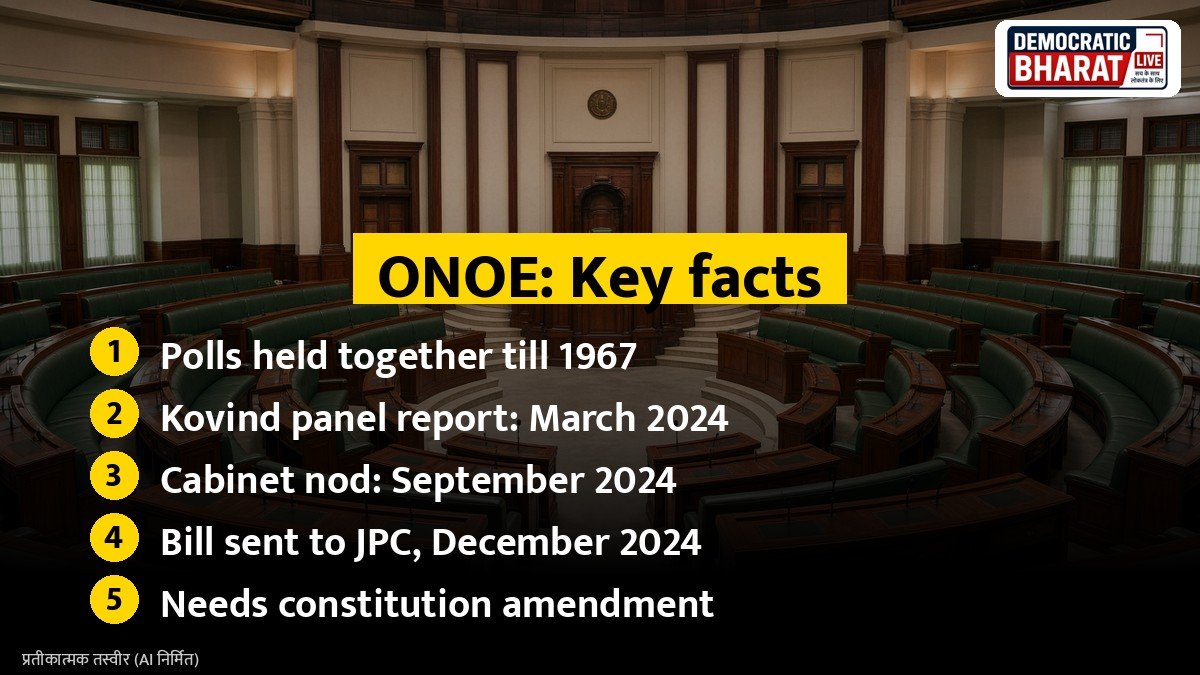
India held simultaneous elections to the Lok Sabha and state assemblies in 1951-52, 1957, 1962 and 1967. The cycle broke after some assemblies were dissolved early in the late 1960s, and the Lok Sabha itself was dissolved early in 1970. Since then, elections have been spread across the five year cycle.
The Kovind committee
In September 2023, the government set up a High Level Committee headed by former President Ram Nath Kovind. It submitted its report in March 2024. Key recommendations:
- Hold Lok Sabha and assembly elections together in the first step.
- Hold municipal and panchayat elections within 100 days of these.
- Prepare a single electoral roll and voter ID for all three levels.
- If a House is dissolved early, fresh elections will be only for the rest of the term.
The bills
The Union Cabinet accepted the recommendations in September 2024. In December 2024, the government introduced the Constitution (One Hundred and Twenty Ninth Amendment) Bill, 2024 and a related bill for union territories in the Lok Sabha. Both were referred to a Joint Parliamentary Committee for detailed study. Check Parliament’s website for the latest status, since the proposal can change after the committee’s review.
Also Read: Election Commission of India Explained: Powers, How the CEC Is Appointed and the 2023 Law | Money Bill Explained: Article 110, Speaker’s Certificate and How It Differs From a Finance Bill
Arguments in favour
- Saves money spent on frequent elections.
- Reduces the time the Model Code of Conduct stops new projects.
- Frees security forces and officials from repeated election duty.
- Lets governments focus on governance.
- May raise voter turnout.
Arguments against
- May weaken federalism, as national issues could overshadow state issues.
- Cutting short the terms of some assemblies raises constitutional questions.
- Needs a very large number of EVMs and VVPATs at once.
- Early dissolution of a government would still lead to mid term polls.
- Regional parties fear it may favour national parties.
What changes are needed
ONOE requires changes to articles dealing with the duration of Parliament and assemblies, and to election laws. The government’s bill proposes a new article to align the terms of assemblies with the Lok Sabha.
Bottom line
One Nation One Election aims to sync India’s election calendar. The idea has strong supporters and critics, and the bill is still going through parliamentary scrutiny.
Source / स्रोत: Legislative Department, Ministry of Law and Justice, Election Commission of India, Press Information Bureau


