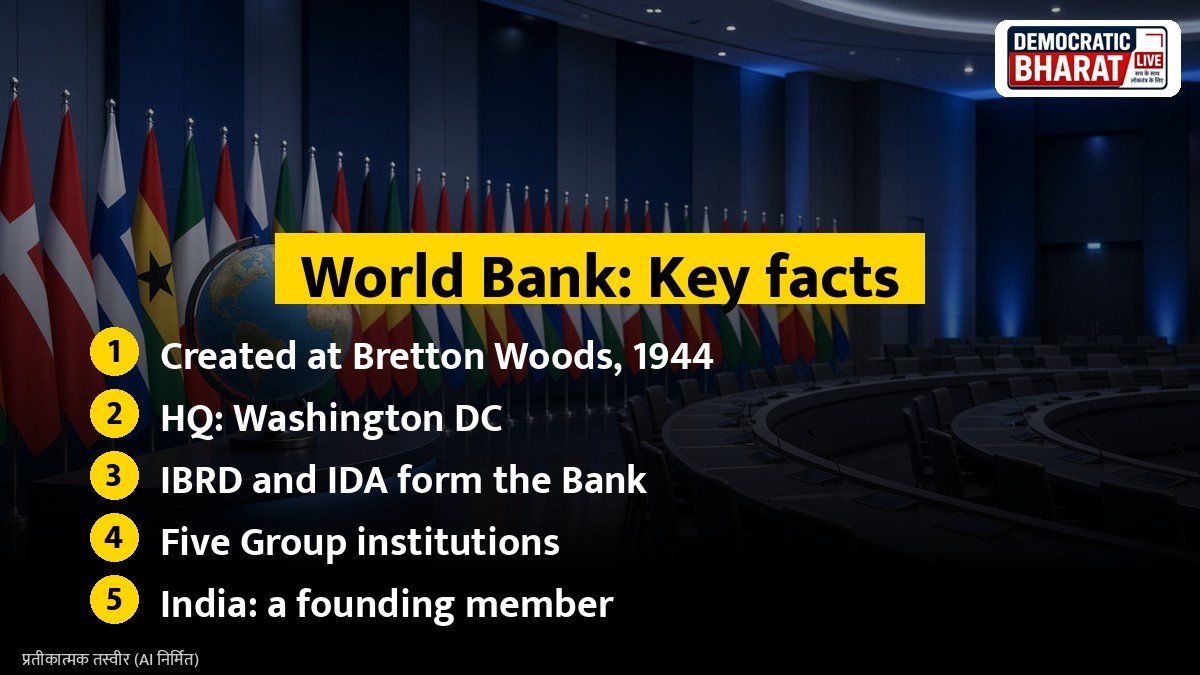
The World Bank was created at the Bretton Woods conference in 1944, alongside the International Monetary Fund (IMF). While the IMF focuses on financial stability, the World Bank focuses on long term development and reducing poverty. It is headquartered in Washington DC. India is a founding member.
The World Bank and the World Bank Group
The “World Bank” usually refers to two institutions:
- IBRD (International Bank for Reconstruction and Development): lends to middle income and creditworthy lower income countries.
- IDA (International Development Association), set up in 1960: gives low interest loans and grants to the poorest countries.
Together with three other bodies, they form the World Bank Group:
- IFC (International Finance Corporation): invests in the private sector.
- MIGA (Multilateral Investment Guarantee Agency): offers political risk insurance.
- ICSID (International Centre for Settlement of Investment Disputes): settles investment disputes.
How it lends
The World Bank raises money by issuing bonds in global markets, backed by member countries’ capital, and lends to governments for projects in areas such as health, education, roads, water, energy and agriculture. Loans come with technical advice and conditions on how the project is run. It also publishes research and data, such as reports on poverty and the global economy.
Leadership and voting
The President of the World Bank Group is traditionally an American. Ajay Banga, an Indian born American business leader, became president in June 2023. Voting power is based on shareholding, with the United States as the largest shareholder. Developing countries have pushed for more voice.
Also Read: What Is BRICS? Members, New Development Bank and India’s Role as Chair in 2026 | What Is the WTO? How the World Trade Organization Works and the Issues India Raises
India and the World Bank
India has been one of the largest borrowers from the World Bank over the decades. India moved from IDA to IBRD lending as its economy grew. World Bank supported projects in India have covered areas such as rural roads, school education, health systems, clean water, disaster resilience and urban development, in partnership with central and state governments. The Department of Economic Affairs handles India’s relationship with the Bank.
Criticism
Critics have argued that some past projects caused displacement or environmental harm and that conditions can limit countries’ choices. The Bank has since adopted environmental and social frameworks.
Bottom line
The World Bank lends for development through the IBRD and IDA. For India, it has been a long term partner in building infrastructure and social services.
Source / स्रोत: World Bank, World Bank in India, Department of Economic Affairs