BRICS is a grouping of major emerging economies. The name comes from the first letters of its original members: Brazil, Russia, India, China and South Africa. The group works on economic cooperation, development finance and reform of global institutions.
How BRICS began
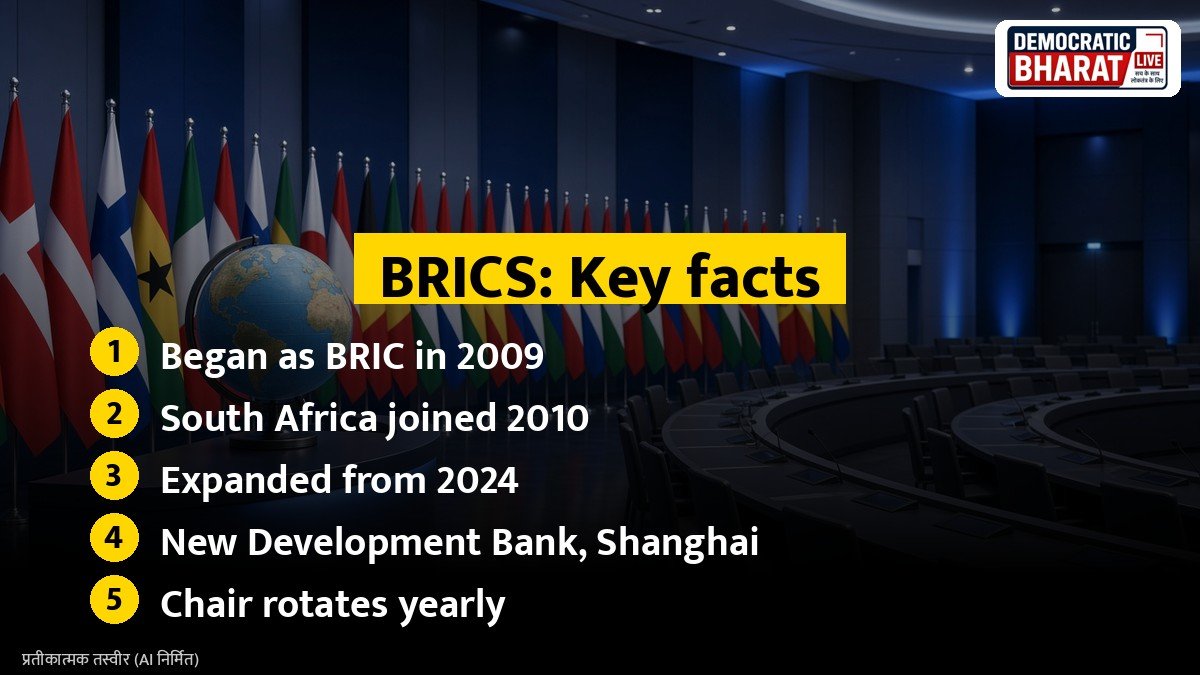
The term BRIC was coined in 2001 by a Goldman Sachs economist to describe fast growing economies. The leaders of Brazil, Russia, India and China held their first summit in Yekaterinburg, Russia, in 2009. South Africa joined in 2010, making it BRICS.
Expansion
At the Johannesburg summit in 2023, BRICS invited new members. From January 2024, Egypt, Ethiopia, Iran and the United Arab Emirates joined as full members. Indonesia joined in January 2025. Saudi Arabia was invited, but its status has not been formally confirmed. BRICS has also created a category of partner countries. Check the Ministry of External Affairs or the official BRICS chair website for the current membership list.
What BRICS does
- Holds an annual leaders’ summit and many ministerial meetings.
- Promotes trade, investment and cooperation in areas such as health, energy, agriculture and technology.
- Pushes for reform of the IMF, World Bank and UN Security Council to give developing countries more voice.
- Supports greater use of local currencies in trade among members.
Also Read: What Is the G20? Members, How the Presidency Rotates and What India Achieved in 2023 | UN Security Council Explained: Permanent Members, Veto Power and India’s Push for a Permanent Seat
New Development Bank
BRICS set up the New Development Bank (NDB), headquartered in Shanghai, in 2015. It funds infrastructure and sustainable development projects in member and other developing countries. India’s first president of the NDB was K V Kamath. BRICS also created a Contingent Reserve Arrangement to help members facing balance of payments pressure.
India’s role
India has hosted BRICS summits in 2012, 2016 and 2021. India holds the BRICS chair in 2026 and is due to host the leaders’ summit. The exact dates and venue should be treated as tentative until officially announced by the Ministry of External Affairs. India has stressed themes such as resilience, innovation, cooperation and sustainability, along with the concerns of the Global South.
Criticism and challenges
Members have very different political systems and interests. Tensions, such as between India and China, sometimes limit common positions. Expansion has also raised questions about how decisions will be reached with more members.
Bottom line
BRICS is a key platform for emerging economies. As chair in 2026, India has a chance to shape the group’s agenda on development, trade and global governance.
Source / स्रोत: Ministry of External Affairs, New Development Bank