The Commonwealth of Nations is a voluntary association of 56 independent countries. Most were once part of the British Empire, but membership is now open to others too. Here is a simple guide.
History
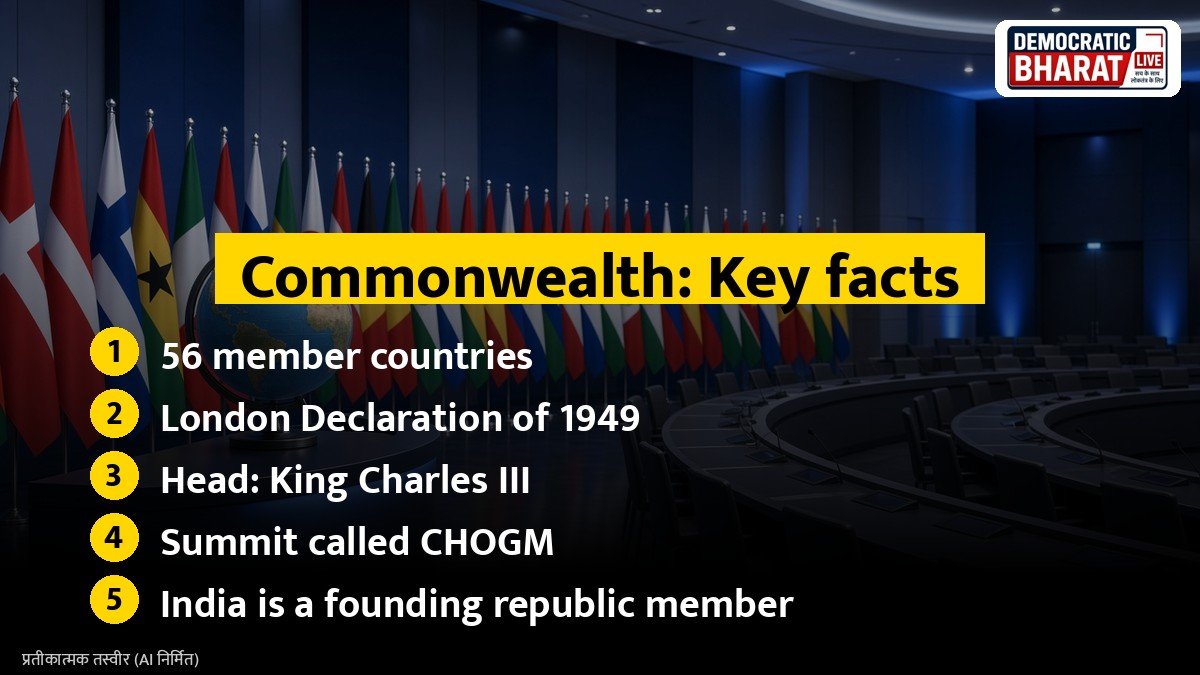
The modern Commonwealth took shape after the Second World War as former colonies gained independence. The London Declaration of 1949 was a turning point. It allowed India to remain a member after becoming a republic, by accepting the British monarch as the symbol of the free association of members and Head of the Commonwealth. This opened the door for other republics to join.
Members
- The Commonwealth has 56 members across Africa, Asia, the Americas, Europe and the Pacific.
- They range from large countries like India, Canada and Australia to small island states.
- Some members, like Mozambique and Rwanda, were never British colonies.
- Gabon and Togo joined in 2022.
Leadership
- King Charles III is the Head of the Commonwealth. The role is symbolic.
- The Commonwealth Secretariat in London is led by a Secretary General, chosen by member governments.
Also Read: What Is BRICS? Members, New Development Bank and India’s Role as Chair in 2026 | What Is ASEAN? Members, How It Works and Why It Matters for India’s Act East Policy
CHOGM
Leaders meet every two years at the Commonwealth Heads of Government Meeting (CHOGM). The 2024 CHOGM was held in Samoa, the first in a Pacific island nation.
Values
The Commonwealth Charter of 2013 sets out shared values, including democracy, human rights, rule of law, sustainable development and gender equality. Members that seriously violate these values can be suspended.
Commonwealth Games
The Commonwealth Games, held every four years, are one of the world’s largest multi sport events. India hosted the 2010 Games in Delhi. In 2025, Ahmedabad was chosen to host the 2030 Commonwealth Games, which will mark the centenary of the event.
India’s role
- India is the largest member by population.
- India contributes to Commonwealth programmes on development, technical cooperation and small states.
- Indian leaders have used the forum to push for issues like climate finance and support for developing countries.
Criticism and relevance
Critics say the Commonwealth has limited power and can seem a relic of empire. Supporters say it offers a useful network for small states, shared legal traditions and cooperation in education, trade and sport.
Scholarships and youth programmes
The Commonwealth runs scholarship and fellowship programmes that let students from member countries study abroad, along with youth networks and awards. Many Indian students have studied in the United Kingdom and other countries through Commonwealth scholarships.
Bottom line
The Commonwealth brings together 56 nations with shared history and values. India’s decision to stay on as a republic in 1949 helped shape the modern association.
Source / स्रोत: The Commonwealth, Ministry of External Affairs, Commonwealth Sport