The temples of Khajuraho in Madhya Pradesh are among the finest examples of Indian temple architecture and sculpture. They are a UNESCO World Heritage Site and draw pilgrims, art lovers and tourists from around the world. Here is a guide.
Location
Khajuraho is in Chhatarpur district of Madhya Pradesh, in the Bundelkhand region.
History
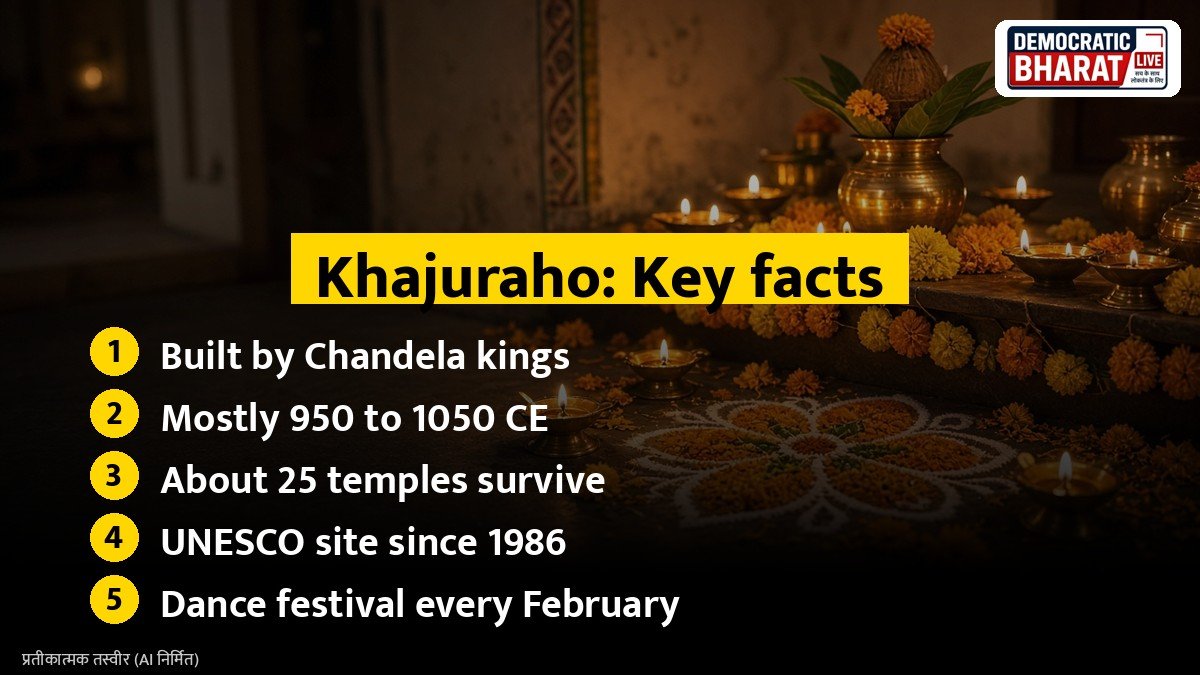
The temples were built by the Chandela dynasty, mostly between about 950 and 1050 CE. Historical accounts suggest there were once around 85 temples. About 25 survive today, spread over an area of roughly 6 square km. The temples were later hidden by forest and came to wider notice in the nineteenth century.
UNESCO status
The Khajuraho Group of Monuments was inscribed on the UNESCO World Heritage List in 1986 for its unique architecture and sculpture. The temples are protected by the Archaeological Survey of India.
Also Read: Konark Sun Temple: History, the Stone Chariot, UNESCO Status and Visitor Guide | Kamakhya Temple Guwahati: History, Ambubachi Mela, Darshan and Visitor Guide
Temple groups
**Western Group:** The largest and best known group, inside a fenced complex. Key temples include:
- **Kandariya Mahadeva Temple:** dedicated to Lord Shiva, the largest and most richly carved temple at Khajuraho.
- **Lakshmana Temple:** dedicated to Vishnu in his Vaikuntha form.
- **Chitragupta Temple:** dedicated to the Sun god.
- **Matangeshwar Temple:** still a living temple where daily worship takes place.
**Eastern Group:** Includes Jain temples such as the Parshvanath, Adinath and Shantinath temples.
**Southern Group:** Includes the Duladeo and Chaturbhuj temples.
Architecture
The temples follow the Nagara style of north India. They stand on high platforms, and their spires rise like mountain peaks, symbolising Mount Meru. The walls are covered with carvings of gods, goddesses, celestial dancers, musicians, warriors, animals and scenes of daily life. Only a small share of the carvings are erotic, though these are the best known.
Khajuraho Dance Festival
Every February, the Khajuraho Dance Festival brings leading classical dancers to perform against the backdrop of the temples. It is organised by the Madhya Pradesh government.
Visiting tips
- The Western Group is open from sunrise to sunset. Check ASI for current ticket rates.
- A light and sound show is held in the evening.
- October to March is the most pleasant time to visit.
- Hire an approved guide to understand the sculptures.
- Dress modestly at the Matangeshwar Temple, where worship continues.
How to reach
- **Air:** Khajuraho has its own airport.
- **Rail:** Khajuraho railway station has trains to Delhi and other cities.
- **Road:** Panna National Park is nearby and can be combined with a visit.
Bottom line
Khajuraho’s temples are a high point of Indian art. Plan a full day to see the Western, Eastern and Southern groups.
Source / स्रोत: Archaeological Survey of India, UNESCO World Heritage Centre, Khajuraho Group of Monuments, Madhya Pradesh Tourism