Polo is a fast team sport played on horseback, in which riders use long mallets to hit a small ball into the opponent’s goal. India has a special link with the sport, as modern polo grew from the traditional game played in Manipur. Here is a simple guide.
Teams and field
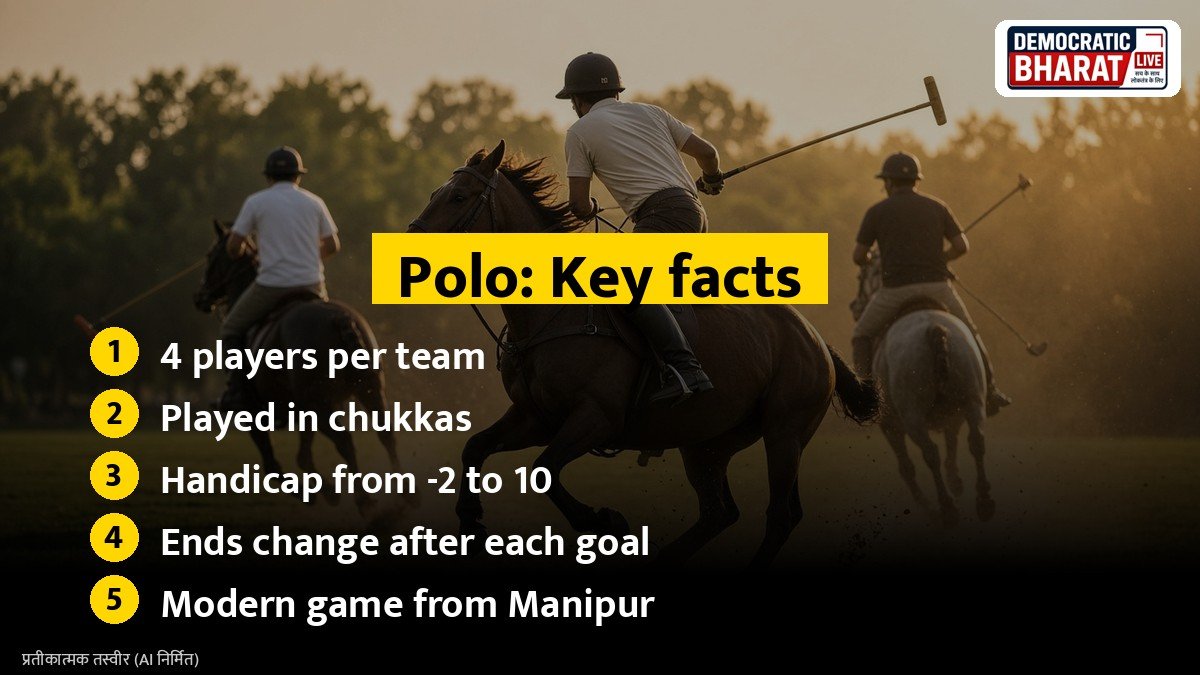
Each team has four players on horseback. A full size polo field is about 300 yards long and 160 yards wide, making it one of the largest fields in sport. Goalposts stand at each end, eight yards apart.
Players and positions
- **Number 1:** main attacker who scores goals
- **Number 2:** works with the attacker and pressures the defence
- **Number 3:** playmaker, usually the strongest player
- **Number 4 or back:** main defender
Chukkas
A polo match is divided into periods called chukkas, each of about seven minutes of play. Matches usually have four to six chukkas, depending on the level. Players change horses, called polo ponies, between chukkas because the game is very tiring for the animals.
Also Read: Olympic Shooting Events Explained: Rifle, Pistol and Shotgun Formats and India’s Medal History | Archery Rules Explained: Recurve vs Compound, the Set System, Target Scoring and India’s Archers
Scoring
A goal is scored when the ball crosses between the goalposts, at any height. Teams change ends after every goal, to balance wind and ground conditions.
The line of the ball
The most important safety rule is the line of the ball, the imaginary path the ball travels. The player following this line has the right of way. Others must not cross in front of that player in a dangerous way. Most fouls relate to crossing this line, and the penalty is a free hit from a set distance.
Handicaps
Each player has a goal handicap from minus 2 to 10, based on skill, with 10 being the best. A team’s handicap is the total of its players’ handicaps. In handicap tournaments, the weaker team is given a head start in goals.
Polo in India
The game called Sagol Kangjei was played in Manipur for centuries. British officers learned it there in the nineteenth century and spread it worldwide. The Calcutta Polo Club, set up in 1862, is often described as the oldest polo club in the world still active.
The Indian Army’s 61st Cavalry, one of the few horse mounted cavalry regiments left in the world, is famous for its polo players. The Indian Polo Association governs the sport in the country, and major tournaments are held in Jaipur, Delhi and Kolkata.
Bottom line
Polo combines riding skill, teamwork and strategy. Its rules focus on safety for riders and horses, and India remains one of the historic homes of the game.
Source / स्रोत: Indian Polo Association, Federation of International Polo