India is one of the world’s largest producers of onion. Maharashtra, Madhya Pradesh, Karnataka, Gujarat and Rajasthan are major producers. Prices can swing sharply through the year, so good storage helps farmers avoid distress sales. The ICAR Directorate of Onion and Garlic Research (DOGR), Pune, guides farmers on storage.
Which onions store well
The rabi crop, harvested in spring, stores better than the kharif crop and forms the bulk of stored onions. Storage life depends on the variety, so choose varieties known for good keeping quality.
Before harvest
- Stop irrigation about two to three weeks before harvest, as advised for your area.
- Harvest when most tops have fallen over naturally.
- Avoid excess nitrogen late in the season, which reduces storage life.
Curing
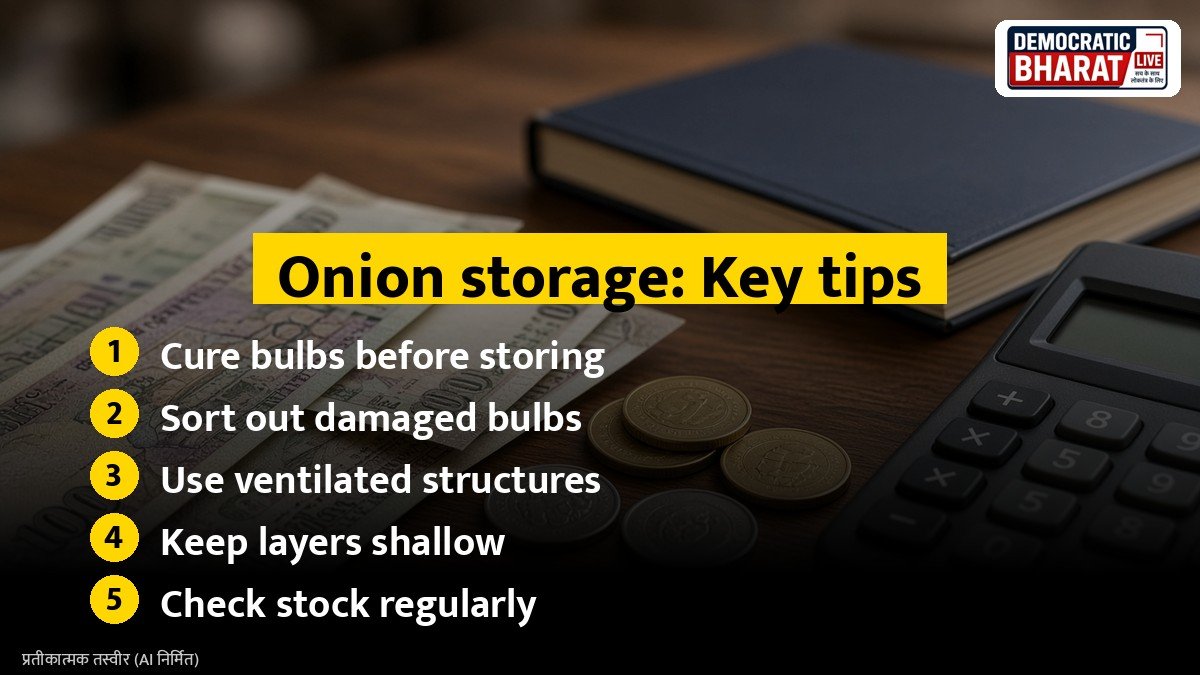
Curing is the most important step. After harvest, onions are dried in the field or in shade with the tops on, and later the tops are cut leaving a short neck. Curing dries the neck and outer skin, which protects bulbs from rot and moisture loss. Follow the method recommended by DOGR or your KVK.
Also Read: Wheat Sowing Guide for Rabi Season: Best Time, Seed Rate, Varieties and Tips From ICAR | eNAM Registration for Farmers: How to Sell Crops Online on the National Agriculture Market
Sorting and grading
Remove bulbs that are damaged, diseased, sprouted, doubled or thick necked before storage. A few rotting bulbs can spoil a whole heap.
Storage structures
- Ventilated structures with good airflow from the bottom and sides are recommended.
- Keep onions in shallow layers rather than deep heaps.
- Protect from rain and direct sun.
- Structures should be raised above the ground.
The National Horticulture Board and state horticulture missions have supported onion storage structures under their schemes. Check with your district horticulture office for current assistance.
During storage
- Check the stock regularly and remove rotting or sprouting bulbs.
- High humidity and poor ventilation increase rot.
- Losses from weight loss, rotting and sprouting are common, and good practices can reduce them.
Selling decisions
Track prices on Agmarknet and eNAM before deciding when to sell. The government also builds a buffer stock of onions through agencies such as NAFED and NCCF to stabilise prices.
Advice for farmers
Before sowing, selling or storing your crop, check the latest information with your district agriculture department, Krishi Vigyan Kendra or mandi committee.
Bottom line
Proper curing, careful sorting and a well ventilated structure are the keys to onion storage. They cut losses and give farmers more control over when to sell.
Source / स्रोत: ICAR Directorate of Onion and Garlic Research, National Horticulture Board, Agmarknet