The World Health Organization (WHO) is the United Nations agency responsible for international public health. It sets health standards, guides countries and coordinates responses to disease outbreaks. Here is an explainer.
History
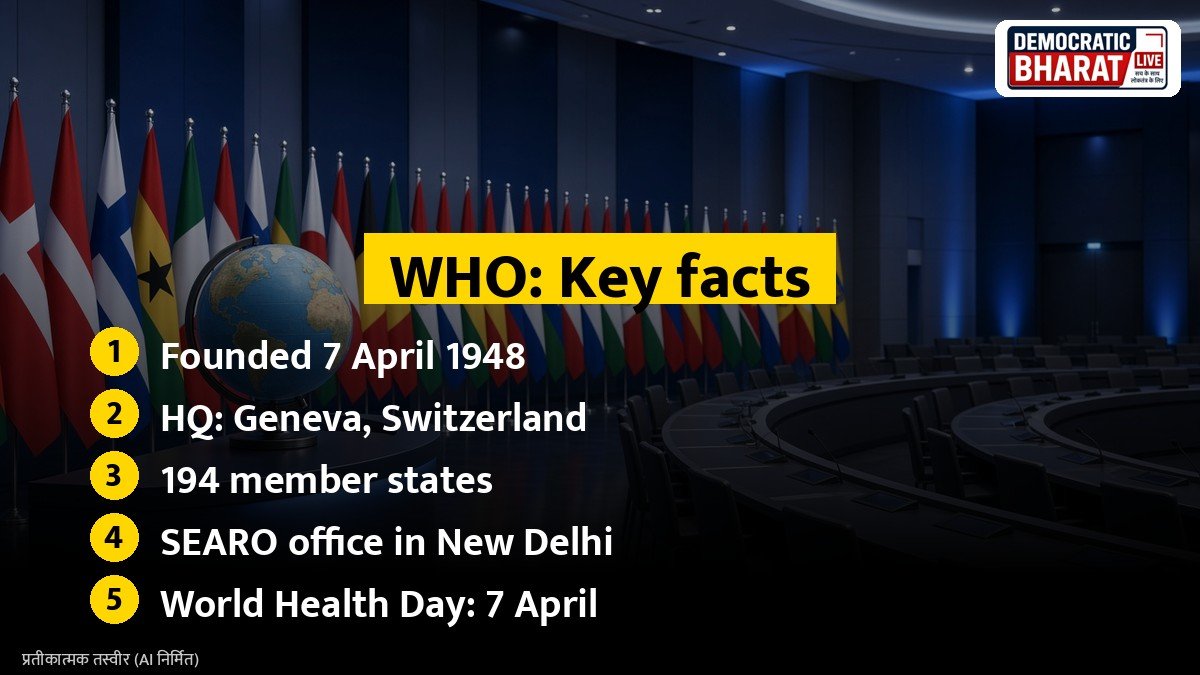
WHO’s constitution came into force on 7 April 1948. That date is now marked every year as World Health Day. Its headquarters are in Geneva, Switzerland.
Structure
- **World Health Assembly:** WHO’s decision making body, made up of all 194 member states. It meets every year in Geneva, usually in May, to set policy and approve the budget.
- **Executive Board:** 34 health experts elected by member states, which carry out the Assembly’s decisions.
- **Secretariat:** Led by the Director General. Dr Tedros Adhanom Ghebreyesus of Ethiopia has been Director General since 2017.
- **Regional offices:** Six regions, each with its own office. India is in the South-East Asia Region, whose regional office is in New Delhi.
What WHO does
- Sets global guidelines on diseases, medicines, nutrition and health systems.
- Declares public health emergencies of international concern under the International Health Regulations.
- Prequalifies vaccines and medicines for use by UN agencies.
- Publishes the International Classification of Diseases and the Essential Medicines List.
- Supports countries with technical help and data.
Also Read: What Is the International Labour Organization? Tripartite Structure, Standards and India’s Role | What Is the WTO? How the World Trade Organization Works and the Issues India Raises
Major achievements
- Smallpox was declared eradicated worldwide in 1980 after a WHO led campaign.
- The South-East Asia Region, including India, was certified polio free in 2014.
- The Framework Convention on Tobacco Control, adopted in 2003, was the first global health treaty under WHO.
- In May 2025, the World Health Assembly adopted a Pandemic Agreement to improve preparedness for future pandemics.
Funding
WHO is funded by assessed contributions, which are like membership fees, and voluntary contributions from countries, foundations and other donors. Voluntary funds make up the larger share. In January 2025, the United States announced its withdrawal from WHO, which affects funding.
WHO and India
- India works closely with WHO on tuberculosis, immunisation, non communicable diseases and health emergencies.
- The WHO Global Centre for Traditional Medicine is being set up in Jamnagar, Gujarat, with Indian support.
- WHO publishes regular data on India’s health indicators.
Bottom line
WHO is the world’s main health body. Its guidelines and coordination affect how India and other countries fight disease and protect public health.
Source / स्रोत: World Health Organization, WHO South-East Asia Regional Office, Ministry of Health and Family Welfare