The International Criminal Court (ICC) is a permanent court that can try individuals for the most serious crimes of international concern. It is often in the news when it issues arrest warrants for leaders. Here is a simple explainer.
History
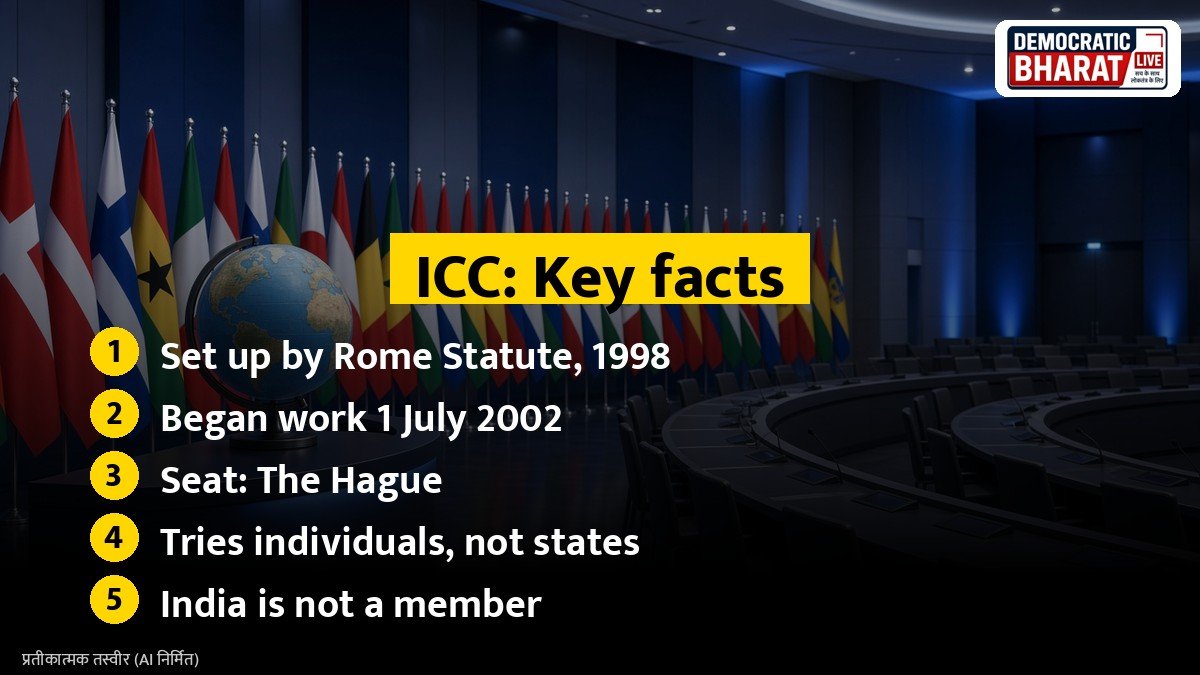
The ICC was created by the Rome Statute, a treaty adopted in Rome in 1998. It came into force on 1 July 2002, when the court began work. The court sits in The Hague, the Netherlands.
Crimes it can try
- **Genocide:** acts meant to destroy a national, ethnic, racial or religious group.
- **Crimes against humanity:** widespread or systematic attacks on civilians, such as murder, enslavement or torture.
- **War crimes:** serious violations of the laws of war.
- **Crime of aggression:** planning or leading an act of aggression by a state, under conditions added later.
Who it can try
The ICC tries individuals, not countries. It can act when:
- The crime was committed on the territory of a member state, or by a national of a member state.
- The UN Security Council refers a situation to the court.
- A non member state accepts the court’s jurisdiction for a situation.
Also Read: What Is the International Court of Justice? Judges, Cases, Advisory Opinions and India | What Is the IMF? How the International Monetary Fund Works, Quotas, Loans and India’s 1991 Crisis
A court of last resort
The ICC follows the principle of complementarity. It acts only when national courts are unwilling or unable to genuinely investigate or prosecute.
Structure
- 18 judges elected by member states for nine year terms.
- An independent Office of the Prosecutor.
- A Registry that handles administration.
- The Assembly of States Parties oversees the court.
Members
Around 125 countries are states parties to the Rome Statute. Several major countries, including India, the United States, China and Russia, are not members.
Why India is not a member
India did not sign the Rome Statute. Among the concerns it raised were the powers given to the UN Security Council to refer and defer cases, the powers of the prosecutor to start cases on his own, and the exclusion of the use of nuclear weapons and terrorism from the list of crimes.
ICC and ICJ
The ICC is often confused with the International Court of Justice (ICJ). The ICJ is the main court of the United Nations and settles disputes between states. The ICC is a separate treaty based court that tries individuals.
Limits
The ICC has no police force and depends on member states to arrest suspects. Trials cannot take place in absentia.
Bottom line
The ICC is the world’s permanent court for the gravest crimes. It holds individuals, including leaders, to account, but depends on state cooperation to work.
Source / स्रोत: International Criminal Court, United Nations Treaty Collection, Rome Statute, Ministry of External Affairs