Safe drinking water is essential for good health. Many Indian homes use water purifiers, but choosing the wrong type can waste money and water. Here is a simple guide.
Start with a water test
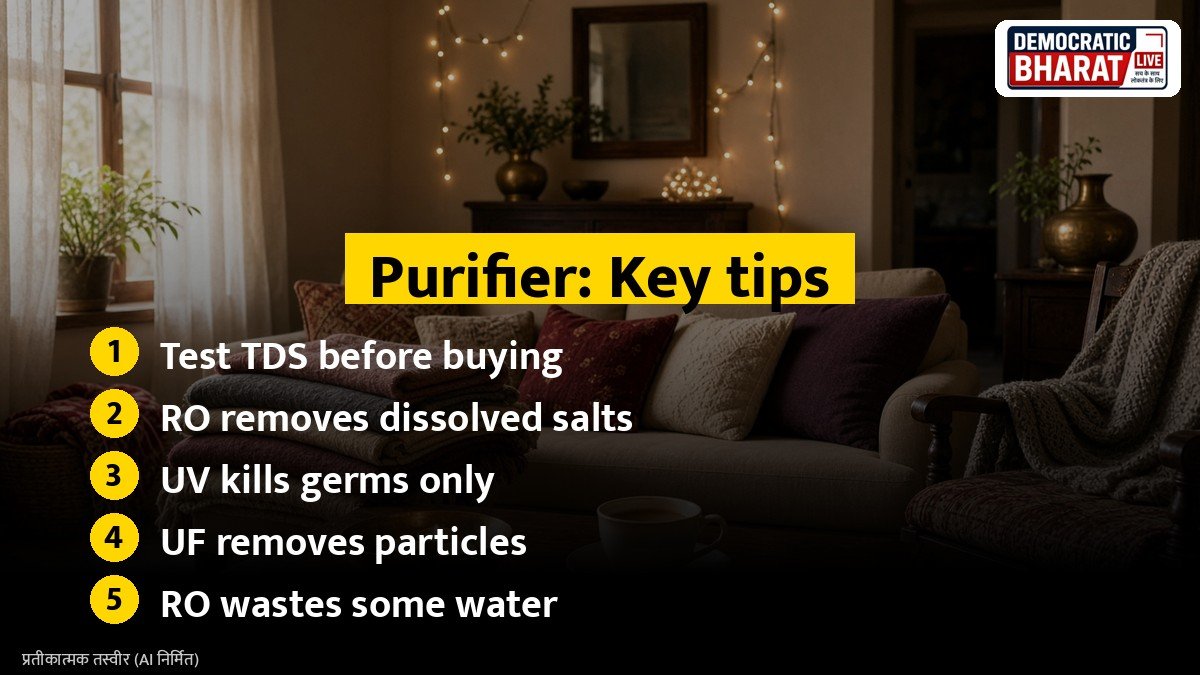
Before buying, find out what is in your water:
- TDS (total dissolved solids): the amount of dissolved salts and minerals.
- Microbial contamination: bacteria and viruses.
- Other contaminants like arsenic, fluoride or iron in some regions.
You can use a TDS meter for a basic check. For a full test, use a NABL accredited lab or the water testing labs set up under the Jal Jeevan Mission.
What the standard says
The Bureau of Indian Standards drinking water standard, IS 10500, sets an acceptable TDS limit of 500 mg per litre, with a permissible limit of up to 2,000 mg per litre where no other source is available.
Types of purifiers
RO (reverse osmosis)
- Removes dissolved salts, heavy metals and many contaminants.
- Suitable for water with high TDS, such as some groundwater sources.
- Wastes a part of the water during purification.
- Can remove useful minerals, so many models add a mineraliser.
UV (ultraviolet)
- Kills bacteria and viruses.
- Does not remove dissolved salts or chemicals.
- Suitable for low TDS water, such as many municipal supplies, where germs are the main concern.
UF (ultrafiltration)
- Removes suspended particles, cysts and some bacteria.
- Works without electricity in many models.
- Does not remove dissolved salts.
Many purifiers combine RO, UV and UF stages.
Also Read: Air Purifier Buying Guide: What CADR, HEPA and Room Size Mean Before You Buy One This Winter | How to Create a Strong Password and Keep Your Accounts Safe: Simple Cyber Safety Tips
Concerns about RO water waste
In 2019, the National Green Tribunal directed the government to restrict RO purifiers where TDS is below 500 mg per litre and to require better water recovery. If you use RO, choose a model with high water recovery and reuse the reject water for mopping or plants.
Buying tips
- Choose based on your water test, not on advertising.
- Check BIS certification where applicable.
- Compare filter replacement costs and service network.
- Check purification capacity and storage tank size.
- Ask about water recovery rate for RO models.
Maintenance
- Replace filters and membranes as advised by the maker.
- Clean the storage tank regularly.
- Get regular servicing from authorised technicians.
Boiling and other methods
Boiling water for a few minutes kills germs and is a reliable low cost option, though it does not remove dissolved salts or chemicals.
Bottom line
Test your water first. RO suits high TDS water, while UV or UF is often enough for low TDS municipal supply. Choose wisely to protect both health and water.
Source / स्रोत: Bureau of Indian Standards, Jal Jeevan Mission, Ministry of Jal Shakti, Central Pollution Control Board