As winter sets in, air quality worsens in many Indian cities, especially across the Indo Gangetic plains. Many families consider buying an air purifier for their homes. Here is a simple air purifier buying guide to help you choose wisely.
Do you need one
An air purifier can reduce fine particles such as PM2.5 indoors, especially in a closed room. It does not clean the air outside and works best with doors and windows closed. It is not a replacement for other measures, such as following pollution advisories.
Filter type: true HEPA
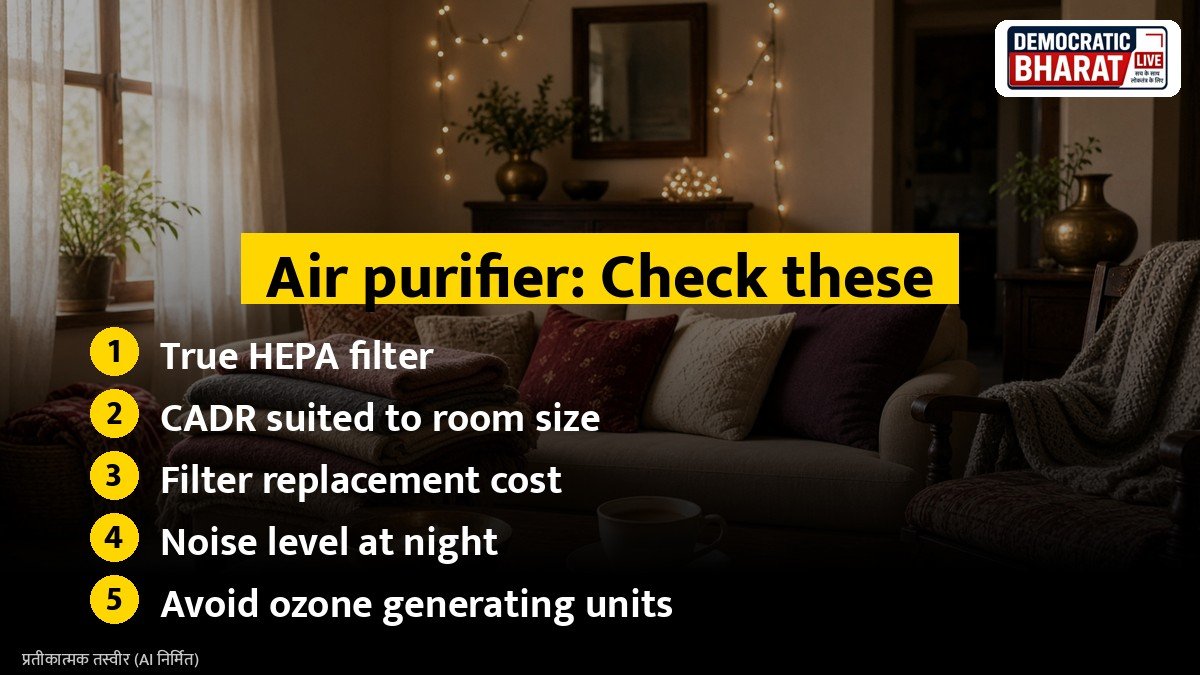
Look for a true HEPA (High Efficiency Particulate Air) filter. A true HEPA filter is designed to capture at least 99.97 percent of particles of 0.3 microns. Terms like “HEPA type” or “HEPA like” may not meet the same standard.
Many purifiers also have a pre filter to catch large dust and an activated carbon filter for odours and some gases.
CADR and room size
CADR, or Clean Air Delivery Rate, tells you how much clean air the purifier delivers per hour, usually in cubic metres per hour or cubic feet per minute. A higher CADR cleans a room faster.
A common rule of thumb used by the US Environmental Protection Agency is to choose a purifier whose CADR, in cubic feet per minute, is at least two thirds of the room’s area in square feet. For example, a 150 square foot room would need a CADR of about 100. Check whether the brand’s recommended room size matches your room.
Also Read: AQI Categories Explained: What Good, Poor, Very Poor and Severe Air Quality Mean for You | Anaemia in India: Signs, Iron Rich Foods and What ICMR-NIN Guidelines Advise
Running cost
- Filters need to be replaced regularly, often every 6 to 12 months, depending on use and pollution levels. Check the price and availability of replacement filters before buying.
- Check power consumption if you plan to run it for long hours.
Noise
Purifiers are noisy at high speed. If you plan to use one in a bedroom, check the noise level at low and sleep modes.
Features worth having
- A PM2.5 sensor and display
- Filter change indicator
- Auto mode that adjusts speed based on air quality
What to avoid
Avoid devices that produce ozone, such as some ionisers and “ozone generators”, since ozone can irritate the lungs. Be careful about claims like “kills 100 percent viruses” without independent test reports.
Placement tips
Place the purifier where air can flow freely, away from walls and furniture. Keep the room closed while it runs.
Bottom line
Choose a true HEPA purifier with a CADR suited to your room, check filter costs and noise, and avoid ozone generating units. Use it alongside checking the CPCB AQI and following health advisories.
Source / स्रोत: Central Pollution Control Board, Bureau of Indian Standards, US EPA: Guide to Air Cleaners in the Home