Organic farming avoids synthetic fertilisers and pesticides and relies on natural inputs and practices. To sell produce as organic, farmers need certification. India has two main systems: the Participatory Guarantee System (PGS India) and the National Programme for Organic Production (NPOP).
PGS India
PGS India is run by the National Centre for Organic and Natural Farming under the Ministry of Agriculture. It is a group based system:
- Farmers form local groups, usually of five or more farmers in a village or nearby villages.
- Members inspect each other’s farms and follow organic standards.
- Records are uploaded to the PGS India portal.
- It is low cost and meant mainly for the domestic market.
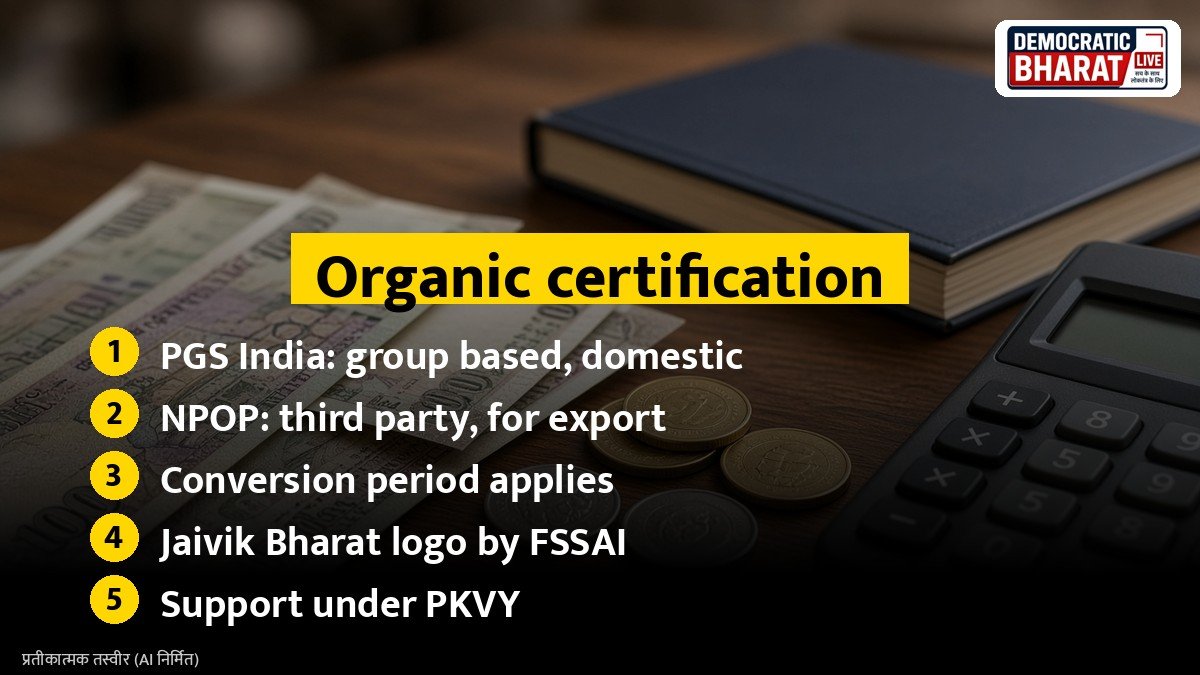
The Paramparagat Krishi Vikas Yojana (PKVY) supports clusters of farmers in adopting organic farming and PGS certification, with financial help for inputs, training and marketing.
NPOP
NPOP is run by APEDA under the Ministry of Commerce. It uses third party certification by accredited certification bodies:
- Inspections are done by the certifying agency.
- It is recognised for exports to many markets.
- It costs more, though grower group certification can reduce costs for small farmers.
Conversion period
A farm cannot be certified organic immediately. It must go through a conversion period, during which organic practices are followed but produce cannot be fully labelled organic. The period differs by crop type and standard, often two to three years for annual crops.
Also Read: Soil Health Card Scheme: How Farmers Can Get Soil Tested and Use the Report to Cut Fertiliser Costs | How MSP Is Fixed in India: Role of CACP, the 1.5 Times Cost Formula and Rabi Crops Covered
Jaivik Bharat logo
FSSAI regulates organic food sold in India under its Organic Food Regulations. Certified organic food can carry the Jaivik Bharat logo. Small producers selling directly to consumers have some exemptions, as per the rules.
Steps to start
- Contact your district agriculture office or KVK about PGS groups or PKVY clusters.
- Get training on organic practices and record keeping.
- Join or form a group and register on the PGS India portal.
- For export, contact an NPOP accredited certification body.
Selling organic produce
Organic produce can be sold through farmer producer organisations, organic markets, e commerce platforms and the Jaivik Kheti portal.
Advice for farmers
Before sowing, selling or storing your crop, check the latest information with your district agriculture department, Krishi Vigyan Kendra or mandi committee.
Bottom line
PGS India is the affordable route for local markets, while NPOP is needed for exports. Both need a conversion period and good records.
Source / स्रोत: PGS India, Department of Agriculture, APEDA: National Programme for Organic Production, FSSAI: Jaivik Bharat