Power cuts are still common in many parts of India, which makes a home inverter a useful buy. But choosing the wrong size can waste money or leave you without power. Here is a simple guide.
Step 1: Calculate your load
List what you want to run during a power cut and add their wattage. For example:
- 4 LED bulbs of 10 W each: 40 W
- 3 ceiling fans of 75 W each: 225 W
- 1 television of 100 W
- 1 WiFi router of 15 W
Total: about 380 W.
Step 2: Choose the VA rating
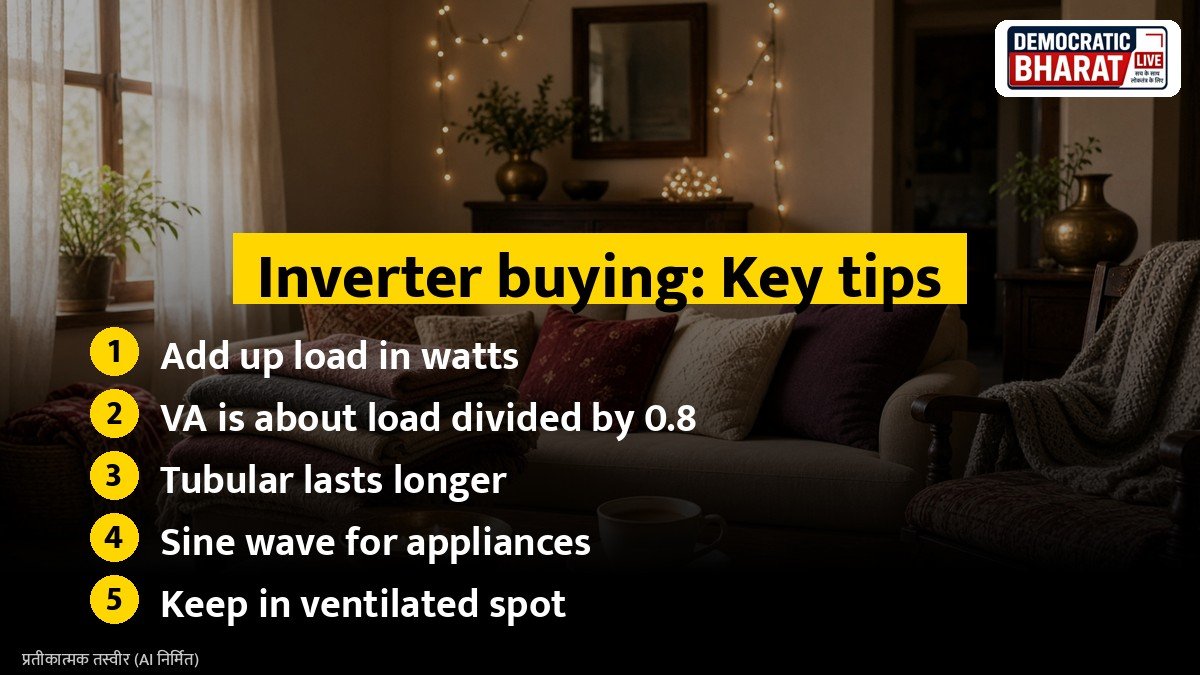
Inverters are rated in volt amperes (VA). A simple rule is to divide your load by a power factor of about 0.8. For 380 W, you need about 475 VA, so a 600 VA to 700 VA inverter gives some margin.
Step 3: Choose the battery
Battery capacity is measured in ampere hours (Ah). A rough backup estimate is:
Backup hours = (Battery Ah x Battery voltage) divided by load in watts, then reduced by about 20 to 30 percent for losses.
A 150 Ah, 12 V battery holds about 1,800 Wh. At 380 W, this gives roughly 3 to 3.5 hours after losses.
Also Read: Diwali Safety Tips: How to Use Festive Lights, Extension Boards and Diyas Without Fire Risk | How to Create a Strong Password and Keep Your Accounts Safe: Simple Cyber Safety Tips
Battery types
- **Tubular lead acid:** most popular for homes. Lasts longer and handles frequent cuts well.
- **Flat plate:** cheaper but shorter life.
- **Lithium ion:** compact, low maintenance and longer life, but costlier.
Pure sine wave or square wave
Choose a pure sine wave inverter. It is safer for computers, fans, motors and other modern appliances and runs them more quietly.
Smart buying tips
- Check warranty terms. Many tubular batteries have long pro rata warranties.
- Buy from authorised dealers and keep the bill.
- Ask about solar compatibility if you plan rooftop solar later. The PM Surya Ghar scheme supports rooftop solar for homes.
Maintenance and safety
- Keep the battery in a well ventilated place, away from children and heat.
- For lead acid batteries, top up with distilled water only, as advised.
- Do not overload the inverter.
- Use proper wiring done by a licensed electrician.
Bottom line
Calculate your load first, pick a slightly larger VA rating and a good tubular or lithium battery. A well chosen inverter gives reliable backup for years.
Source / स्रोत: Bureau of Energy Efficiency, Bureau of Indian Standards, Ministry of Power