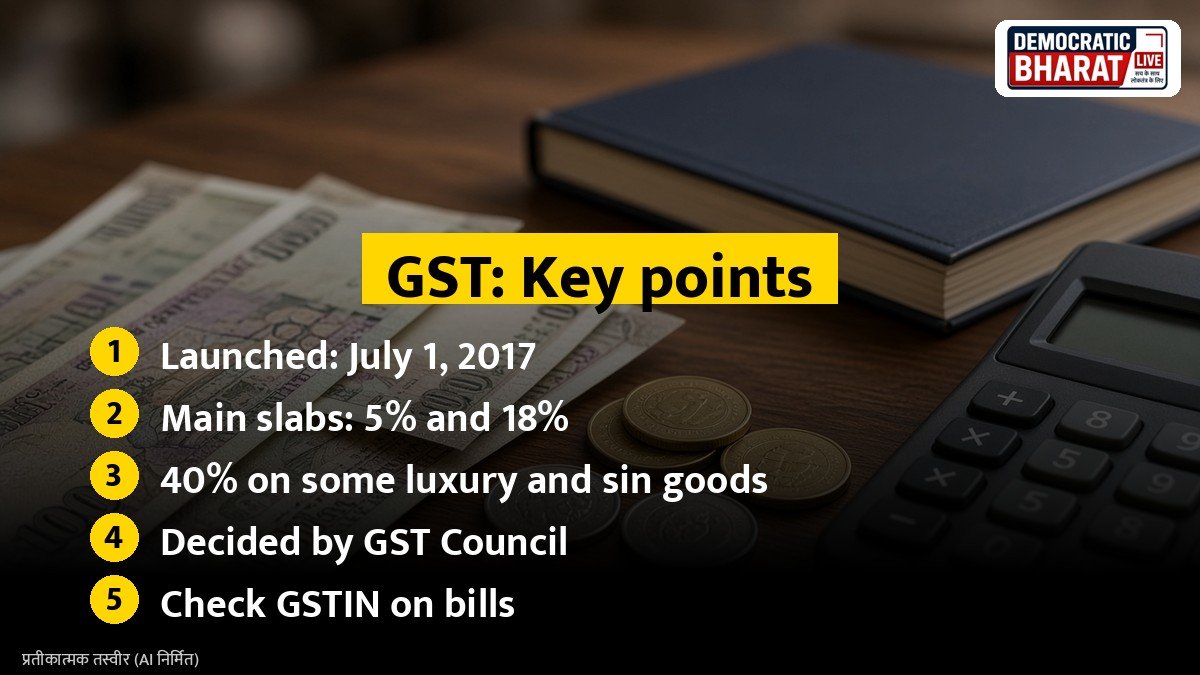
The Goods and Services Tax (GST) came into force on July 1, 2017, replacing many central and state indirect taxes. Rates are decided by the GST Council, which includes the Union Finance Minister and finance ministers of the states.
The 2025 rate rationalisation
At its meeting in September 2025, the GST Council approved a major simplification. From September 22, 2025, most goods and services moved into two main slabs:
- 5 percent, for many essential and common use items.
- 18 percent, the standard rate for most other goods and services.
A special rate of 40 percent applies to certain luxury and sin goods. Some items remain exempt or at nil rate, and special low rates apply to items such as precious metals. The earlier 12 and 28 percent slabs were largely removed in this change.
What it meant for consumers
As per the government’s announcements, several daily use items, some food products, many medicines, and some consumer durables saw lower GST after the change. Individual life and health insurance premiums were exempted from GST. Since rates are item specific, check the official rate list on the CBIC GST website for any product.
Types of GST on your bill
- CGST and SGST: charged in equal parts on sales within a state.
- IGST: charged on sales from one state to another.
So an 18 percent GST within a state appears as 9 percent CGST plus 9 percent SGST.
Also Read: How to Link PAN with Aadhaar Online: Status Check, Rs 1,000 Fee and What Happens to an Inoperative PAN | Income Tax Refund Status: How to Check It Online and What to Do if Your Refund Is Delayed
How to check a GST bill
- Look for the seller’s GSTIN, a 15 character number.
- Verify the GSTIN using the Search Taxpayer option on gst.gov.in.
- Check that the rate charged matches the official rate for the item.
- Check that GST is charged on the price, not added twice.
Small businesses under the composition scheme cannot charge GST from customers.
Complaints about overcharging
If you are charged a higher GST than notified, or a seller does not pass on a rate cut, you can complain through the National Consumer Helpline (1915) or the GST grievance options on official portals.
Restaurants
GST on restaurant services is generally 5 percent without input tax credit for most standalone restaurants, with higher rates in some hotel restaurants as per rules. Service charge is separate and not a tax.
Bottom line
GST is now mainly a two slab system of 5 and 18 percent, with 40 percent for some goods. Always check the GSTIN and the rate on your bill.
Source / स्रोत: GST Council, Central Board of Indirect Taxes and Customs, GST portal