During festivals, demand for sweets, khoya and milk products goes up sharply. This also brings a rise in cases of adulteration. The Food Safety and Standards Authority of India (FSSAI) publishes simple household tests in its DART (Detect Adulteration with Rapid Test) guide. Here is how to spot adulterated sweets and buy safely.
Buy from licensed shops
Every food business must have an FSSAI licence or registration, and its number should be displayed. Buy from shops that show this number and keep the premises clean.
Check the best before date
As per FSSAI directions effective from October 2020, sweet shops selling loose, non packaged sweets must display the best before date for the sweets on the tray or container. Do not buy sweets past this date.
Test khoya for starch
Khoya is sometimes mixed with starch. A simple test from the FSSAI guide:
- Take a small amount of khoya and boil it in a little water.
- Let it cool.
- Add a few drops of iodine solution.
If the colour turns blue, starch may be present.
Also Read: How Much Salt Should You Eat a Day? What WHO and ICMR-NIN Guidelines Say About Daily Salt Intake | AQI Categories Explained: What Good, Poor, Very Poor and Severe Air Quality Mean for You
Silver foil (vark)
Silver vark on sweets is sometimes replaced with aluminium. Genuine silver foil, when burned, usually disappears leaving a small shiny ball. Aluminium foil leaves a grey residue. If in doubt, choose sweets without vark.
Colours
Very bright or unusual colours in sweets can be a warning sign. FSSAI allows only certain synthetic food colours, within limits. Avoid sweets that stain your fingers heavily.
Milk and paneer
The FSSAI guide also lists tests for milk, such as detecting water or detergent, and for paneer and ghee. You can download the DART book free from the FSSAI website.
Packaged sweets
Read the label for:
- Name and FSSAI licence number of the manufacturer
- Date of manufacture and best before date
- List of ingredients and allergens
- Storage instructions
How to complain
If you suspect adulteration, you can complain through the FSSAI Food Safety Connect app, the FoSCoS portal, or the FSSAI helpline number listed on its website. You can also contact your district Food Safety Officer.
Make sweets at home
Many families prefer to make simple sweets at home during festivals. Using fresh milk and trusted ingredients reduces the risk.
Bottom line
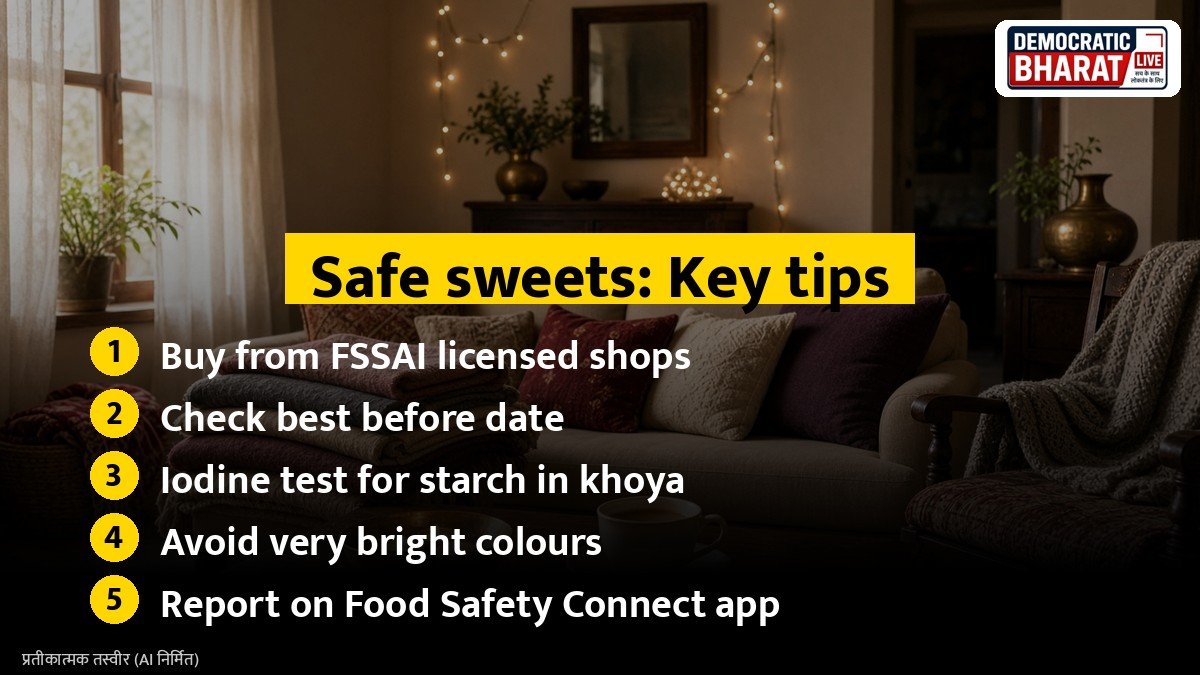
To avoid adulterated sweets, buy from licensed shops, check the best before date, do simple home tests and report anything unsafe to FSSAI.
Source / स्रोत: FSSAI, FSSAI DART book, Food Safety Connect