After the paddy harvest in October and November, many farmers in north India burn the leftover straw to clear fields quickly for wheat. Burning harms soil health and adds to winter air pollution. Here are the main crop residue management options promoted by the government and agricultural scientists.
Why burning hurts the farmer too
Burning destroys organic matter and useful microbes in the top layer of soil. It also wastes nutrients such as nitrogen, phosphorus, potassium and sulphur that the straw would otherwise return to the field. Over time, soil becomes harder and needs more fertiliser. Smoke also affects the health of farm families and nearby villages.
In situ options: manage straw in the field
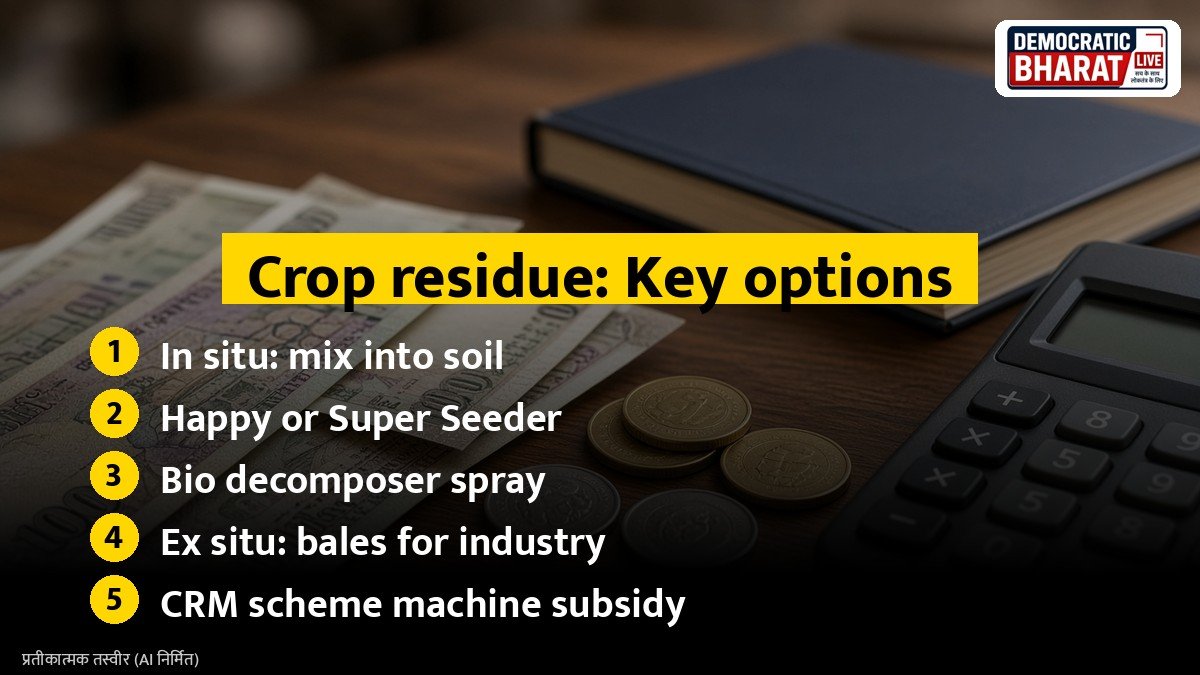
- **Happy Seeder:** sows wheat directly into standing stubble, leaving straw as mulch on the surface. Mulch keeps moisture in and suppresses weeds.
- **Super Seeder:** cuts and mixes straw into the soil and sows wheat in one pass.
- **Mulcher and reversible plough:** chop the straw and turn it into the soil.
- **Bio decomposer:** a microbial solution developed by ICAR-IARI, Pusa, which is sprayed on straw to speed up decomposition in the field. Farmers should follow the recommended waiting period and moisture conditions.
- **Super SMS on combine harvesters:** spreads chopped straw evenly so seeding machines work better.
Ex situ options: take straw out of the field
Straw can be collected with balers and rakes and sold or supplied to biomass power plants, compressed biogas units, paper and board mills, and as cattle feed or bedding. Several states run collection centres and link farmers with industries.
Also Read: eNAM Registration for Farmers: How to Sell Crops Online on the National Agriculture Market | Wheat Sowing Guide for Rabi Season: Best Time, Seed Rate, Varieties and Tips From ICAR
Government support
Under the Crop Residue Management (CRM) scheme of the Ministry of Agriculture, farmers can get financial assistance to buy residue management machines, and cooperatives, FPOs and panchayats can get higher support to set up Custom Hiring Centres. Small farmers can then rent machines at low cost instead of buying them. Application processes and rates are decided by state agriculture departments, so check your state portal.
Practical tips
- Plan machine booking at the Custom Hiring Centre before harvest.
- Ask the combine operator to use a straw management system.
- Keep enough moisture in the field if you plan to use the bio decomposer.
- Contact your Krishi Vigyan Kendra for a field demonstration.
Advice for farmers
Before sowing, selling or storing your crop, check the latest information with your district agriculture department, Krishi Vigyan Kendra or mandi committee.
Bottom line
Stubble is a resource, not waste. Mixing it into the soil or selling it as biomass protects soil health, saves fertiliser and keeps the air cleaner for everyone.
Source / स्रोत: Ministry of Agriculture and Farmers Welfare, ICAR