Electronic Voting Machines (EVMs) have been used in all Lok Sabha and assembly elections in India for many years. Since 2019, every EVM has been paired with a Voter Verifiable Paper Audit Trail (VVPAT) unit. Here is how the system works.
Parts of the system
- Ballot Unit: the machine with candidate names, symbols and blue buttons, kept inside the voting compartment.
- Control Unit: kept with the presiding officer, who enables each vote.
- VVPAT: a printer unit with a glass window, connected to the ballot unit.
How a vote is cast
- The presiding officer presses the Ballot button on the control unit.
- The voter presses the button next to the chosen candidate on the ballot unit.
- A red light glows and a beep sounds.
- The VVPAT prints a slip with the candidate’s serial number, name and symbol.
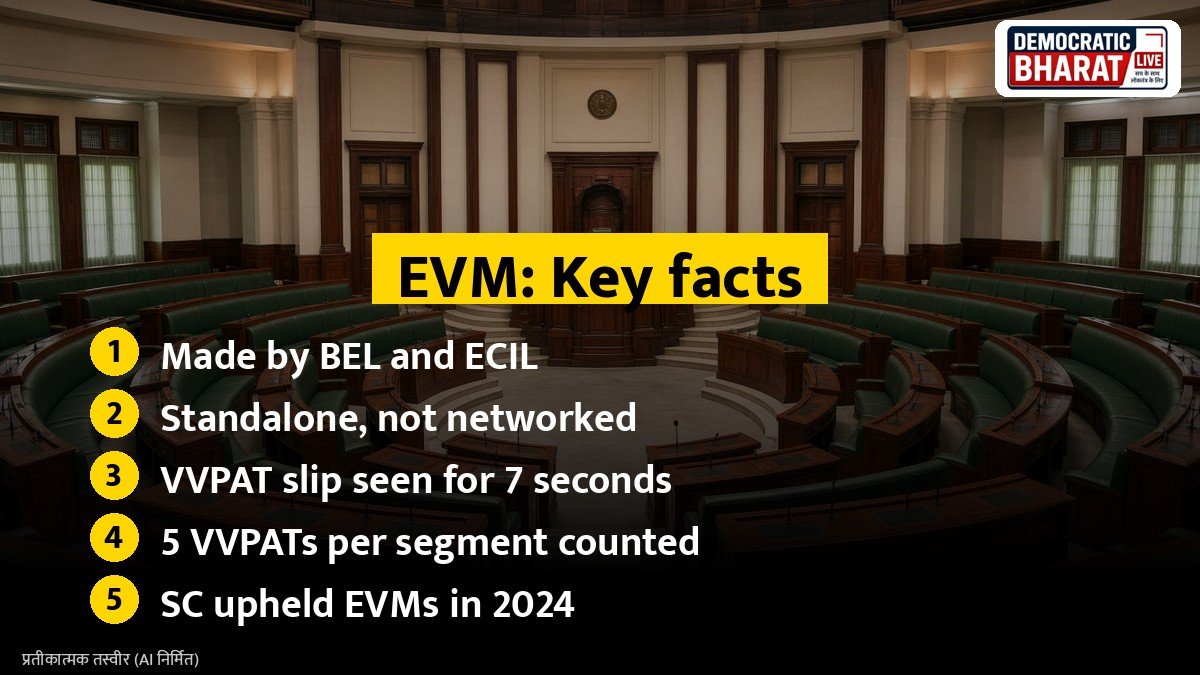
- The slip is visible through the window for about seven seconds, then drops into a sealed box.
Who makes EVMs
EVMs are made by two public sector companies: Bharat Electronics Limited (BEL) and Electronics Corporation of India Limited (ECIL).
Also Read: What Is an Ordinance? Article 123, Six Week Rule and Supreme Court Limits Explained | No-Confidence Motion Explained: How It Works in the Lok Sabha and What Happens if a Government Loses
Safeguards
- EVMs are standalone machines with no wireless, internet or Bluetooth connection.
- The software is burned into one time programmable chips.
- First level checks are done by engineers in the presence of party representatives.
- Machines are randomly allocated to constituencies and polling stations in two rounds.
- Mock polls are held before voting in front of polling agents.
- Machines are sealed and stored in strong rooms under armed guard and CCTV, with candidates allowed to watch.
History
EVMs were first used in 1982 in part of the Paravur assembly constituency in Kerala. VVPATs were first used in 2013 in the Noksen assembly by election in Nagaland.
VVPAT slip counting
Following a Supreme Court order in 2019, VVPAT slips of five randomly selected polling stations in each assembly segment are counted and matched with EVM results.
The 2024 Supreme Court ruling
In April 2024, the Supreme Court rejected petitions seeking a return to paper ballots or full counting of all VVPAT slips. It gave two directions:
- Symbol loading units must be sealed and stored for 45 days after results.
- Candidates who come second or third can ask, within seven days of results and on paying the cost, for engineers to check the burnt memory of up to 5 percent of EVMs in a constituency.
The debate
Some opposition parties and activists continue to raise doubts about EVMs and ask for more VVPAT counting. The Election Commission maintains that the machines are secure and that VVPAT matching has confirmed results.
Bottom line
EVMs record votes electronically, and VVPAT slips let voters verify their choice. Multiple safeguards and court checks are in place to protect the integrity of the vote.
Source / स्रोत: Election Commission of India, Supreme Court of India, Press Information Bureau